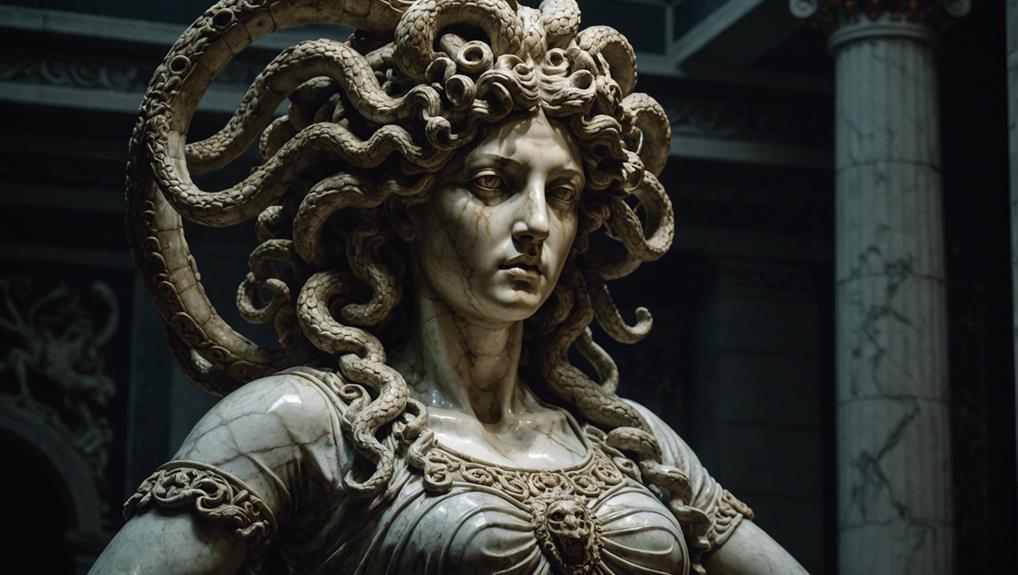
As you explore the Metropolitan Museum of Art on Fifth Avenue, you'll come face-to-face with Medusa, the mesmerizing and terrifying figure from ancient Greek mythology. Born from sea gods Phorcys and Ceto, Medusa's transformation into a sea creature is just the beginning of her fascinating story. In classical art, Medusa's depiction evolves from a beautiful maiden to a menacing persona, capturing both beauty and horror. With snakes intertwined with mythical creatures in vase paintings, and masterful blending of horror and beauty in Roman sculptures, you'll be drawn to the symbolism behind Medusa's serpentine hair, embodying femininity, power, and danger. And that's just the beginning of the story…
Ancient Greek Origins of Medusa
In ancient Greece, you'll find the earliest recorded mentions of Medusa, a monster so terrifying that even the gods feared her. You might wonder, what's behind the myth of this snake-haired creature? To understand Medusa's origins, let's explore her mythical roots. In Greek mythology, Medusa was born from the sea god Phorcys and the sea goddess Ceto. This monstrous birth makes sense, given her later transformation into a sea creature.
As you investigate Medusa's connections to goddesses, you'll notice a fascinating pattern. The goddess Athena, known for her wisdom and warfare, plays a significant role in Medusa's story. According to myth, Poseidon, god of the sea, ravished Medusa in Athena's temple, angering the goddess. This desecration led to Medusa's transformation into a monster. Athena's involvement highlights the complex web of relationships between gods, goddesses, and monsters in Greek mythology.
Medusa's connections to goddesses don't stop there. Her story intertwines with that of the goddess Persephone, queen of the underworld. In some versions of the myth, Medusa is described as a beautiful maiden, one of the three Gorgon sisters, before her transformation. This beauty is reminiscent of Persephone's own story, where she's abducted by Hades and becomes queen of the underworld. By exploring Medusa's ancient Greek origins, you'll uncover a rich tapestry of mythical roots and goddess connections that continue to captivate and inspire artists to this day.
Vase Paintings of Mythical Creatures
As you explore the world of ancient Greek art, you'll notice that serpents are a recurring motif, particularly in vase paintings. You'll see how these slithering creatures are often depicted alongside other mythical beasts, showcasing the Athenian potters' fascination with the fantastical. Now, let's take a closer look at how these monsters of Athenian vases were brought to life through the art of vase painting.
Serpents in Greek Art
You'll often find serpents intertwined with other mythical creatures on ancient Greek vases, where they add an air of mystery and danger to the scenes depicted. These serpents are more than just decorative elements; they're imbued with deep cultural symbolism. In Greek mythology, snakes were associated with rebirth, renewal, and transformation. They were also seen as symbols of healing, wisdom, and prophecy.
In vase paintings, serpents often appear alongside other creatures from Greek mythology, like Medusa, hydras, and dragons. These composite creatures were meant to evoke a sense of awe and fear in the viewer. The serpent's ability to shed its skin, symbolizing rebirth and regeneration, made it a powerful symbol in ancient Greek culture. The cultural significance of snakes is evident in the way they're depicted in art, often entwined with gods and goddesses, highlighting their connection to the divine.
Monsters of Athenian Vases
As you explore the Met's collection, you'll encounter Ceramic Horrors that will leave you mesmerized. These ancient artworks not only demonstrate exceptional craftsmanship but also offer a glimpse into the mythological world of ancient Greece.
You'll notice that Mythical Menaces like Medusa, with her snakes for hair, are often depicted in battle scenes or as standalone figures. The Minotaur, half-man and half-bull, is another fearsome creature that dominates Athenian vase paintings. These monstrous beings were an integral part of ancient Greek mythology, symbolizing the unknown and the feared.
The skillful hands of ancient Greek potters and painters brought these mythical creatures to life on ceramic vessels, creating a visual language that continues to fascinate us today. As you explore further into the world of Athenian vase paintings, you'll discover a space where Mythical Menaces and Ceramic Horrors coexist, offering a unique window into the creative genius of ancient Greek artisans.
Roman Sculptures of Medusa's Head
Gazing upon Roman sculptures of Medusa’s head, you’re struck by the masterful blending of horror and beauty. The Romans’ fascination with Medusa’s iconic visage led to the creation of exquisite works of art that continue to captivate audiences today. As you explore the Roman sculptures of Medusa’s head at the Met Fifth Avenue, you’ll notice the remarkable attention to detail and realism that defined Roman Portraiture. The intricate carvings bring out the lifelike texture of Medusa’s serpentine hair and her haunting yet mesmerizing expression, showcasing the Romans’ skill in evoking emotion through stone. These sculptures serve as timeless inspirations for modern artists, influencing everything from contemporary sculpture to salon art design in NYC. As you admire these masterpieces, you can see how classical artistry continues to shape and inspire creative expressions across different mediums.
The Marble Masters of ancient Rome were renowned for their skill in capturing the subtleties of human expression, and their depictions of Medusa are no exception. With intricate details and nuanced facial expressions, these sculptures bring the mythological creature to life. You'll be struck by the way the Roman artists balanced the monstrous aspects of Medusa's appearance with a sense of vulnerability and humanity.
One of the most striking aspects of Roman sculptures of Medusa's head is the way they humanize the mythological creature. By emphasizing her beauty and vulnerability, the Roman artists created a sense of empathy and connection with the viewer. As you gaze upon these masterpieces, you'll find yourself drawn into the world of ancient Roman art, where mythology and reality blend seamlessly together.
The Gorgon in Classical Coins
Beyond the domain of sculptures, the Gorgon's likeness also appeared on classical coins, where her iconic visage was miniaturized yet still conveyed a sense of powerful menace. As you explore the world of classical coins, you'll discover that Medusa's image was used to convey authority, protection, and even good luck. Her presence on coins signifies the Coinage Evolution, where her mythological significance was leveraged to convey Numismatic Significance.
| Region | Coin Description |
|---|---|
| Sicily (5th century BCE) | Medusa's head with snakes entwined in her hair, symbolizing protection for the city-state |
| Athens (4th century BCE) | Medusa's head with a Gorgoneion, a symbol of good luck and protection for the Athenian people |
| Macedon (3rd century BCE) | Medusa's head with a warrior's helmet, representing the power and authority of the Macedonian kingdom |
As you examine these coins, you'll notice that Medusa's image was adapted to fit the cultural and political context of each region. Her numismatic significance lies in her ability to evoke a sense of authority, protection, and good fortune. The use of Medusa's image on classical coins not only showcases her enduring appeal but also highlights the Coinage Evolution, where mythological figures like Medusa were used to convey Numismatic Significance.
Medusa's Evolution in Mosaics
As you explore Medusa's Evolution in Mosaics, you'll discover exquisite works of art that showcase the Gorgon's transformation in ancient artistic expressions. You'll uncover mosaic masterpieces that reveal the intricacies of Medusa's character, from her snake-adorned head to her mesmerizing gaze. In these ancient artistic expressions, you'll find a rich tapestry of stories waiting to be unraveled.
Mosaic Masterpieces Unveiled
You'll find that Medusa's transformation in mosaics is a fascinating journey, with early examples showcasing her as a beautiful maiden, often surrounded by flowers and foliage. As you explore further, you'll notice a shift towards a more menacing persona, with serpents and fierce expressions dominating the scenes. This evolution is a confirmation of the artistic revival of ancient craftsmanship, where Byzantine influences merged with decorative motifs to create colorful storytelling.
Some notable aspects of Medusa's mosaic masterpieces include:
- Mosaic narratives: Intricate scenes depicting Medusa's mythological story, often intertwined with other mythological creatures.
- Ancient craftsmanship: Exquisite tilework and attention to detail, showcasing the skill of ancient artisans.
- Byzantine influences: The blending of Eastern and Western artistic styles, resulting in unique and enchanting visuals.
- Decorative motifs: The use of flowers, foliage, and geometric patterns to create visually stunning backdrops for Medusa's stories.
As you explore these mosaic masterpieces, you'll uncover a rich tapestry of artistic expression, where Medusa's transformation serves as a canvas for the evolution of artistic styles and techniques.
Ancient Artistic Expressions
In the domain of ancient mosaics, Medusa's evolution unfolds as a tribute to the artistic genius of bygone eras, where each piece serves as a window into the cultural and aesthetic values of its time. As you explore these ancient artworks, you'll notice how Medusa's image transforms, reflecting the artistic innovations of each era. From the intricate, multicolored tiles of Roman mosaics to the more subtle, monochromatic depictions in Byzantine art, each piece tells a story of cultural significance.
You'll see how Medusa's snakes become more serpentine and menacing over time, symbolizing the fears and anxieties of the societies that created them. You'll also notice how her gaze, once a symbol of feminine power, becomes more demure and submissive, reflecting the shifting cultural attitudes towards women. Through these mosaics, you'll gain a deeper understanding of the artistic and cultural values of ancient civilizations, as well as the enduring fascination with Medusa's enigmatic beauty.
Greek and Roman Literary Influences
Medusa's snake-haired visage owes its enduring presence in classical art to the rich literary heritage of ancient Greece and Rome, where her mythological significance was cemented through the works of Ovid, Hesiod, and other prominent authors. You may wonder, what role did literature play in shaping the legend of Medusa? The answer lies in the works of epic poets, who wove her story into the fabric of classical mythology.
Through their writings, Literary Icons like Ovid and Hesiod humanized Medusa, transforming her from a mere monster to a complex, multidimensional character. You'll discover that their works not only solidified Medusa's place in classical mythology but also influenced the artistic representations that followed.
Some key literary influences on Medusa's mythological significance include:
- Ovid's _Metamorphoses_, which tells the story of Medusa's beheading and the birth of Pegasus
- Hesiod's _Theogony_, which describes Medusa as a beautiful maiden, one of the three Gorgon sisters
- Apollodorus' _Bibliotheca_, which recounts Perseus' quest to behead Medusa
- Lucan's _Pharsalia_, which portrays Medusa as a powerful symbol of horror and destruction
These literary works not only cemented Medusa's place in classical mythology but also paved the way for her enduring presence in art, inspiring generations of artists to recreate her image in various forms.
The Met's Collection of Medusa Art
The Metropolitan Museum of Art's vast collection boasts an impressive array of Medusa-inspired artworks, spanning centuries and mediums, that showcase her enduring appeal to artists and art enthusiasts alike. As you explore the Met's collection, you'll discover a diverse range of artworks that reveal the many facets of Medusa's enigmatic persona. From ancient Greek and Roman sculptures to Renaissance paintings and modern installations, the Met's collection is a proof of Medusa's timeless allure.
As you investigate further into the collection, you'll notice the curator's vision at play. The Met's curators have carefully selected artworks that not only showcase Medusa's beauty but also highlight her complex symbolism and cultural significance. You'll see how artists across the centuries have reinterpreted Medusa's myth, infusing her with new meanings and symbolism. The collection is a masterclass in museum politics, where the Met's curators have navigated the complexities of art historical narratives to present a cohesive and compelling story.
As you wander through the galleries, you'll encounter works that challenge your perceptions of Medusa. You'll see her depicted as a powerful symbol of femininity, a monster, and even a victim. The Met's collection is a reflection of our own fascination with the unknown, the exotic, and the dangerous. It's a reminder that art is not just about aesthetics but also about the stories we tell ourselves about the world and our place within it.
Classical Depictions of Perseus
As you explore the classical depictions of Perseus, you'll find that ancient artists often portrayed him as a triumphant hero, his bravery and cunning illuminated in exquisite marble and bronze. These masterpieces not only showcased the artists' technical skills but also revealed the cultural significance of Perseus' heroic journey.
- Artists took creative liberties to emphasize Perseus' heroic pose, often depicting him standing victorious over Medusa's lifeless body.
- With artistic freedom, they experimented with fresh perspectives, showcasing Perseus from unusual angles or highlighting his emotional state.
- By drawing inspiration from ancient myths, these artists infused their works with symbolic meaning, making Perseus an enduring symbol of courage and wisdom.
- In the historical context of ancient Greece, Perseus' mythological impact was immense, inspiring generations of artists, writers, and thinkers.
As you investigate further into the Met's collection, you'll notice how these classical depictions of Perseus have contributed to his timeless appeal. The artistic license taken by ancient artists has resulted in a rich cultural heritage, allowing us to appreciate the nuances of Perseus' character and the cultural significance of his story. By examining these masterpieces, you'll gain a deeper understanding of the mythological context and the artistic vision that shaped our perception of this legendary hero.
Symbolism Behind Medusa's Snakes
As you explore the symbolism behind Medusa's snakes, you'll discover that her serpentine hair represents a complex mix of femininity, power, and danger. You'll learn how the snakes' metamorphosis signifies the transformation of beauty into monstrosity. Ultimately, you'll understand how Medusa's deadly beauty embodies the contradictions of ancient Greek mythology.
Serpentine Hair Symbolism
Exploring through ancient mythology, Medusa's serpentine locks embody the dark, primal forces that lurk beneath civilization's veneer. As you investigate the symbolism behind Medusa's snakes, you'll uncover a complex web of meanings that reflect the cultural significance of feminine power and beauty standards.
Medusa's snakes can be seen as a symbol of:
- Feminine power, representing the untamed and uncontrollable forces of nature
- Hair identity, where snakes replace traditional locks, subverting traditional beauty standards
- Snake metaphor, signifying transformation, renewal, and the cyclical nature of life
- Cultural significance, as Medusa's image has been used throughout history to represent the 'other,' the unknown, and the feared
Through artistic representation, Medusa's serpentine hair has become an enduring symbol of mythical representation, embodying the symbolic significance of femininity, power, and the darker aspects of human nature. As you explore Medusa's image in classical art, you'll uncover the complexities of her serpentine locks, revealing the intricate web of meanings that have captivated artists and audiences alike.
Snake Metamorphosis Signifies
Through Medusa's snakes, you're witnessing a symbol of transformation, where the shedding of skin represents the cyclical nature of life, death, and rebirth. As you explore upon her serpentine locks, you're confronted with the darker aspects of human nature. The snakes embody the fears transformed, the primitive magic that lies within, and the ancient wisdom that whispers secrets to those who dare to listen. Medusa's snakes are a power symbol, a manifestation of the human darkness that lurks beneath the surface. They represent the cultural anxiety that arises from the unknown, the uncontrollable forces that shape our lives. Yet, in their twisted, scaly bodies, you'll find a strange beauty, a confirmation to the transformative power of life. As you investigate deeper into the symbolism, you'll discover that Medusa's snakes are not just a symbol of fear, but a reminder of the cyclical nature of existence, where life and death are intertwined, and transformation is the only constant.
Deadly Beauty Embodied
You're drawn to Medusa's snakes because they embody a contradictory allure, where beauty and deadliness coexist in a mesmerizing display of power. This fatal attraction is rooted in the seductive power of the snakes, which seem to hypnotize and repel simultaneously. As you gaze upon Medusa's serpentine locks, you can't help but feel a thrill of excitement mixed with a dash of fear.
The symbolism behind Medusa's snakes is multifaceted:
- Duality of human nature: The snakes represent the conflicting desires and impulses that lie within us, symbolizing the eternal struggle between good and evil.
- Feminine power: The snakes are often seen as an extension of Medusa's feminine power, emphasizing her capacity to both nurture and destroy.
- Transformation and renewal: The snakes' ability to shed their skin symbolizes transformation, renewal, and the cyclical nature of life and death.
- Danger and mystery: The snakes embody the unknown, the mysterious, and the feared, drawing you in with an otherworldly allure.
As you stand before Medusa's image, you're captivated by the snakes' mesmerizing dance, a testament to the enduring power of this mythical creature.
The Monster in Ancient Greek Pottery
As you explore the world of ancient Greek pottery, you'll find that Medusa's presence is a recurring theme, a demonstration of the power of mythic creatures in shaping cultural narratives. By examining these ancient works of art, you'll gain a deeper understanding of the cultural context in which they were created, and the enduring appeal of the Medusa myth. What role did Medusa play in ancient Greek pottery, where mythological creatures often served as cautionary symbols? In this particular setting, Medusa's terrifying visage was more than just a decorative element – it was a potent symbol of Ceramic Fears and Vase Terrors.
On ancient Greek vases, Medusa's image was often paired with other Monster Myths, serving as a warning against the dangers of the unknown. These Ancient Icons were not just ornamental; they conveyed moral lessons and cautioned against the perils of hubris. By depicting Medusa and other Greek Horrors, potters aimed to evoke a sense of Artistic Frights, reminding viewers of the importance of living virtuously.
In Pottery Symbolism, Medusa's snake-haired head represented the destructive power of the feminine, a force both captivating and terrifying. As a cautionary symbol, Medusa warned against the dangers of feminine wiles and the importance of maintaining masculine control. Through her image, potters conveyed the importance of balance and moderation in all aspects of life.
Medusa's Impact on Renaissance Art
During the Renaissance, Medusa's potent symbolism was revived, and her image began to permeate the works of artists who sought to convey the darker aspects of human nature. You'll notice that Medusa's influence extended far beyond classical antiquity, as artists of the Renaissance era drew inspiration from her enigmatic presence.
As a Cultural Icon, Medusa embodied the contradictions of feminine power, beauty, and danger. Her Dark Allure captivated artists, who sought to capture her essence in their work. You'll see that Medusa's image was often used to convey the complexities of human nature, from the struggle between good and evil to the blurred lines between beauty and ugliness.
Some key aspects of Medusa's impact on Renaissance art include:
- Renaissance Revival: Medusa's image was revived as a symbol of artistic innovation, reflecting the era's fascination with classical antiquity.
- Artistic Rebellion: Artists used Medusa's image to challenge traditional Beauty Standards and explore the complexities of human nature.
- Mythic Inspiration: Medusa's mythological heritage inspired artists to experiment with new forms and themes, pushing the boundaries of artistic expression.
- Feminist Symbol: Medusa's image became a potent symbol of feminine power, inspiring artistic representations that celebrated female strength and agency.
Through Medusa's image, Renaissance artists explored the tensions between beauty and horror, good and evil, and light and darkness. As you explore the Met's collection, you'll discover how Medusa's cultural heritage continues to inspire artistic innovation and cultural iconography.
Timeless Allure of the Gorgon
Beyond the Renaissance, Medusa's mystique has continued to captivate artists and audiences alike, with her timeless allure transcending centuries and artistic mediums. As you explore the world of Medusa, you'll discover that her enigmatic presence has inspired countless works of art, from sculptures to paintings, and even modern adaptations in film and literature.
You might wonder what makes Medusa's appeal so enduring. One reason is her embodiment of feminine power, a symbol of a strong, autonomous woman who defies patriarchal norms. Her gaze, often depicted as a potent and mesmerizing force, exudes dark seduction, drawing you in with an otherworldly allure. This paradox of beauty and danger has captivated artists, who continue to reinterpret and reimagine Medusa's myth.
As you investigate the Met Fifth Avenue's collection, you'll notice how Medusa's image has been reinterpreted over time, reflecting the cultural and artistic values of each era. From the classical Greek and Roman depictions to modern reinterpretations, Medusa's mystique remains unwavering, a confirmation of her timeless allure. You'll find yourself drawn into the world of Medusa, where the boundaries between beauty and horror blur, and the power of the feminine is on full display.
Frequently Asked Questions
What Inspired Artists to Depict Medusa as a Beautiful Woman?
As you ponder why artists depicted Medusa as a stunning beauty, consider the underlying motivations. You'll discover that it was a bold statement of Feminine Power, a demonstration of Artistic Freedom, and a subtle act of Cultural Rebellion. By redefining Beauty Standards, artists challenged traditional norms. Medusa's Symbolic Significance transformed her from a monster to a symbol of empowerment, making her a fascinating subject in art. This shift in perception reveals the complexities of human nature and the power of art to shape our understanding.
Is Medusa's Story Based on a Real Historical Figure?
You're about to uncover the truth behind Medusa's mysterious past. Like peeling back the layers of an onion, let's dig into the historical inspirations behind this mythological figure. While Medusa's story is steeped in mythical origins, it's unlikely based on a real historical figure. Scholars believe her character was crafted from ancient Greek fears of female power and the unknown. No concrete evidence links her to a specific historical person, leaving her legend to continue fascinating us.
Are There Any Modern Adaptations of Medusa in Popular Culture?
You're curious about modern adaptations of Medusa in popular culture. Well, you're in luck! Medusa has been reimagined in various forms of pop culture. For instance, the Medusa Reboot in comics and graphic novels offers a fresh spin on the mythological figure. You can also spot Medusa-inspired characters in TV shows, films, and video games. Even fashion brands and beauty products have incorporated Medusa's iconic snakes and striking gaze into their designs. It's clear that Medusa's allure continues to captivate audiences in modern times.
Can I See Medusa Art Pieces in Person at the Met?
As you step into the Met, you're about to unravel the mystique of Medusa. You're on a quest to witness her serpentine beauty up close. Navigate the Museum's grand halls, and you'll find that art accessibility has never been easier. The Met's vast collections await, and with a little museum navigation, you'll soon be face-to-face with Medusa's mesmerizing gaze.
Are There Any Myths About Medusa Outside of Greek Mythology?
You'll notice Medusa's influence in various cultures is intriguing. In Peruvian Legend, the serpent-haired goddess Pachamama shares similarities with Medusa. Mesopotamian Roots also connect her to the goddess Ishtar. Slavic Folklore features a multi-headed serpent, while African Myths depict a serpent-like creature. Even Chinese Dragons have parallels with Medusa's reptilian features. You'll discover that Medusa's legend extends far beyond ancient Greece, weaving a fascinating tapestry of cultural connections.
About the Author