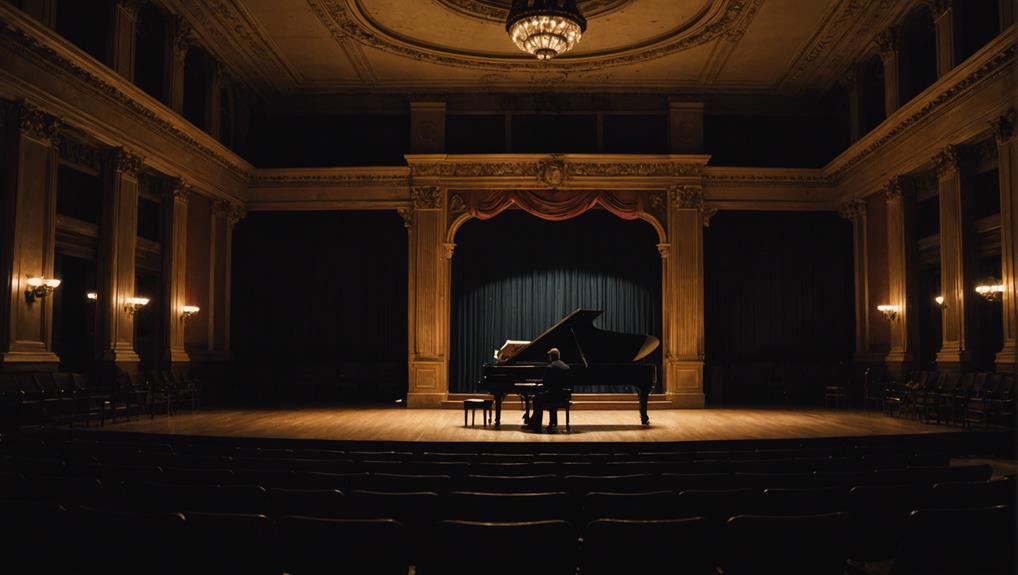
Glenn Gould's life was a paradox of creative genius and crippling self-doubt, a duality that fueled his innovative approach to classical music and inspired the opera 'The Loser,' which made its debut at Brooklyn Academy of Music. This enigmatic figure's struggles with anxiety, fear of failure, and relentless pursuit of perfection are masterfully captured in the opera. As the curtains open, audiences are transported to a world of introspection and self-discovery, where the tormented artist's plight is laid bare. As the opera unfolds, the complexities of Gould's psyche are revealed, and the lines between reality and fantasy blur, inviting the audience to step further into the shadows of his extraordinary life.
Unraveling the Enigma of Glenn Gould
During the height of his fame, Glenn Gould's eccentric persona and unconventional piano technique captivated audiences, yet beneath the public facade, a complex and enigmatic individual remained shrouded in mystery. As a pianist, Gould's artistic expression was a reflection of his inner turmoil, with his music serving as a means of catharsis. His unique approach to playing the piano, characterized by a distinctive finger independence and a strong emphasis on counterpoint, was a manifestation of his rebellious spirit and desire for creative freedom.
Gould's musical legacy is a tribute to his innovative approach to classical music. His iconic recordings of Bach's Goldberg Variations, released in 1955 and 1981, are a testament to his artistic growth and evolution. These recordings, which showcased his technical mastery and emotional depth, cemented his status as a musical genius. Through his music, Gould conveyed a sense of vulnerability and introspection, revealing a deep sense of humanity that resonated with audiences worldwide.
As a trailblazer in the world of classical music, Gould's impact extended beyond his own performances. He inspired a generation of musicians to challenge conventional norms and push the boundaries of artistic expression. His musical legacy continues to inspire and influence musicians today, a tribute to the enduring power of his artistry.
A Life of Perpetual Insecurity
Glenn Gould's obsessive self-doubt and fear of failure fueled a lifetime of perpetual insecurity, driving him to seek solace in his music. This internal turmoil manifested in anxious dreams, where the pressure to perform flawlessly consumed his every waking moment. His fearful ambitions to master the piano only intensified the anxiety, as he constantly questioned his abilities. The weight of criticism from others and himself hung heavy, making it difficult for him to shake off the feeling of inadequacy.
Gould's insecurity seeped into every aspect of his life, from his relationships to his performances. He was notorious for his eccentricities, which some speculate were coping mechanisms for his deep-seated anxiety. His reclusive nature, for instance, might have been a way to shield himself from the harsh judgments of the outside world. Even his iconic piano playing, marked by an unorthodox style, was likely an attempt to assert control over his craft.
Insecurity plagued Gould's every move, causing him to second-guess his decisions and doubt his talent. Yet, it was this very anxiety that fueled his creative genius. His music became an escape, a sanctuary where he could momentarily silence the self-doubt. Through his art, he found solace, and the world was gifted with masterpieces that continue to inspire. Despite the turmoil, Gould's music stood as a proof of the power of creativity in the face of fear and uncertainty.
Shadows of a Musical Genius
Behind the curtain of his eccentric persona, a musical genius lurked, fueled by an insatiable passion that drove him to revolutionize the classical music scene. Glenn Gould's creative legacy continues to inspire and influence musicians to this day. His innovative approach to music, characterized by unconventional techniques and interpretations, left an indelible mark on the classical music world.
| Aspect | Description | Impact |
|---|---|---|
| Unconventional Techniques | Experimented with unconventional hand positions, finger independence, and pedaling techniques | Expanded the possibilities of piano playing |
| Innovative Interpretations | Brought new insights to classical masterpieces, challenging traditional interpretations | Inspired new generations of musicians |
| boundary-pushing Recordings | Recorded iconic albums that redefined the classical music landscape | Set a new standard for classical music recordings |
| Pioneering Spirit | Embraced new technologies and formats, such as the LP and the radio | Democratized access to classical music |
| Collaborative Approach | Collaborated with other artists, fostering a sense of community and creative exchange | Encouraged cross-pollination of artistic ideas |
As a musical prodigy, Gould's creative genius was shaped by his intense focus, discipline, and passion. His relentless pursuit of innovation and perfection continues to inspire new generations of musicians, ensuring his creative legacy endures. Through his work, Gould demonstrated that freedom and creativity can coexist, even in the most traditional of art forms.
The Agony of Unfulfilled Potential
Few artists have struggled with the burden of unfulfilled potential as intensely as Glenn Gould, whose relentless pursuit of perfection often left him mired in self-doubt and uncertainty. His frustrated dreams of mastering every nuance of music haunted him, as he felt trapped by the weight of his own unrealized talent. The pressure to create something truly original and groundbreaking was suffocating, and Gould's inner critic was merciless.
As he immersed further into his craft, Gould's expectations of himself grew more unrealistic, fueling his anxiety and self-doubt. He was torn between the desire to break free from the constraints of traditional music and the fear of not living up to his own standards. This internal conflict stifled his creativity, leaving him feeling like a loser, stuck in the shadows of his own potential.
Gould's agony was compounded by the public's expectations of him as a genius. The world saw him as a master, but he saw himself as a failure, unable to tap into the full extent of his talent. This disconnect between his public image and private struggles only added to his frustration, making it harder for him to overcome his creative blocks. As a result, Gould's music, though brilliant, remained a reflection of the agony of unfulfilled potential, a reminder that even the greatest artists can be crippled by their own self-doubt.
When Creativity Meets Self-Doubt
As Glenn Gould's creative struggles come to the forefront, it becomes clear that self-doubt can be a crippling force in the creative process. Fear of imperfection can lead to creative blocks, causing even the most talented artists to question their abilities. When doubt creeps in, it can be a major obstacle to overcome, stifling innovation and hindering artistic growth.
Fear of Imperfection
Self-doubt creeps in, casting a shadow on the creative process, as the fear of imperfection paralyzes the artist, rendering their brushstrokes hesitant and their melodies muted. The fear of imperfection can be overwhelming, causing creatives to question their abilities and second-guess their every move. This fear can manifest in various ways, including:
- Performance anxiety: The pressure to deliver a flawless performance can be crippling, causing artists to freeze up and doubt their skills.
- Creative constraints: The fear of imperfection can lead to self-imposed restrictions, stifling creativity and limiting artistic expression.
- Self sabotage: Artists may unconsciously undermine their own work, fearing that their best efforts won't be good enough.
- Unreal expectations: The pressure to create something perfect can lead to unrealistic goals, causing artists to feel like they're constantly falling short.
Creative Blocks Form
When creativity collides with self-doubt, the once-fluent stream of ideas stagnates, and the artist's mind becomes a barren landscape devoid of inspiration. This collision marks the formation of creative blocks, a debilitating phenomenon that plagues even the most brilliant minds. As artistic stagnation sets in, the mind becomes mired in mental barriers, making it difficult to break free from the shackles of self-doubt. The fear of imperfection, a constant companion to creative souls, amplifies the problem, making it harder to shake off the feeling of inadequacy. As a result, the creative process grinds to a halt, and the artist is left staring at a blank canvas, unable to conjure up even a spark of inspiration. The silence is deafening, and the mind, once a fertile ground for ideas, lies barren and still. To overcome this creative impasse, the artist must confront their deepest fears and learn to silence the voice of self-doubt, allowing creativity to flow freely once again.
Doubt Creeps In
Fears of inadequacy creep into the artist's mind, insidiously whispering that their best work is behind them, and that the next creation will be a disappointment. This creeping doubt can be crippling, making it difficult for creatives to produce their best work. It's a constant battle to silence the inner critic, and convince oneself that the next creation will be just as brilliant as the last.
When Creative Anxiety sets in, it's essential to recognize the signs and take action. Here are a few strategies to overcome self-doubt:
- Take a break: Step away from the canvas, manuscript, or instrument, and clear your mind.
- Revisit past successes: Remind yourself of your achievements and the hard work that led to them.
- Seek feedback: Talk to trusted peers or mentors who can offer constructive criticism and encouragement.
- Create for yourself: Make art that brings you joy, without worrying about external validation.
The Opera as Psychological Probe
As the opera shines a light on Glenn Gould's inner world, it exposes the turmoil that often accompanied his creative genius. Through the opera, the complexities of his mind are unraveled, revealing the psychological depths that fueled his art. By probing these depths, the opera offers a nuanced exploration of the intricate relationship between mental health and artistic expression.
Inner Turmoil Exposed
Through the opera's probing lens, the turbulent landscape of Glenn Gould's inner world emerges, with his eccentricities and contradictions laid bare. This psychological investigation uncovers the private struggles of a musical genius, revealing the dark legacy of his inner turmoil.
The opera exposes the complexities of Gould's mind, where brilliance and madness coexisted in a delicate balance. His private struggles, often hidden from the public eye, are now revealed on stage.
Here are 4 key aspects of Gould's inner turmoil exposed in the opera:
- Fears and anxieties: Gould's obsessive-compulsive disorder and hypochondria are woven into the narrative, showcasing the crippling fears that haunted him.
- Creative struggles: The opera highlights Gould's self-doubt and the pressure to constantly innovate, revealing the intense scrutiny he faced as a performer.
- Social isolation: Gould's reclusive nature and difficulties with relationships are poignantly portrayed, humanizing the enigmatic figure.
- Inner conflicts: The opera masterfully captures the contradictions within Gould, oscillating between confidence and self-doubt, genius and madness.
Musical Genius Unraveled
By dissecting the intricate harmony of Gould's creative process, the opera lays bare the psychological underpinnings of his musical genius. Delving into the complexities of his artistic mind, the opera reveals the intense struggles Gould faced in pursuit of creative freedom. His relentless drive for perfection came at a cost, forcing him to make artistic sacrifices that took a toll on his mental health.
| Aspect of Genius | Psychological Insight | Artistic Ramification |
|---|---|---|
| Innovative Technique | Fear of conformity | Revolutionary piano style |
| Perfectionism | Anxiety and self-doubt | Uncompromising artistic vision |
| Eccentricity | Social isolation | Unconventional performance style |
| Inner Critic | Self-sabotage and criticism | Selective collaboration |
| Visionary Thinking | Fearlessness and risk-taking | Groundbreaking compositions |
Through this psychological probe, the opera humanizes Gould's genius, revealing the intricate web of emotions, thoughts, and experiences that shaped his art. By exploring the intricate harmony of his creative process, the opera presents a nuanced portrait of a musical genius who sacrificed everything for his art.
Psychological Depths Explored
Gould's inner world, full of contradictions and paradoxes, unfolds like a rich tapestry, as the opera meticulously examines his psyche, laying bare the psychological depths that fueled his creative genius.
Through the opera, we gain insight into the intricate workings of Gould's mind, where artistic complexity and human fragility coexist in a delicate balance. The opera probes the shadows of his psyche, revealing the insecurities, anxieties, and fears that fueled his creative process.
Here are four key aspects of Gould's psychological depths that the opera explores:
- Performance anxiety: The opera sheds light on Gould's crippling stage fright, which often left him debilitated and questioning his career choices.
- Social isolation: The opera portrays Gould's difficulties in forming and maintaining relationships, highlighting his deep-seated fear of rejection and abandonment.
- Perfectionism: The opera examines Gould's relentless pursuit of perfection, which drove him to obsess over minute details, often at the expense of his mental and physical well-being.
- Inner turmoil: The opera scrutinizes Gould's struggles with depression, hypochondria, and his obsessive-compulsive disorder, revealing the intense emotional pain he endured.
Behind the Scenes of The Loser
Director Robert Wilson meticulously crafted the sets and lighting for The Loser, evoking the eerie, isolated world of its protagonist. Behind the scenes, the crew worked tirelessly to bring this haunting opera to life. The dynamics among the crew members were essential, as each department had to work in harmony to achieve Wilson's vision. Stage anxiety was palpable, but the cast and crew's dedication to the project helped to alleviate some of the pressure.
Rehearsals were a challenge, as the team had to navigate the complexities of the opera's non-linear narrative. Wilson's direction was instrumental in guiding the performers through the emotional highs and lows of the protagonist's journey. Set design played a vital role in creating the sense of isolation and despair, with stark, monochromatic tones dominating the aesthetic. Costume decisions were equally significant, with the protagonist's attire reflecting their inner turmoil.
Sound engineering was also critical, as the opera's score was a character in its own right. The sound design added depth and texture to the performance, drawing the audience into the protagonist's world. Lighting choices were equally deliberate, with Wilson using shadows and silhouettes to create an atmosphere of foreboding. Through meticulous attention to detail, the crew brought The Loser to life, crafting an immersive experience that would haunt the audience long after the curtain fell.
Brooklyn Academy of Music Debut
On a chilly winter evening, the Brooklyn Academy of Music's Howard Gilman Opera House played host to the highly anticipated debut of The Loser, an opera that would shatter conventions and leave audiences spellbound. As the lights dimmed, the crowd hummed with anticipation, excited to experience the unconventional storytelling and avant-garde music that had generated so much buzz.
The Loser, inspired by the life of Glenn Gould, was poised to defy expectations and push the boundaries of traditional opera. As the curtain rose, the audience was transported to a world of introspection and self-discovery, where the lines between reality and fantasy blurred.
Here are just a few reasons why The Loser's debut was a night to remember:
- Innovative storytelling: The Loser's unconventional narrative structure kept audiences on the edge of their seats, wondering what would happen next.
- Haunting melodies: The opera's avant-garde score, featuring a unique blend of classical and electronic elements, left a lasting impression on all who attended.
- Stunning visuals: The set design and lighting were nothing short of breathtaking, immersing the audience in a world of darkness and introspection.
- Electrifying performance: The cast's powerful vocals and emotional depth brought the complex characters to life, leaving the audience in awe.
As the final notes faded away, it was clear that The Loser had made a lasting impact on the New York opera scene. Brooklyn Academy of Music's Opera House had played host to something truly special, and audiences would be talking about this unforgettable night for years to come.
Unconventional Storytelling Methods
The creators of 'The Loser' at Brooklyn Academy of Music are pushing the boundaries of storytelling with their non-traditional narrative approach. By rejecting conventional structures, they're able to craft a unique and engaging experience that mirrors the unconventional life of Glenn Gould. This bold experiment in storytelling allows the audience to connect with the opera's themes and characters in a pleasantly surprising way.
Non-Traditional Narrative
By eschewing traditional narrative structures, the creators of 'The Loser' at Brooklyn Academy of Music employ a non-linear, fragmented approach to storytelling that mirrors the turbulent inner world of its protagonist. This unconventional storytelling method allows the audience to piece together the narrative, much like the protagonist's own fractured psyche.
The use of experimental formats and unconventional storytelling methods creates a sense of disorientation, mirroring the protagonist's inner turmoil. This non-traditional narrative approach also allows for a more immersive experience, drawing the audience into the protagonist's world.
Some notable features of this non-traditional narrative include:
- Disjointed timelines: The story jumps back and forth in time, echoing the protagonist's fragmented thoughts.
- Multiple narrative threads: The story weaves together multiple storylines, reflecting the complexity of the protagonist's emotions.
- Unreliable narrators: The audience is forced to question what is real and what is just a product of the protagonist's imagination.
- Experimentation with form: The creators push the boundaries of traditional opera, incorporating innovative staging and multimedia elements.
This non-traditional narrative approach adds to the sense of unease and uncertainty, perfectly capturing the essence of the protagonist's struggles.
Breaking Conventional Boundaries
Through its bold rejection of traditional storytelling methods, 'The Loser' boldly pushes the boundaries of opera, defying audience expectations and challenging the very notion of what constitutes a narrative. This Artistic Rebellion is evident in its unconventional approach to storytelling, where the lines between reality and fantasy are blurred. The opera's Sonic Innovation is palpable, as it weaves together a complex tapestry of sounds and visuals to create an immersive experience.
| Unconventional Methods | Resulting Experience |
|---|---|
| Fragmented narrative structure | Audience is forced to piece together the story, becoming an active participant |
| Experimentation with sound design | Sonic landscapes that evoke emotions and create tension |
| Use of multimedia elements | Blurs the line between reality and fantasy, creating an immersive experience |
| Non-linear storytelling | Challenges audience expectations, keeping them engaged and curious |
| Unconventional vocal techniques | Creates an otherworldly, haunting quality, adding to the opera's emotional impact |
The Tormented Artist's Plight
Glenn Gould's eccentricities and obsessive perfectionism fueled a lifelong struggle to reconcile his artistic vision with the harsh realities of performance. His relentless pursuit of creative expression often came at a great personal cost, as he sacrificed relationships, comfort, and even his own well-being for the sake of his art. This artistic angst, a hallmark of his tormented existence, drove him to push boundaries and challenge conventions.
The weight of his creative sacrifices was crushing at times, yet Gould persisted, driven by an unwavering dedication to his craft. His plight was marked by:
- Relentless self-criticism: Gould was notorious for his harsh self-editing, often re-recording takes until exhaustion.
- Obsessive attention to detail: He spent hours fine-tuning every nuance, from finger placement to pedaling techniques.
- Solitary confinement: Gould's intense focus led to isolation, as he withdrew from social interactions to focus on his art.
- Emotional turmoil: The pressure to create took a toll on his mental health, leading to anxiety and depression.
Through his struggles, Gould's artistry flourished, yet the toll on his psyche was undeniable. His story serves as a poignant reminder that creative genius often comes at a steep personal cost. As we reflect on his legacy, we're forced to confront the darker aspects of artistic expression, where the pursuit of perfection can become an all-consuming force.
Unraveling the Mystery of Fame
Six decades after his meteoric rise, the enigmatic Glenn Gould remains an international celebrity, his name synonymous with genius, eccentricity, and a brand of artistic excellence that continues to fascinate audiences worldwide. Yet, behind the allure of fame lies a complex web of contradictions, begging the question: what drives our obsession with celebrities like Gould?
Fame's dark side reveals a culture of celebrity obsession, where the masses crave a glimpse into the private lives of the famous. We're drawn to their triumphs and tragedies, often forgetting that they're human beings, not demigods. Gould's reclusive nature and eccentricities only fueled the public's fascination, making him an enigmatic figure shrouded in mystery. His music became a reflection of his inner turmoil, a manifestation of the tensions between his creative genius and personal struggles.
As we unravel the mystery of fame, we're forced to confront the duality of celebrity culture. On one hand, it inspires and educates, pushing artistic boundaries and challenging societal norms. On the other hand, it perpetuates an unhealthy fixation on the private lives of celebrities, often at the expense of their mental and emotional well-being. Glenn Gould's legacy serves as a poignant reminder that fame is a double-edged sword, capable of both elevating and destroying those who wield it. By examining the complexities of fame, we may just uncover the secrets to a more compassionate and balanced appreciation of artistic genius.
Frequently Asked Questions
What Inspired the Creators to Turn Glenn Gould's Life Into an Opera?
They drew inspiration from Glenn Gould's complex persona, weaving a creative vision that honored his artistic expression. The opera celebrates his musical legacy, reflecting the Canadian identity that shaped his work. By exploring his eccentricities and contradictions, the creators crafted a unique narrative that resonates with audiences seeking freedom from convention. This innovative approach captures the essence of Gould's rebellious spirit, ensuring his artistic expression remains vibrant and relevant.
Is the Opera a Traditional Biography or a Fictionalized Account?
Picture a film about a rebellious artist, where the script takes creative liberties with their life story. That's basically what happens in an opera about Glenn Gould's life. Is the opera a traditional biography or a fictionalized account? The creators take artistic liberties, blending fact and fiction to craft a compelling narrative. While rooted in reality, the opera's storyline is not entirely factual, opting for a more nuanced, dramatic portrayal of Gould's life, rather than a straightforward biographical retelling.
How Does the Opera Balance Music and Dialogue?
In balancing music and dialogue, the opera masterfully weaves together vocal harmonies and dramatic pauses to create a compelling narrative. The musical narrative unfolds with a lyrical flow, seamlessly integrating spoken words with melodic phrases. This harmonious blend allows the audience to connect emotionally with the story, as the music elevates the dialogue to a symphonic experience.
Will the Opera Feature Gould's Most Famous Piano Pieces?
She wonders if the opera will feature Glenn Gould's most famous piano pieces. The creators likely faced tough decisions on musical omissions, balancing fan expectations with dramatic flow. Fortunately, piano highlights like the iconic 'Goldberg Variations' and 'Partita No. 1' will likely take center stage, showcasing Gould's virtuosity and artistry. These masterpieces will unquestionably shine, giving the opera its emotional resonance and depth.
Are There Plans for a Wider Tour Beyond Brooklyn Academy of Music?
As the opera’s success grows, fans anxiously wonder if it’ll travel beyond Brooklyn. Fortunately, the creative team is already exploring tour logistics, considering how to scale the production without compromising its essence. They’re working to guarantee the show’s intimate, emotional impact remains intact as they plan to take it on the road, bringing Gould’s story to a wider audience seeking inspiration and artistic freedom. Discussions include potential venues that can preserve the opera’s unique atmosphere while accommodating larger audiences. The team is drawing inspiration from other successful productions, such as the Jerry Seinfeld Beacon residency, which maintains an intimate connection between performer and audience despite its broader reach. As plans take shape, excitement builds for the opportunity to share this compelling story on a national scale.
About the Author