
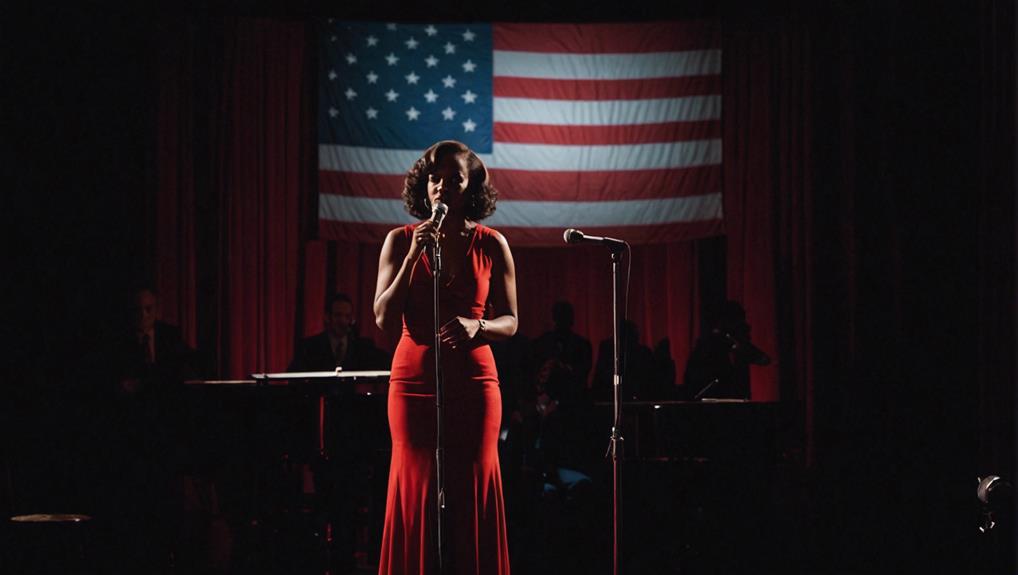
You head into the CSC's production of Carmen Jones expecting a sultry, passionate tale, but what you get is a sanitized, timidly directed adaptation that fails to deliver on its promise of fiery romance and intense drama. The lack of chemistry between leads and superficial character emotions only add to the disappointment. However, the talented cast shines vocally, conveying emotional depth through nuanced performances. But even these highlights can't save the production from its overall lack of punch. Want to know more about where it all went wrong?
A Sanitized Take on Passion
You expect a fiery passion to drive the characters' actions in Carmen Jones, but instead, you get a watered-down, sanitized take on passion that falls flat. The romantic tension between Carmen and Joe, the two leads, is surprisingly lacking, leaving you wondering why you should care about their relationship. The chemistry between them is nonexistent, making it difficult to believe they're even remotely interested in each other.
The characters' emotional authenticity is also questionable. Their emotions are superficial, and you never truly feel like you're getting a glimpse into their inner worlds. When Carmen sings about her desire for freedom, it sounds more like a shallow declaration than a heartfelt cry from the soul. Joe's supposed passion for Carmen comes across as more of a possessive obsession than a deep emotional connection.
The lack of emotional authenticity is especially disappointing given the show's premise. Carmen Jones is supposed to be a sultry, seductive tale of love and desire, but it ends up feeling like a tame, PG-rated version of what could've been a sizzling drama. The sanitized take on passion results in a show that's more yawn-inducing than spellbinding. You're left wishing for a more intense, unbridled portrayal of romance and desire, but it never comes.
Timid Direction Falters
As you watch Carmen Jones, you can't help but notice the director's cautious approach, which ultimately strips the production of its emotional impact. By playing it safe, the director misses opportunities to explore the complex themes and relationships that make this story so compelling. You're left wondering what could've been if the director had taken more risks and pushed the boundaries of the narrative.
Directional Choices Matter
Most of the time, a director's bold vision can elevate even the most mediocre script, but in the case of Carmen Jones, the timid direction falters. You can't help but wonder what could have been if the director had taken more risks and pushed the boundaries of the production.
| Aspect | Directional Choice | Impact |
|---|---|---|
| Pacing | Rushed scenes, lack of tension | Underwhelming dramatic impact |
| Character Development | One-dimensional characters, lacking depth | Emotional disconnection |
| Thematic Exploration | Superficial exploration of themes | Missed opportunities for depth |
The director's inability to take creative risks and exercise artistic vision results in a lackluster production. When a director is constrained by fear of failure or desire for approval, they sacrifice creative freedom and settle for mediocrity. As an audience member, you crave intimacy and connection with the performance, but Carmen Jones fails to deliver. The director's timid approach stifles the production's potential, leaving you underwhelmed and unfulfilled.
Failing to Take Risks
Frequently, a director's reluctance to take risks results in a production that feels stifled, and Carmen Jones is no exception. You can't help but sense the creative stagnation that settles over the stage, like a haze that refuses to lift. The director's fear of taking artistic risks has led to a watered-down, lukewarm production that fails to ignite any real passion.
This lack of artistic fearlessness holds the entire production back, stifling its potential for greatness. You're left wondering what could have been if the director had taken a few more chances, pushed the boundaries, and really let the performers shine. Instead, the entire show feels like a missed opportunity, a chance to do something truly remarkable that was squandered by playing it safe. You're left feeling underwhelmed, like you've seen it all before, and that's a real shame. By not taking risks, the director has guaranteed that Carmen Jones will be quickly forgotten, lost in the sea of more daring and innovative productions.
Vocal Performances Shine Bright
You're immediately struck by the powerhouse vocals of the talented cast, whose impressive range and control bring Oscar Hammerstein II's lyrics to life with palpable emotion. As you listen, you're drawn into the emotional depth of the characters, thanks to the vocal nuance and precision of the performers. The cast's ability to convey the emotional resonance of the lyrics is nothing short of breathtaking, making the characters' struggles and triumphs feel deeply personal.
The lead performers, in particular, shine with their rich, expressive voices, capable of expressing the full gamut of human emotion. Their vocal control is stunning, effortlessly maneuvering through the complex melodies and harmonies with precision and power. The emotional resonance of their performances is palpable, making it impossible not to be moved by the characters' stories.
Throughout the production, the cast's vocal prowess is consistently impressive, elevating the overall impact of the show. Even in the quieter moments, the subtlety and nuance of their performances create an intimate connection with the audience. It's clear that the cast has put in the work to master their craft, and the result is a truly unforgettable vocal experience.
Lackluster Choreography Falls Flat
As you watch the choreography in Carmen Jones, you can't help but feel underwhelmed – the energy's just not there, and the movement choices seem uninspired. You're left wondering why the choreographer didn't take more risks, especially in key scenes that cry out for more dynamic movement. Instead, the lackluster choreography falls flat, and you're stuck feeling unimpressed.
Lacking Energy and Pizzazz
With only a few sparks of energy, the choreography in Carmen Jones falls woefully short of the high-energy spectacle it promises, leaving you wondering when the excitement will kick in. The stale performances lack a creative spark, making you feel like you're stuck in a rut. The choreographer's vision seems to be missing, leaving the dancers to struggle through lackluster routines.
Here are a few reasons why the choreography falls flat:
- Underwhelming ensemble numbers: The group scenes lack cohesion and energy, making it hard to stay engaged.
- Uninspired solos: The solo performances are forgettable and lack the pizzazz needed to captivate the audience.
- Lack of dynamic movement: The choreography is stagnant, with too much repetition and not enough variation.
- Poor flow: The shifts between scenes are clunky, disrupting the rhythm of the performance.
Uninspired Movement Choices
What's striking about the choreography in Carmen Jones is how it relies on uninspired movement choices that fail to elevate the performance. You can't help but feel a lack of emotional resonance in the physical storytelling, which leaves the audience disconnected from the characters' emotional journeys.
| Movement | Emotional Resonance | Physical Storytelling |
|---|---|---|
| Stiff gestures | Limited emotional expression | Lacking vulnerability |
| Repetitive phrases | No clear narrative arc | Unengaging movement quality |
| Overly simplistic | No emotional depth | No sense of risk-taking |
The choreographer's choices seem to prioritize simplicity over complexity, resulting in a lack of nuance and depth. The movements feel generic, lacking the specificity and detail that could make the characters' stories more relatable. As a result, the emotional resonance of the performance falls flat, leaving you feeling disconnected from the characters and their struggles.
Missed Opportunities Abound
During the performance of Carmen Jones, you're struck by the countless missed opportunities to elevate the choreography and make a lasting impact on the audience. It's as if the creative team played it safe, sacrificing boldness for blandness. This lack of creative freedom leads to a sense of artistic compromise, where the choreographer's vision is watered down to appeal to a broader audience.
The results are a series of uninspired movement choices that fail to leave a lasting impression. Consider the following: The choreography lacks originality, relying on predictable patterns rather than innovative expression. Without a deeper emotional connection, the performance feels superficial and forgettable. In contrast, productions like How to Transcend a Happy Marriage demonstrate how bold artistic choices can create a more profound and resonant experience.
- Underutilized ensemble: The chorus is relegated to background movement, rather than being integrated into the storytelling.
- Lack of dynamic range: The choreography rarely shifts in tone or intensity, creating a flat, one-note experience.
- Unimaginative staging: The set and props are underutilized, leaving the dancers to carry the entire narrative burden.
- Missed emotional resonance: The choreography fails to tap into the emotional depth of the characters, leaving the audience disconnected.
Set Design Misses the Mark
You're immediately struck by the underwhelming set design, which fails to transport you to the 1940s American South. It's as if the creative budget was stretched too thin, sacrificing the artistic vision in the process. The sparse, uninspired backdrop barely evokes the sense of time and place that's essential to this classic tale. You can't help but feel that the production's priorities were misaligned, with too much focus on flashy costumes and not enough on crafting an immersive environment.
The set's lack of depth and detail makes it difficult to become fully invested in the story. It's like being presented with a rough sketch instead of a richly textured canvas. The absence of nuance and attention to period-specific details is glaring, leaving you feeling disconnected from the characters and their struggles. You're left wondering what could have been achieved with a more substantial creative budget, one that would have allowed the artistic vision to flourish.
The missed opportunities are palpable, and it's hard not to imagine what could have been if the set design had been more thoughtful and considered. As it stands, the production's shortcomings in this area detract from the overall experience, leaving you feeling underwhelmed and unfulfilled.
Themes of Prejudice Undeveloped
Carmen Jones's failure to adequately explore themes of prejudice and racism undersells the opera's potential impact, leaving audiences with a watered-down portrayal of the African American experience. You expect a production that tackles the complexities of racial tensions, social norms, and power dynamics, but instead, you're met with a shallow exploration of these essential themes.
The opera's inability to dive deeper into the systemic barriers and cultural stereotypes that perpetuate racism is a missed opportunity. You're left wondering what could have been if the production had taken a more nuanced approach. For instance:
- Social norms: The opera could have examined how societal expectations perpetuate racism, rather than glossing over it.
- Power dynamics: A deeper analysis of how power imbalances contribute to racial tensions would have added depth to the narrative.
- Cultural stereotypes: By not addressing these stereotypes, the production reinforces the very racism it aims to critique.
- Systemic barriers: Failing to address the institutional barriers that perpetuate racism undermines the opera's impact.
Unfulfilled Potential Leaves Disappointment
By the final curtain, the unfulfilled promise of Carmen Jones leaves a lingering sense of disappointment, a feeling that's only amplified by the production's failure to deliver on its potential. You can't help but wonder what could've been if the creative team had taken more risks and pushed the boundaries of this classic tale. Instead, the production plays it safe, making creative compromises that dilute the impact of the story.
As you watch the characters navigate the complexities of love, prejudice, and identity, you're left with a sense of "what if." What if the director had taken a bolder approach to storytelling? What if the actors had been given more freedom to explore their characters' depths? The artistic visions that could've elevated this production to new heights are sadly absent, replaced by a sense of playing it safe.
You're left feeling like you've only scratched the surface of what Carmen Jones could've been. The themes, the characters, the music – everything feels like it's been held back, restrained from reaching its full potential. It's a shame, because you can sense the talent and passion of the cast and crew. But in the end, it's the unfulfilled promise that lingers, leaving you with a sense of disappointment and longing for what could've been.
Frequently Asked Questions
Is Carmen Jones a Faithful Adaptation of Bizet's Opera?
You might wonder, is Carmen Jones a faithful adaptation of Bizet's opera? Honestly, it's complicated. While it stays true to the original's spirit, it takes operatic liberties to modernize the story. The all-black cast and Americanized setting raise questions of cultural appropriation. You'll notice the creative choices made to reimagine the classic, but you can't help but wonder what's been lost in translation.
What Is the Historical Context of the Original Carmen Jones?
You're about to uncover the fascinating history behind Carmen Jones. Did you know that during the 1940s, nearly 30% of African Americans lived in rural areas, setting the stage for the opera's adaptation? Carmen Jones, an African American-centered adaptation of Bizet's Carmen, emerged in 1943, exploring racial stereotypes head-on. This opera's historical significance lies in its bold portrayal of black life, breaking down barriers and challenging societal norms. As you explore further, you'll find a rich tapestry of cultural significance woven into its fabric.
How Does the CSC Production Differ From Other Adaptations?
You're curious about how the CSC production of Carmen Jones differs from other adaptations. Well, it's all about the creative liberties taken by the directors and the artistic choices they made. You'll notice that this production stays true to the original story while adding some fresh twists. The CSC team opted for a more subtle approach, toning down the drama and emphasizing the emotional depth of the characters. This unique approach sets it apart from other adaptations, making it a standout.
Are There Any Notable Changes to the Original Storyline?
As you explore the CSC production, you'll notice subtle yet significant changes to the original storyline. Particularly, the racial undertones are toned down, and cultural sensitivity takes center stage. You'll find the adaptation thoughtfully reimagines the narrative, avoiding stereotypes and embracing a more nuanced exploration of identity. This invigorating approach allows the characters to breathe, and their stories to unfold with a newfound authenticity that resonates deeply.
What Is the Target Audience for This Production of Carmen Jones?
You'll notice this production of Carmen Jones is catering to a diverse audience with urban appeal. It's clear the creators want to attract a crowd that reflects the vibrant energy of the city. You'll feel the pulse of the urban jungle in every scene, with a cast that mirrors the diverse demographics of the city streets. This production is for you, if you crave a night out that's raw, real, and relatable.
About the Author


