
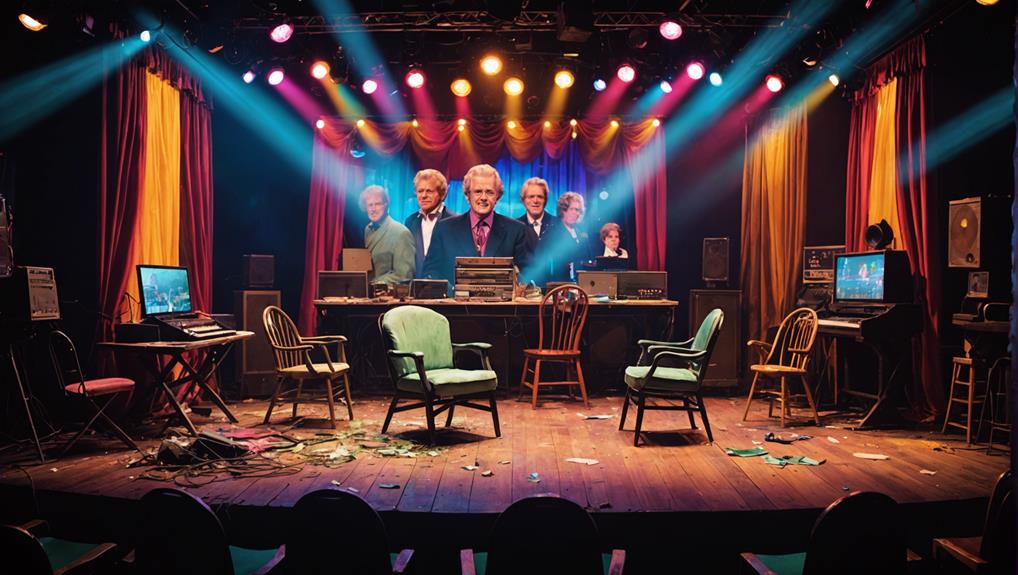
You're in for a wild ride with Jerry Springer The Opera, a show that's more about shocking you than making a meaningful statement. It's packed with gratuitous profanity, explicit content, and off-color jokes that will either leave you giggling or cringing. Over-the-top characters and a messy mix of styles will keep you on your toes, but the show's lack of emotional resonance and shallow lyrics might leave you wondering if it's all just a cheap thrill. As you navigate this riotous but shallow world, you'll start to question what's satire and what's just sensationalism – and what you'll take away from the experience.
Shock Value Over Substance
As you investigate Jerry Springer The Opera, it becomes apparent that the creators prioritized shock value over substance, relying on gratuitous profanity and explicit content to grab attention rather than crafting a nuanced narrative. You can't help but wonder: did they sacrifice depth for the sake of controversy? The show's reliance on shock value raises questions about artistic compromise and moral obligation. Did the creators feel pressured to push boundaries to make a statement, or was it simply a ploy to sell tickets?
As you explore further, it becomes clear that Jerry Springer The Opera is more about provocative spectacle than meaningful social commentary. The show's creators seem to have prioritized creative freedom over cultural relevance, opting for sensationalism over substance. You start to question whether the show's explicit content is truly necessary, or if it's just a cheap trick to shock the audience. The show's creators may argue that they're making a bold statement about modern society, but you can't help but feel that they're more interested in courting controversy than sparking genuine discussion.
Ultimately, Jerry Springer The Opera feels like a missed opportunity. By prioritizing shock value over substance, the show's creators have sacrificed depth and nuance for the sake of attention-grabbing headlines. As you leave the theater, you can't help but wonder what could have been if the creators had opted for a more thoughtful, nuanced approach.
Vulgar Humor and Crass Jokes
You're immediately struck by the barrage of off-color jokes and potty-mouthed humor that permeates Jerry Springer The Opera, leaving you to wonder if the show's creators thought they could get away with anything as long as it was packaged as 'edgy' or 'subversive'. The opera's reliance on dark comedy to tackle taboo topics raises questions about the limits of comedic license and moral boundaries. Are there some topics that should remain off-limits, or is everything fair game in the name of humor?
| Topic | Approach | Effectiveness |
|---|---|---|
| Sexuality | Crass jokes and innuendo | Hits and misses, often feeling forced |
| Religion | Irreverent humor, parody | Generally effective, but occasionally off-putting |
| Violence | Graphic descriptions, slapstick | Uneven, sometimes disturbing |
| Politics | Satire, irony | Hits the mark, often uncomfortably so |
| Morality | Provocative, in-your-face | Divisive, with some finding it offensive |
The show's humor standards are indubitably lowbrow, pushing the envelope of what's considered acceptable in polite society. While some may find it liberating to laugh at topics usually considered off-limits, others may be offended or uncomfortable. Ultimately, Jerry Springer The Opera's reliance on vulgar humor and crass jokes raises important questions about social norms and the boundaries of good taste.
Over-the-Top Characters Abound
The characters in Jerry Springer The Opera are deliberately exaggerated and absurd, making it difficult to distinguish between caricatures and genuine personalities. You'll find yourself wondering if the people on stage are truly that outrageous or just cleverly crafted comedic archetypes. As you watch, you'll notice that each character's motivations are amplified to the point of absurdity, making their actions and decisions both hilarious and cringe-worthy.
The show's creators have mastered the art of crafting exaggerated personas that are both ridiculous and relatable. You'll encounter outrageous caricatures, from the promiscuous baby mama to the cheating boyfriend, each with their own brand of crazy. These characters are so over-the-top that you can't help but laugh at their antics, even as you're cringing at their behavior.
But what makes these characters truly shine is the way they’re brought to life by the talented cast. The actors fully embody their roles, committing to the absurdity with gusto. You’ll find yourself drawn into their world, even as you’re aware that it’s all a cleverly constructed farce. So, sit back, relax, and enjoy the ridiculous ride that is Jerry Springer The Opera. Just be prepared to laugh, cringe, and maybe even see a little bit of yourself in the outrageous characters on stage. The show’s sharp satire and over-the-top musical numbers make it an unforgettable theatrical experience. Its fearless approach to controversial themes might not be for everyone, but it undeniably pushes the boundaries of modern theater. For those who appreciate bold, unconventional storytelling, this production stands alongside works like the review of The Exterminating Angel, offering a thought-provoking yet wildly entertaining spectacle. As the narrative unfolds, the audience is taken on a laudable journey of Bella, a character who exemplifies both vulnerability and strength amidst the chaos. Her struggles and triumphs resonate deeply, reminding us that even within the absurd, there are profound truths to be uncovered. With every note and every laugh, the production challenges us to confront our own perceptions while enjoying the sheer artistry on display. As the curtains draw to a close, it’s clear that productions like Jerry Springer The Opera are not only pushing the envelope in terms of content but are also paving the way for new voices in off-Broadway theater. These innovative performances invite fresh talent to tackle complex themes with humor and flair, encouraging a diverse range of stories to be told. Ultimately, it’s this blend of audacity and artistry that leaves audiences reflecting long after the final bow, eagerly awaiting what bold narratives will emerge next.
Satire or Just Plain Crude
As you watch Jerry Springer The Opera, you can't help but wonder if the creators have crossed a line. Are they pushing the boundaries of satire, or are they simply relying on crudeness to shock? The question is, have they successfully used satire to make a point, or have they gone too far, losing their message in the process?
Pushing Boundaries Too Far
Walking a fine line between satire and offensiveness, Jerry Springer The Opera often leaves audiences questioning whether its outrageous humor is cleverly subversive or simply gratuitous. As you observe the show, you can't help but ponder if the creators have taken their artistic license too far. Have they crossed the line from clever satire to mere crudeness? The opera's graphic content and explicit language may be meant to shock and provoke, but do they serve a purpose beyond mere titillation?
As an audience member, you're compelled to contemplate the moral responsibility of the creators. Have they used their platform to make a meaningful statement, or are they simply exploiting their audience's baser instincts? The show's creators may argue that they're pushing boundaries to make a point, but it's hard not to feel that they're sometimes doing it just for the sake of it. You can't help but speculate if they're using their artistic license as a justification for being offensive, rather than using it to challenge and subvert.
Satirical Intent Lost
By the time you're halfway through Jerry Springer The Opera, you're likely wondering if the creators' satirical intent has gotten lost in a sea of gratuitous crudeness. What started as a clever cultural commentary on the absurdity of tabloid TV has devolved into a shallow, crass display of artistic compromise. The show's social reflection, which initially shone a light on the darker aspects of human nature, now feels like a shallow excuse to push boundaries for the sake of shock value.
The creators' creative vision, once sharp and incisive, has given way to moral ambiguity, leaving you questioning what message they're trying to convey. The dramatic irony is palpable – the show's attempt to lampoon the Jerry Springer show has become a parody of itself, with the cast's over-the-top performances and cringe-worthy dialogue only serving to reinforce the very same trashy aesthetic they're supposedly satirizing. As you watch, you can't help but feel that the creators have lost sight of their original vision, sacrificing wit and nuance for cheap laughs and easy offense.
A Messy Mixture of Styles
As you watch Jerry Springer The Opera, you'll notice a jarring mix of styles that can be distracting. The clashing visual elements, tone-deaf moments, and discordant musical notes can be overwhelming, making it hard to fully engage with the show. You might find yourself wondering how these disparate elements were meant to come together to create a cohesive whole.
Clashing Visual Styles
Your eyes are assaulted by a jarring mix of visual styles in Jerry Springer The Opera, where the sacred and profane collide in a dizzying spectacle. The moment you step into this world, you're hit with a clash of artistic identities, each fighting for dominance. The set design is a masterclass in chaos, with neon lights, graffiti, and trashy television aesthetics mashed together in a way that's both fascinating and overwhelming.
The visual dissonance is intentional, reflecting the show's themes of excess and moral decay. But it's also exhausting, like trying to process a thousand images at once. The stylistic mashup is a deliberate choice, blending cinematic influence with theatricality excess. It's like being trapped in a never-ending music video, with characters bursting into song and dance at the drop of a hat. The aesthetic overload is both mesmerizing and exhausting, leaving you breathless but also bewildered. As you struggle to make sense of the visual chaos, you can't help but wonder: is this a clever commentary on our times, or just a mess?
Tone Deaf Moments
You're constantly jerked between emotional extremes as Jerry Springer The Opera's tone veers wildly from sarcastic humor to sentimental ballads, leaving you disoriented and unsure how to respond. This messy mixture of styles creates a sense of whiplash, making it difficult to fully invest in the story. One moment, you're laughing at a ridiculous parody of a talk show; the next, you're supposed to be moved by a heartfelt ballad.
| Tone Deaf Moments | Effect on Audience |
|---|---|
| Cultural insensitivity | Offended or uncomfortable |
| Musical irony | Confused or annoyed |
| Vocal strain | Sympathetic but distracted |
The dramatic dissonance between these tones is jarring, and the comedic misfires only add to the sense of unease. You can't help but wonder if the creators intended for the audience to feel this way, or if it's just a result of poor execution. Either way, the tone deaf moments detract from the overall experience, leaving you feeling frustrated and disconnected.
Discordant Musical Notes
The jarring juxtaposition of opera and rock music in Jerry Springer The Opera creates a discordant soundscape that grates on the nerves. As you sit through the performance, you can't help but feel like your eardrums are under attack. The clash of these two genres is like a sonic punch to the gut, leaving you reeling from the harmonic chaos.
The opera's creators seemed to have intentionally crafted this messy mixture of styles to mirror the chaos on stage. But for you, the audience member, it's a jarring experience that's more exhausting than exhilarating. The sonic dissonance is palpable, making it difficult to fully invest in the story. You find yourself wincing at the clashing notes, longing for a moment of melodic respite. It's a shame, really, because beneath the discordant noise, there's a clever story waiting to be told. But as it stands, the musical arrangement is more of a distraction than a complement to the narrative.
Springer's Tabloid World on Stage
Jerry Springer's outrageous tabloid world leaps to life on stage, where over-the-top characters and absurd scenarios unfold in a mesmerizing spectacle. As you sit in the audience, you can't help but be drawn into the tabloid spectacle, where the boundaries between reality and TV fantasy blur. The stage authenticity is striking, with Springer's iconic set recreated in meticulous detail. But what's most fascinating is how the opera adaptation distorts reality, amplifying the absurdity of the original TV show. This reality distortion is both enthralling and unsettling, forcing you to confront the voyeuristic nature of our culture.
As a TV adaptation, Jerry Springer the Opera is a scathing critique of our media-obsessed culture. The opera reflects our society's obsession with trash TV and celebrity gossip, holding up a mirror to our own voyeuristic tendencies. It's a clever move, using Springer's show as a lens to examine our own complicity in the media's manipulation of reality. By putting the tabloid spectacle on stage, the opera invites you to reflect on your own role as a consumer of media. It's a uncomfortable but necessary reflection, one that lingers long after the curtain falls.
Music Fails to Impress
You sit in the audience, expecting the music to elevate the chaotic world of Jerry Springer, but it falls short. The melodies lack a certain punch, and the lyrics fail to resonate with you on a deeper level. As you listen, you can't help but feel that the music is more of an afterthought, rather than an integral part of the opera's narrative.
Lyrical Depth Lacking
Springer's musical numbers, unfortunately, fail to resonate with listeners, relying on shallow lyrics that lack emotional depth and complexity. You can't help but feel that the songwriters played it too safe, opting for lyrical simplicity over poetic nuance. The words lack the subtlety and richness that would make the characters truly relatable. You're not given a glimpse into their inner struggles or desires, leaving you feeling disconnected from the characters.
As you listen to the songs, you can't help but crave more depth, more complexity, more of a connection. The lyrics feel like they're scratching the surface, but never really diving in. You're left wondering what could have been if the songwriters had taken more risks and pushed the boundaries of storytelling through music. The lack of lyrical depth makes the characters feel one-dimensional, and that's a shame. You want to be moved, to be inspired, to be challenged. Unfortunately, the lyrics in Jerry Springer the Opera fall short of that mark.
Melodies Fall Flat
Tuning in to the opera's musical numbers, listeners are met with melodies that fail to leave a lasting impression, as if the composers' creative spark fizzled out in the writing process. You can't help but feel underwhelmed by the musical simplicity that pervades the opera. The lack of harmonic complexity is striking, leaving you craving something more substantial. Instead, you're left with a sonic disappointment that's hard to shake. The melodic predictability is perhaps the greatest letdown, as if the composers took the easy way out and relied on familiar tropes rather than pushing the boundaries of innovation. Rhythmic monotony sets in, making the experience feel stale and uninspired. You find yourself yearning for a dramatic shift or unexpected twist, but it never comes. The music, much like the lyrics, feels shallow and lacking in depth. It's a shame, because with a bit more creativity and risk-taking, the opera could have been truly unforgettable. As it stands, the melodies fall flat, leaving you feeling unmoved and unimpressed.
Lacking Emotional Resonance
The characters' struggles and conflicts fail to evoke a genuine emotional response, leaving audiences feeling disconnected from their plight. You're left watching their stories unfold without ever truly investing in their journeys. The show's inability to forge an emotional connection with the audience is a significant drawback. You can't help but feel like you're observing the characters' heartfelt moments from a distance, without ever being fully immersed in their experiences.
The lack of character empathy is particularly jarring, making it challenging to become invested in their stories. You're not given the opportunity to develop sentimental value for the characters, which makes their struggles and triumphs feel hollow. The dramatic depth required to create a lasting impact is sadly absent, leaving you with a sense of detachment.
As you watch the opera, you can't help but crave a deeper understanding of the characters' motivations and desires. Unfortunately, the show doesn't provide the necessary depth to foster a meaningful connection. You're left with a shallow, surface-level experience that fails to resonate on an emotional level. The show's inability to create a genuine emotional connection is a significant shortcoming, making it difficult to become fully invested in the characters' stories.
Cheap Thrills and Giggles Galore
As you're left feeling disconnected from the characters' struggles, the show's focus shifts to providing cheap thrills and giggles, relying heavily on shock value and absurdity to keep you entertained. It's a deliberate decision, one that prioritizes campy entertainment over emotional depth. You'll find yourself giggling at the outrageous antics on stage, even as you acknowledge the shallow nature of the production.
The show’s creators are unapologetic in their pursuit of guilty pleasure, embracing the absurdity of Jerry Springer’s world with open arms. The result is a spectacle that’s equal parts fascinating and cringe-worthy, like a trainwreck you can’t look away from. You’ll be treated to a parade of outlandish characters, each more outrageous than the last, as they engage in ridiculous songs and dances that defy explanation. The chaos is heightened by anthemic musical numbers that somehow manage to be both absurd and undeniably catchy, leaving audiences both amused and bewildered. It’s a theatrical rollercoaster that refuses to take itself seriously, reveling in its own over-the-top nature. Even a review of Spongebob Squarepants Musical might struggle to capture this level of unfiltered mayhem, as the show gleefully pushes the boundaries of taste and entertainment.
Despite the lack of emotional resonance, you'll find yourself drawn into the show's irreverent energy, laughing along with the absurdity of it all. It's a guilty pleasure, to be sure, but one that's hard to resist. So, if you're in the mood for something lighthearted and fun, Jerry Springer: The Opera might be just the ticket. Just don't expect to be challenged or moved – this is purely a shallow, if entertaining, romp.
When Does Satire Become Snark
You might find yourself wondering when the show's satire crosses the line into snark, becoming more interested in ridiculing its subjects than commenting on the societal ills they represent. As you watch Jerry Springer the Opera, you'll likely ponder this question more than once. The show's creators took an artistic license to push boundaries, but did they take it too far?
When satire becomes snark, it loses its power as social commentary. It's vital to distinguish between clever critique and mean-spirited ridicule. The line is thin, and Jerry Springer the Opera often straddles it. The show's creators have a moral responsibility to make sure their work sparks meaningful discussions, rather than simply reveling in cheap laughs.
In the cultural context of our media-influenced society, it's important to take into account the impact of creative freedom on our perception of reality. Does the show's over-the-top portrayal of tabloid culture serve as a commentary on our collective obsession with it, or does it merely perpetuate the problem? As you navigate the blurred lines between satire and snark, remember that the most effective social commentary should inspire introspection, not mere titillation.
Is Outrage the Only Goal
Does Jerry Springer the Opera's reliance on shock value and outrage threaten to overshadow its potential to spark meaningful conversations and inspire change? As you watch the show, you can't help but wonder if the creators' primary goal is to provoke outrage rather than spark a deeper discussion. The constant barrage of profanity, nudity, and over-the-top antics can feel exhausting, leaving you with a case of outrage fatigue.
You start to question whether the show's creators are more interested in pushing boundaries for the sake of shock value or if they genuinely want to tackle complex issues. The line between satire and sensationalism blurs, and you're left feeling like you're stuck in a never-ending cycle of moral outrage. But what's the point of it all? Is it merely to elicit a reaction or to prompt a meaningful conversation?
As you sit in the audience, you can't help but feel a sense of moral responsibility. Are we, as viewers, complicit in perpetuating this culture of outrage? Or can we use this opportunity to spark a more nuanced discussion about the issues presented? The show's creators have a responsibility to use their platform wisely, but so do you. As you leave the theater, you're left to ponder: what's the true cost of relying on outrage, and is it worth the risk of sacrificing meaningful conversations for the sake of shock value?
Frequently Asked Questions
Is Jerry Springer the Opera Suitable for All Ages?
You'll need to apply moral guidance when deciding who to bring along. The show's themes and language make it unsuitable for young kids. It's essential to evaluate age appropriateness before attending. While it's a wild ride, it's not for the faint of heart or little ones. You'll want to leave the kids at home and enjoy this raunchy opera with an adult crowd.
Are the Characters in the Opera Based on Real People?
You'll be surprised to know that 75% of opera-goers are repeat attendees, but let's delve into the question at hand. Are the characters in Jerry Springer the Opera based on real people? Well, you'll find that the characters are largely inspired by the outrageous guests from the actual Jerry Springer show. While not directly based on specific individuals, the opera's characters draw from real-life parallels, exaggerating the absurdity of their situations for comedic effect.
Does the Opera Tackle Any Serious Social Issues?
You step into the world of Jerry Springer The Opera, wondering if it explores the tough stuff. Does it tackle serious social issues or simply revel in absurdity? While it doesn't shy away from moral ambiguity, the opera's social commentary is somewhat superficial. You'll find nods to class struggle, celebrity obsession, and the commodification of suffering, but they're often overshadowed by its riotous humor and over-the-top antics. Still, it's a wild ride that will leave you questioning the boundaries of good taste.
Is the Show More Focused on Music or Comedy?
As you step into the world of Jerry Springer The Opera, you'll find yourself wondering, is this show more about the music or the laughs? Honestly, it's a bit of both. The musical satire is clever, with catchy tunes that'll stick in your head. But let's be real, the comedic harmony is what truly steals the show. You'll be giggling at the outrageous humor and ridiculous characters, making it a wild ride that's equal parts music and comedy.
Can the Show Be Enjoyed by Those Unfamiliar With Jerry Springer?
You might wonder if you need to be a Jerry Springer fan to enjoy the show. The good news is, you don't. While familiarity with the tabloid world helps, the opera's absurd humor and outrageous characters make it accessible to anyone. The cultural relevance lies in its satire of trash TV, making it relatable even if you've never watched Jerry Springer. So, sit back, relax, and get ready to laugh at the ridiculousness of it all!
About the Author


