
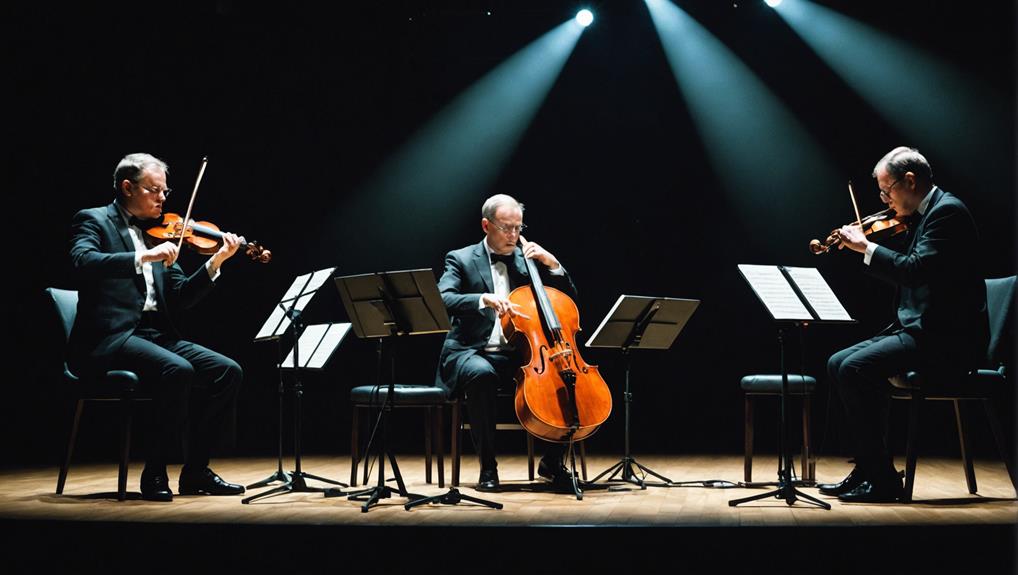
We were blown away by the Belcea Quartet's primal performance of Shostakovich at Zankel Hall, where they delivered a raw, visceral portrayal of human emotion. The music reverberated with sorrow, anguish, and desperation, leaving us breathless. The quartet's masterful execution was a shared emotional experience, binding the audience together. Shostakovich's dark masterpiece was reborn, capturing the essence of Soviet Era oppression and fear. As we absorbed every note, we felt the music tap into our deepest emotions and primal responses. Want to know how this performance went from intense to transcendent?
Unflinching Portrayal of Human Emotion
As we settled into our seats at Zankel Hall, the Belcea Quartet launched into Shostakovich's String Quartet No. 8, its unflinching portrayal of human emotion piercing the air like a collective gasp. The music was a visceral representation of the human experience, laying bare the complexities of emotional intensity and human vulnerability. The quartet's masterful execution conjured up a sense of raw emotion, as if we were witnessing an intimate confession.
The notes seemed to reverberate deep within our chests, evoking feelings of sorrow, anguish, and desperation. The music was a reflection of our own experiences, our own struggles, and our own vulnerabilities. The Belcea Quartet's interpretation was not just a performance, but a shared emotional experience that bound us together as humans. We felt the weight of Shostakovich's emotional intensity, the unbridled passion, and the unrelenting honesty.
Through the quartet's performance, we were reminded that music has the power to tap into our deepest emotions, to expose our vulnerabilities, and to connect us on a primal level. As we listened, we were struck by the realization that we are not alone in our struggles, that our emotions are universal, and that music can be a powerful catalyst for empathy and understanding. The Belcea Quartet's performance was a poignant reminder of the transformative power of music, and its ability to pierce the veil of our emotional armor, exposing our shared humanity.
Shostakovich's Dark Masterpiece Unleashed
With the quartet's instruments singing in harmony, Shostakovich's dark masterpiece unfolded before us, its haunting melodies and discordant notes conjuring an atmosphere of foreboding and unease. We were transported to a world of darkness and despair, echoes of Russian History's turbulent past reverberating through every note.
As we listened, we couldn't help but think of the Soviet Era, a time of oppression and surveillance, where the slightest misstep could mean imprisonment or worse. Shostakovich's music seemed to capture the essence of that era, the fear and paranoia that permeated every aspect of life.
- The quartet's performance was like a window into the composer's troubled mind, a mind that had witnessed the Stalinist purges and the brutal suppression of dissent.
- The music seemed to howl with rage and sorrow, a cry against the injustices of the Soviet regime.
- And yet, despite the darkness, there was a sense of defiance, a refusal to be silenced or oppressed, that resonated deeply with us.
As the music washed over us, we felt like we were experiencing a piece of Russian History, a demonstration to the power of art to capture the essence of human experience.
Raw Energy and Unbridled Passion
The Belcea Quartet's performance burst forth with raw energy and unbridled passion, each musician attacking their instrument with a ferocity that was both enthralling and intimidating. As we sat in the audience, we couldn't help but be swept up in the whirlwind of sound that enveloped us.
| Emotional Intensity | Fierce Dynamics | Instrumental Ferocity |
|---|---|---|
| Turbulent outbursts | Sudden fortissimos | Violin strings screaming |
| Heart-wrenching melodies | Soaring crescendos | Cellos growling in unison |
| Haunting harmonies | Whisper-soft pianissimos | Violins dancing in tandem |
| Cathartic releases | Thunderous double basses | The entire quartet in frenzied harmony |
The Belcea Quartet's performance was a masterclass in harnessing raw energy and unbridled passion to convey the emotional turbulence that lies at the heart of Shostakovich's music. As we listened, we felt the music coursing through our veins, a visceral response that left us breathless and wanting more. The fierce dynamics and instrumental ferocity on display were a testament to the quartet's technical prowess, but it was their ability to tap into the emotional turbulence of the music that truly set the performance ablaze.
The Abyss Stares Back Silently
Silence hung in the air like a palpable force, a stark counterpoint to the frenzied passion that had come before. As we sat in stunned silence, the weight of Shostakovich's music settled upon us like a shroud. It was as if we were staring into the abyss, and the abyss was staring back at us silently. The Belcea Quartet's performance had conjured an existential dread that hung in the air like a challenge, daring us to confront the void within.
In this moment, we were acutely aware of the cosmic silence that surrounds us, the silence that lurks beneath the surface of our everyday lives. It was a silence that was both beautiful and terrifying, a reminder of the infinite unknown that lies beyond our tiny, insignificant lives.
- The music seemed to strip away our defenses, leaving us vulnerable and exposed.
- We felt the weight of our own mortality, the impermanence of all things.
- In the silence, we heard the whispers of the universe, reminding us of our place in the grand scheme of things.
As we sat there, suspended in this moment of cosmic silence, we were forced to confront the darkness that lurks within. It was a primal, visceral experience, one that left us changed forever. The Belcea Quartet's performance of Shostakovich's String Quartet No. 13 was more than just music – it was an existential reckoning.
Sonic Landscapes of Fear and Anger
Fears and anxieties, long buried, began to resurface as the Belcea Quartet's intense, slashing bowstrokes conjured sonic landscapes of fear and anger. We felt the raw emotion emanating from the strings, like a primal scream piercing through the silence. The quartet's performance of Shostakovich's string quartet was a visceral experience, evoking feelings we thought we'd long suppressed.
The music was a reflection of the turmoil that churned within us, a manifestation of our deepest fears and darkest anxieties. The notes seemed to reverberate deep within our souls, awakening feelings we'd rather keep hidden. We were no longer passive listeners, but active participants in this cathartic experience. The Belcea Quartet's mastery of dynamics created an eerie atmosphere, where fearful silences hung heavy in the air, punctuated by angry resonance that shook us to our core.
As the music built towards its climax, we felt like we were standing at the edge of an abyss, staring into the void. The quartet's performance was a primal scream, a release of all the pent-up emotions we'd been carrying around. We were left breathless, our hearts racing, as the last notes faded away. The silence that followed was oppressive, a reminder that the fears and anxieties we'd confronted would always linger, waiting to resurface. Yet, in that moment, we felt a sense of liberation, as if we'd finally faced our deepest fears and emerged victorious.
Frequently Asked Questions
What Inspired the Belcea Quartet's Primal Performance of Shostakovich?
What drove our primal performance of Shostakovich? We'd say it was our quest for musical intensity. We wanted to tap into the raw emotion, the turbulent spirit that Shostakovich poured into his quartets. Our artistic vision was to release that intensity, to convey the complexity and depth of his music. We rehearsed tirelessly, pouring our hearts into every note, every gesture, until we became one with the music, and the music became primal.
How Does Zankel Hall's Acoustics Enhance Chamber Music Performances?
We’re not exactly sound wave experts, but we’re pretty sure Zankel Hall’s acoustics are the secret sauce behind its chamber music magic. Designed to perfection, the hall’s acoustic design allows every pluck and bow stroke to resonate with crystal clarity, enveloping the audience in a sonic hug. It’s no wonder the Belcea Quartet’s primal performance of Shostakovich was so electrifying – the hall’s acoustics amplified every emotional note, transporting us to a world of raw, unbridled beauty. The intimate setting enhances the connection between performers and listeners, making every whisper of sound feel personal and immediate. This was especially evident during the jawdropping technique by Andrei Ionita, whose cello sang with both fiery intensity and delicate nuance. In a space where every note lingers just long enough to stir the soul, it’s impossible not to be completely captivated.
What Role Does Silence Play in Shostakovich's Musical Compositions?
We find that Shostakovich masterfully wove silence into his compositions, creating a sonic vacuum that amplifies the emotional impact of his music. These deliberate pauses serve as musical punctuation, allowing the listener to absorb the complexity of his work. By incorporating silence, Shostakovich adds depth and nuance, making his music even more profound and thought-provoking.
Can Raw Energy in Music Evoke Emotional Catharsis in Listeners?
We believe raw energy in music can evoke emotional catharsis in listeners. It's like sonic therapy, allowing us to release pent-up emotions. A primal scream, if you will. This musical exorcism can be incredibly liberating, providing an emotional release that's hard to find elsewhere. When we let go and allow the music to wash over us, we can experience a profound sense of emotional cleansing. It's a powerful reminder that music has the ability to heal and transform us.
How Does the Belcea Quartet Prepare for Intense, Dramatic Performances?
It's understandable if you're wondering – 'do musicians really need to prepare that much for a performance?' But yes, we do! To deliver intense, dramatic performances, we focus on meticulous rehearsal techniques, like dissecting scores and experimenting with dynamics. We also develop personal performance rituals, such as meditation or visualization, to access the emotional depth required for a primal performance.
About the Author


