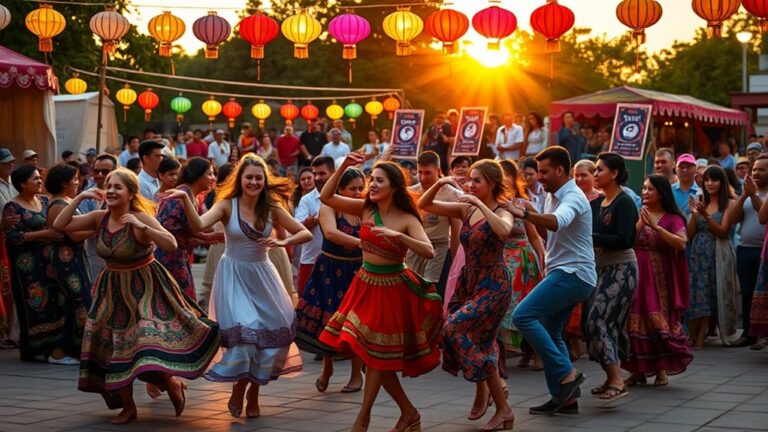
You're exploring the origins of dance styles around the world, discovering rich cultural heritage and traditions. African dance roots tell stories and convey emotions, whereas Asian traditions embed moral values and legends. Latin American rhythms, like Salsa and Tango, add flair to the mix. As you traverse through European folk dances, Middle Eastern moves, and more, you'll find unique styles and influences. You'll uncover the history and evolution of ballet, and the fusion of global dance styles, and as you continue, the lively world of dance will reveal its many secrets.
African Dance Roots
Plunging into African dance roots, you'll find a rich cultural heritage that's been passed down through generations. You'll discover that African storytelling is deeply intertwined with dance, as it's used to convey messages, myths, and legends. Tribal rhythms play a significant role in African dance, with each beat and melody evoking a specific emotion or telling a unique story. The cultural significance of African dance can't be overstated, as it's a way to express oneself, connect with others, and honor ancestral traditions.
As you explore deeper into African dance, you'll find that it's a potent form of spiritual expression. Dance rituals are an integral part of community celebration, bringing people together to honor the divine, celebrate life, and mourn loss. You'll notice that traditional costumes are often worn during these rituals, adorned with symbols and colors that hold deep meaning. Ancestral connections are likewise a vital aspect of African dance, as dancers seek to honor their forebears and continue their legacy. Through dance, you'll experience the lively energy of African culture, where community celebration and spiritual expression converge. By embracing African dance, you'll gain a deeper comprehension of the cultural significance and richness of this ancient tradition, and you'll be free to express yourself in a unique and potent way. African dance roots are a reflection of the freedom and creativity that's at the heart of human expression.
Asian Dance Traditions
As you shift from African dance roots to Asian dance traditions, you'll discover a diverse range of styles that reflect the region's unique cultural heritage. You'll find that traditional storytelling is deeply embedded in Asian dance, with cultural expressions that convey moral values, myths, and legends. Rhythmic patterns and spiritual significance are likewise integral to these dances, often performed during social gatherings and festivals. Regional variations abound, with historical influences shaping the distinct styles of different countries.
You'll notice that performance styles, costume designs, and dance rituals vary greatly across Asia. For instance, the traditional dances of India, China, and Japan have unique choreography evolution and musical accompaniment. These dances often serve as a means of community bonding, bringing people together to celebrate and express themselves. Artistic collaborations between dancers, musicians, and costume designers are common, resulting in stunning performances that showcase the region's rich cultural diversity. Asian dance festivals, which take place throughout the year, are a demonstration of the significance of dance in the region's cultural scenery. As you explore Asian dance traditions, you'll gain a deeper appreciation for the freedom of expression and the importance of preserving cultural heritage. By embracing these traditional dances, you'll experience the beauty and richness of Asian cultural expressions.
Latin American Rhythms
You're now stepping into the lively world of Latin American rhythms, where you'll discover a kaleidoscope of styles that reflect the region's rich cultural melting pot. As you explore this dynamic world, you'll find that each style has its own unique history and evolution. You'll investigate the salsa history, which originated in Cuba and Puerto Rico, and has since become a staple of Latin American dance. The samba influence, which emerged in Brazil, has likewise had a significant impact on the development of Latin American rhythms.
As you dance through the region, you'll notice the tango evolution, which has its roots in Argentina and Uruguay. This dramatic and sensual style has captivated audiences worldwide, and its influence can be seen in many other Latin American dances. You'll furthermore discover the cha cha origins, which date back to the 1950s in Cuba, and have since become a popular style around the world. The bachata rhythms, which originated in the Dominican Republic, have likewise gained popularity in recent years, with their romantic and sensual sound.
You'll find that Latin American rhythms are all about freedom and self-expression, allowing you to let loose and dance to the beat of your own drum. With their rich history, cultural significance, and infectious energy, it's no wonder that Latin American rhythms have become a staple of dance styles around the world. You'll feel the passion and energy of these rhythms, and you'll be inspired to move your body and let the music take control.
European Folk Dances
You're now exploring European Folk Dances, which feature distinctive folk steps that set them apart from other styles. As you learn about these dances, you'll discover the traditional waltz, a classic style that's still widely performed today. You'll additionally encounter Celtic moves, which bring a unique energy and flair to European folk dancing, and you'll find that they complement the folk steps and waltz perfectly.
Folk Steps
Exploring European folk dances means discovering a rich fabric of traditional steps, each reflecting the unique cultural heritage of its region. You'll find that these dances often tell stories of freedom, love, and community, allowing you to express yourself and connect with others. As you investigate folk steps, you'll notice the importance of traditional costumes, which are often worn during community celebrations. These costumes are a symbol of cultural identity and are usually passed down through generations.
You'll have the freedom to choose from a variety of folk dances, each with its own unique style and rhythm. From the lively polkas of Eastern Europe to the elegant tarantellas of Italy, you'll find a dance that suits your personality and style. As you learn and master these folk steps, you'll become a part of a larger community that values tradition, creativity, and self-expression. By embracing these dances, you'll experience the joy and freedom that comes with celebrating your individuality and cultural heritage.
Traditional Waltz
How does the traditional waltz, a staple of European folk dances, enchant audiences with its rise and fall movements? You're drawn into the dance as you watch the couples sway to the music, their steps seemingly effortless. The traditional waltz has a rich waltz history, with its origins dating back to 16th-century Europe. Over time, various waltz variations have emerged, each with its own unique style and flair.
As you explore the realm of traditional waltz, you'll discover the freedom and expression that comes with this dance style. You're not limited by rigid rules or conventions, but instead, you're encouraged to let loose and let the music guide you. The waltz's rise and fall movements create a sense of fluidity, allowing you to move freely and unencumbered. With its enchanting rhythm and elegant movements, the traditional waltz is a true embodiment of the freedom and joy that dance can bring. You can experience this freedom for yourself by learning about the different waltz variations and exploring the waltz history that has shaped this beloved dance style.
Celtic Moves
A rich cultural heritage underlies Celtic moves, a lively subset of European folk dances. You'll find that Celtic footwork is a key element in traditional jigs, Irish step, and Scottish reels. These dances aren't just about the steps, though – they're likewise a way to express folk storytelling and rhythmic patterns that have been passed down through generations.
As you explore Celtic moves, you'll discover the cultural significance behind them. They're often performed during festival celebrations, where you'll see dancers wearing traditional dance costumes. These community gatherings are a great way to experience the energy and joy of Celtic dances. You'll feel the freedom and spontaneity of the dances, which are deeply rooted in the community's history and heritage. By participating in or watching Celtic moves, you'll gain a deeper comprehension of the importance of folk dances in bringing people together and preserving cultural traditions.
Middle Eastern Moves
You're now exploring the lively world of Middle Eastern Moves, where you'll discover the mesmerizing Belly Dance, characterized by its fluid movements and rhythmic isolations. As you learn about Arabic Rhythms, you'll notice the strong emphasis on percussion and the way it drives the energy of the dance. You'll additionally encounter Tribal Moves, which combine traditional and modern elements to create a unique fusion of styles and techniques.
Belly Dance
Belly dance originated in the Middle East, where it's been a staple of cultural expression for centuries. You're likely familiar with the sensual movements and elaborate costumes that define this dance style. As you investigate belly dance history, you'll discover it's a rich and diverse art form that's evolved over time. You'll learn about the different types of belly dance, from traditional to fusion, and how they've been influenced by various cultures.
You'll likewise explore the stunning belly dance costumes that are an integral part of the performance. These costumes are often adorned with intricate designs, sequins, and beads, and are designed to accentuate the dancer's movements. As you learn more about belly dance, you'll appreciate the freedom and self-expression it embodies. You'll see how it empowers dancers to express themselves through movement, and how it celebrates individuality and creativity. By embracing belly dance, you'll experience the thrill of this ancient art form.
Arabic Rhythms
Through the lens of Arabic rhythms, Middle Eastern moves take center stage, showcasing the dynamic energy of this ancient dance form. You'll discover that Arabic folk music and dance are deeply intertwined, with traditional instruments like the oud and qraqeb setting the tone for energetic performances. As you explore Arabic rhythms, you'll notice the complex rhythmic patterns that underlie the dance, which is rich in dance symbolism and cultural significance.
You'll find that modern interpretations of Arabic rhythms often blend traditional and contemporary styles, giving you the freedom to express yourself in new and innovative ways. Regional variations likewise play a significant role, with different areas of the Middle East boasting their own unique flavors and styles. By investigating Arabic rhythms, you'll gain a deeper appreciation for the diversity and richness of Middle Eastern culture, and you'll be able to experience the liberation and joy that comes with moving to these infectious beats. You'll be free to let the music guide you, and to lose yourself in the dynamic energy of Arabic rhythms.
Tribal Moves
As you investigate the domain of Tribal Moves, also known as Middle Eastern Moves, you'll discover a dance style that's deeply rooted in community and cultural heritage. You'll find that Tribal Moves are closely tied to tribal rituals, which are a crucial part of the culture. These rituals allow you to connect with your ancestral connections, giving you a sense of freedom and belonging.
You can experience the beauty of Tribal Moves by:
- Learning traditional dance steps that've been passed down through generations
- Comprehending the history and significance of tribal rituals in Middle Eastern culture
- Embracing your ancestral connections and letting them guide your movements
As you dig deeper into Tribal Moves, you'll find that it's not just a dance style, but a way to express yourself and connect with others. It's a celebration of freedom, community, and cultural heritage. By embracing Tribal Moves, you'll be able to tap into your ancestral roots and experience the joy of dance.
Indian Classical Dance
You'll find Indian classical dance rooted in ancient traditions, with its origins dating back thousands of years. As you explore this world, you'll discover a diverse range of styles that embody the spirit of freedom and self-expression. You'll encounter Bharatanatyam techniques, which emphasize intricate footwork and hand gestures, along with Kathak storytelling, which weaves together myth and legend through dance. Odissi expressions will captivate you with their subtle yet potent conveyance of emotion, whereas Manipuri grace will leave you in awe of its gentle, lyrical movements.
As you investigate Indian classical dance further, you'll experience the fluidity of Mohiniyattam, the drama of Kuchipudi, and the lively energy of Indian folk dances. You'll find that these styles often come together in spectacular dance festivals, celebrating the diversity and richness of Indian culture. These festivals are a reflection of the freedom and creativity that defines Indian classical dance, allowing you to express yourself and connect with others on a deeper level. By embracing these diverse styles and techniques, you'll find that Indian classical dance offers a unique path to self-discovery and empowerment, one that's waiting for you to explore and experience. With its deep roots and lively expressions, Indian classical dance is a true representation of the human spirit's desire for freedom and creative expression.
South American Sway
Indian classical dance's lively energy is now giving way to the sensual rhythms of South America. You're about to initiate a voyage through the dynamic dance styles of this continent, where freedom of expression knows no bounds. As you explore the realm of South American dance, you'll discover the samba influence that's taken the globe by storm. This infectious rhythm has captivated audiences, inspiring you to let loose and move your body to the beat.
You're not just a spectator; you're an active participant in the tango evolution that's sweeping the nation. With every step, you're expressing yourself, breaking free from your inhibitions, and embracing the raw energy of the dance. The South American sway is all about liberation, and you're free to interpret the music in your own unique way. Consider the following aspects of South American dance:
- The samba's Afro-Brazilian roots, which have shaped the genre into what it is today
- The dramatic, passionate movements of the tango, which exude intensity and desire
- The fusion of traditional and modern styles, resulting in a truly innovative sound
As you immerse yourself in the South American sway, you'll find that the samba influence and tango evolution are intertwined, creating a rich cultural heritage that's waiting to be explored. You're free to experiment, to push boundaries, and to express your inner dancer. So, let the music guide you, and let your spirit soar.
Caribbean Dance Styles
Your adventure through dance styles now takes you to the lively Caribbean, where the air's alive with rhythmic energy. You'll discover a unique blend of cultural expressions, shaped by folk influences and music integration. Soca rhythms and calypso movements are just a few examples of the colorful dance styles you'll encounter. As you explore deeper, you'll find that dancehall influences and reggae vibes have become an integral part of the Caribbean's social dances.
You'll experience the excitement of traditional celebrations, where carnival festivities bring people together. The streets come alive with colorful costumes, energetic performances, and infectious music. You'll feel the freedom to express yourself, as you join in the social dances that are a hallmark of Caribbean culture. From Jamaica to Trinidad and Tobago, each island has its own distinct flavor, but they all share a common thread – a passion for music and dance.
As you investigate the Caribbean's dance styles, you'll notice how they're deeply rooted in the region's history and cultural heritage. You'll see how soca and calypso have evolved over time, incorporating new influences as they remain true to their traditional roots. The result is a dynamic, ever-changing environment of dance styles that reflect the Caribbean's spirit of freedom and creativity. You'll be inspired to move your body to the rhythm, as you become a part of the Caribbean's lively dance culture.
Ballet Dance History
You're about to explore the rich history of ballet, which has its roots in 15th-century Italy, where it originated as a formalized dance form. As you learn about ballet's evolution, you'll discover how it branched out into various dance forms, such as classical, neoclassical, and contemporary ballet. You'll additionally find out how ballet's royal origins, particularly in the French court, influenced its development and transformation over time, shaping it into the sophisticated dance style it's known for today.
Ballet Roots
Ballet's origins date back to 15th-century Italy, where it emerged as a formalized form of dance. You'll find that ballet techniques are still widely used today, and they're a great way to express yourself freely. As you investigate the realm of ballet, you'll notice that it's not just about the dance – it's additionally about the ballet costumes, which are often elaborate and beautiful.
You can experience the freedom of ballet by learning about its roots and history. Some key aspects of ballet include:
- Mastering ballet techniques to improve your dance skills
- Comprehending the importance of ballet costumes in conveying a message or telling a story
- Appreciating the cultural significance of ballet in different parts of the globe
As you probe deeper into the domain of ballet, you'll discover that it's an art form that allows you to express yourself freely and creatively. You'll be able to move your body in new and exciting ways, and you'll have the opportunity to wear beautiful ballet costumes that make you feel confident and free.
Dance Forms
The history of ballet dance is a rich and varied one, spanning centuries and evolving over time. You're about to investigate the dance evolution that has shaped ballet into what it is today. As you immerse yourself in the realm of ballet, you'll notice the cultural influences that have contributed to its unique style. From the elegant movements to the dramatic poses, ballet has been shaped by the freedom of expression and the creativity of its performers.
You'll find that the dance evolution of ballet has been influenced by various cultures, resulting in a diverse range of styles and techniques. The cultural influences of Italy, France, and Russia have all played a significant role in shaping the art form. As you learn more about ballet, you'll appreciate the freedom and creativity that has gone into its development. You'll see how ballet has become a universal language, allowing dancers to express themselves and connect with audiences around the globe.
Royal Origins
Several centuries ago, royal courts in Europe played a significant role in shaping the origins of ballet dance. You'll find that ballet's roots are deeply connected to royal ceremonies, where it was used to showcase aristocratic elegance. As you investigate the history of ballet, you'll discover that it was a symbol of freedom and creativity, allowing dancers to express themselves in a unique and beautiful way.
You can experience the essence of ballet by considering the following aspects:
- Ballet's technical foundation is rooted in royal court dances
- The art form has evolved to incorporate various styles and techniques
- Ballet continues to inspire and influence contemporary dance forms
As you probe deeper into the realm of ballet, you'll appreciate the significance of royal origins in shaping its aesthetic and technique. The aristocratic elegance and grandeur of royal ceremonies have had a lasting impact on the art form, making it a timeless and universal language of expression. You'll find that ballet's rich history and cultural significance continue to captivate audiences, inspiring a sense of freedom and creative expression.
Global Dance Fusion
As you investigate global dance fusion, you'll find it's a dynamic, constantly changing genre that draws upon various styles from around the world, resulting in unique, enthralling performances. You're free to express yourself through dance fusions, which emerge from cultural exchanges between different communities. These exchanges allow you to break free from traditional boundaries and create something entirely new. By embracing dance fusions, you're not merely preserving cultural heritage but additionally promoting cross-cultural comprehension and freedom of expression.
You can experience global dance fusion in various forms, from hip-hop and contemporary to ballet and folk. It’s a genre that doesn’t restrict you to a specific style or technique, giving you the freedom to experiment and innovate. As you explore deeper into global dance fusion, you’ll discover that it’s not just about the dance itself, but about the story it tells and the emotions it evokes. You’ll find that dance fusions can be a significant tool for social change, allowing you to express your thoughts and feelings in a way that transcends language and cultural barriers. By embracing global dance fusion, you’re embracing the freedom to create, express, and connect with others on a deeper level. This freedom of expression is what makes global dance fusion so enchanting and empowering. The role of improvisation in dance plays a crucial part in global dance fusion, allowing dancers to blend different styles organically and create unique movements in the moment. This spontaneity not only enhances creativity but also deepens the emotional connection between the performer and the audience. By incorporating improvisation, dancers can push artistic boundaries, making each performance a unique and dynamic experience.
Frequently Asked Questions
What Is Dance?
What's dance to you? It's freedom in motion, isn't it? You're expressing yourself, tapping into cultural significance, and making history with every step. You're not just moving, you're telling a story that's rooted in dance history, and that's liberating, don't you think? You're breaking free, one dance at a time.
Is Dance a Sport?
You're wondering if dance is a sport. You're pushing yourself in competitive dancing, perfecting dance techniques. You're free to move, to express, and to compete. You decide what dance means to you, and if it's a sport, you're an athlete, using your body to convey emotion and tell stories, unapologetically and freely.
Can Dance Be Therapy?
You're exploring if dance can be therapy. It absolutely can, as dance therapy promotes emotional expression and movement healing. You'll experience physical benefits, a creativity outlet, and social connection, freeing your mind and body. Through dance, you're releasing endorphins, finding a healthy escape, and embracing your true self.
Is Dance a Language?
You're a million times more expressive when you dance. You use movement expression to convey emotions, creating a universal cultural communication. Dancing frees you, allowing you to speak without words, it's a language that breaks barriers, and you're unstoppable when you let your body talk, embracing freedom in every step.
Can Anyone Learn Dance?
You're wondering if anyone can learn dance. Absolutely, you can! Dance accessibility is key, and with beginner techniques, you're free to explore. You'll discover that dance is for everyone, regardless of skill level. You can take classes, practice online, and express yourself freely, releasing your inner dancer and embracing the joy of movement.
About the Author