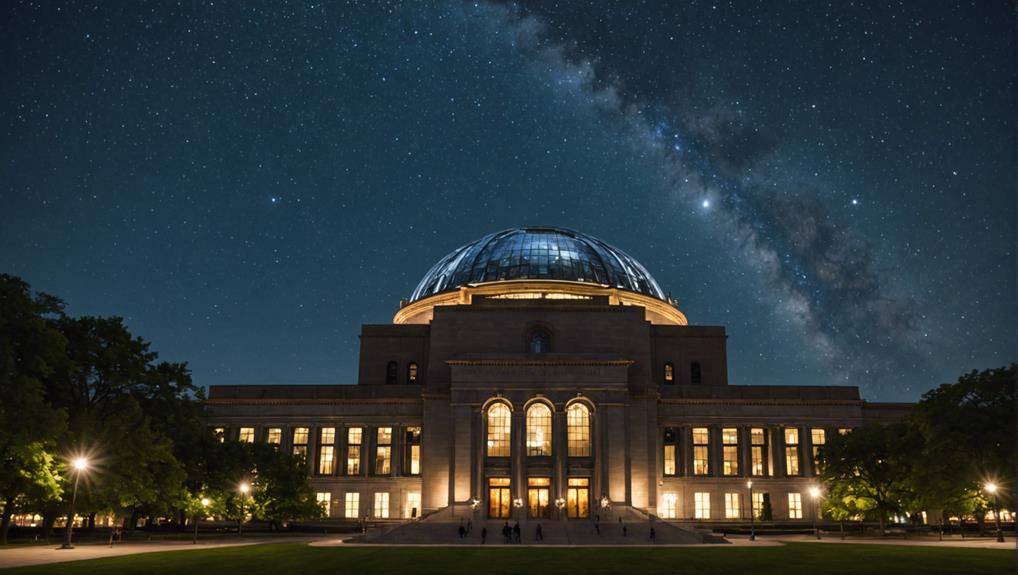
We're curious about the Dark Universe exhibit at the American Museum of Natural History, where we can uncover the mysteries of dark matter and dark energy. This exhibit reveals the secrets of the universe's evolution and showcases groundbreaking research. We'll explore the characteristics of dark matter, the search for dark energy, and how scientists use cutting-edge technology to visualize the universe's secrets. As we venture into the unknown, we'll discover immersive displays, interactive activities, and opportunities to learn from scientists and educators. And that's just the beginning of our cosmic journey.
Exploring the Cosmic Frontier
As we venture into the vast expanse of the universe, we're struck by the sheer scale and mystery of the cosmic frontier, where scientists are still unraveling the secrets of dark matter and dark energy. It's a domain that's both fascinating and intimidating, full of unanswered questions and unexplored territories. As we explore deeper into the unknown, we begin to grasp the enormity of the universe's complexity, and the tiny fraction we've managed to comprehend.
We're drawn to the American Museum of Natural History's Dark Universe exhibit, where we can immerse ourselves in the mysteries of the cosmos. The exhibit's cutting-edge visuals and interactive displays transport us to the farthest reaches of the universe, allowing us to visualize the invisible forces that shape our reality. We're captivated by the stunning visuals, which reveal the intricate dance of celestial bodies and the eerie glow of dark matter.
As we navigate the cosmic frontier, we're reminded of the infinite possibilities that lie beyond our planet. We're humbled by the realization that we're but a small part of a vast, interconnected web of galaxies and stars. The American Museum of Natural History's Dark Universe exhibit inspires us to continue exploring, to push the boundaries of our understanding, and to unravel the secrets that remain hidden in the vast expanse of space.
Unraveling Dark Matter Mysteries
We're now faced with the challenging task of unraveling the mysteries of dark matter, a phenomenon that makes up approximately 27% of the universe, yet remains invisible to our telescopes. As we explore deeper into the unknown, we're forced to confront the limitations of our current understanding. Dark matter's elusive nature has sparked a flurry of questions, leaving us wondering what lies beyond the reaches of our observatories.
| Characteristics | Dark Matter |
|---|---|
| Composition | Unknown |
| Interactions | Gravity, possibly weak nuclear force |
| Distribution | Galactic halos, galaxy clusters |
| Detection Methods | Gravitational lensing, galaxy rotation curves |
As we navigate the complexities of dark matter, we're reminded that the universe still holds many secrets. The table above highlights some of the key aspects of dark matter, but even these facts only scratch the surface. We're driven by an insatiable curiosity, fueled by the desire to uncover the truth behind this enigmatic force. By investigating the mysteries of dark matter, we're not only expanding our understanding of the universe but also pushing the boundaries of human knowledge.
The Search for Dark Energy
Approximately 68% of the universe's mass-energy density is attributed to dark energy, a mysterious component driving the accelerating expansion of the cosmos. We're still investigating, trying to comprehend what dark energy is and how it operates. One thing's for certain – it's a game-changer. Without dark energy, the universe would be slowing down, not speeding up.
As we explore further into the search for dark energy, we're faced with more questions than answers. We're talking about a force that's pushing galaxies apart at an alarming rate. It's like trying to grasp a handful of sand – the harder we investigate, the more it slips through our fingers. We've attempted to pin it down using various theories, from phantom energy to quintessence, but nothing seems to stick.
We're not giving up, though. Scientists are working tirelessly to develop new experiments and observations that can shed some light on this enigmatic force. We're talking about next-gen telescopes, space-based surveys, and even gravitational wave detectors. The more we discover, the more we realize how little we understand. But that's what makes the search for dark energy so thrilling. We're on the cusp of a major breakthrough, and we can't wait to see what secrets the universe has in store for us.
Visualizing the Universe's Secrets
By harnessing the power of cutting-edge technology, we're uncovering the veil on the universe's secrets, revealing hidden patterns and relationships that were previously invisible to us. As we explore deeper into the mysteries of the cosmos, we're developing innovative visualization tools that allow us to see the universe in entirely new ways. By combining massive datasets with advanced algorithms and stunning visuals, we're creating immersive experiences that transport us to the farthest reaches of the cosmos.
We're using these tools to investigate the vast expanse of the universe, from the intricate dance of galaxy clusters to the delicate balance of cosmic forces. We're witnessing the evolution of the universe unfold before our eyes, as if we're experiencing the cosmos' own history. The data is telling a story, and we're listening intently, deciphering the secrets hidden within the noise.
As we visualize the universe's secrets, we're not just passive observers – we're active participants, using our collective curiosity to drive discovery. We're pushing the boundaries of what's possible, and in doing so, we're redefining our understanding of the cosmos. The universe is full of mysteries waiting to be unraveled, and we're honored to be a part of this grand adventure.
Groundbreaking Research Revealed
Through a series of groundbreaking discoveries, scientists are now exploring the universe's most elusive secrets, shedding light on the mysterious forces that have shaped the cosmos. We're witnessing a revolution in our understanding of the universe, and it's exhilarating. Researchers have made tremendous progress in grasping the nature of dark matter and dark energy, the invisible components that make up about 95% of the universe.
By analyzing vast amounts of data from space-based telescopes and ground-based observatories, we've gained insight into the universe's evolution. We've discovered that dark energy, a mysterious force, is driving the accelerating expansion of the universe. This realization has profound implications for our understanding of the cosmos and its ultimate fate.
Closer to home, scientists have made significant strides in understanding the distribution of dark matter within our own galaxy, the Milky Way. By mapping the galaxy's rotation curve, researchers have revealed the presence of dark matter, which is essential for holding the galaxy together. These findings have far-reaching implications for our understanding of galaxy formation and evolution.
As we explore deeper into the mysteries of the universe, we're reminded of the awe-inspiring complexity and beauty of the cosmos. We're proud to be a part of this extraordinary journey of discovery, and we can't wait to see what secrets the universe still holds.
Immersive Experience Awaits
We're entering the Dark Universe exhibit, where state-of-the-art visuals and immersive technologies will transport us to the cosmos, allowing us to explore the universe in unprecedented ways. As we journey further, the exhibit's cutting-edge technology wraps around us, enveloping us in a 360-degree experience that simulates the thrill of space travel. We're no longer mere observers; we're active participants in a cosmic expedition.
The visuals are stunning, with vibrant colors and razor-sharp details that make us feel like we're floating among the stars. We're surrounded by interactive displays that let us manipulate celestial bodies, witnessing firsthand the mesmerizing dance of gravity and motion. The immersive experience is so real, we can almost smell the cosmic dust and feel the gravity's gentle pull.
As we wander through the exhibit, we're struck by the sheer scale and complexity of the universe. The visuals are so vivid, we can't help but feel a sense of awe and wonder at the mysteries waiting to be unraveled. The Dark Universe is more than just an exhibit – it's a journey of discovery, a chance to explore the unknown and push the boundaries of human understanding. We're not just visitors; we're cosmic travelers, setting off on a thrilling adventure through the vast expanse of space and time.
Frequently Asked Questions
Is the Dark Universe Exhibit Suitable for All Ages?
We're wondering if the Dark Universe exhibit is suitable for all ages. Honestly, we think it's best for kids aged 6 and up. The interactive displays and visuals are engaging, but some concepts, like dark matter and dark energy, might go over younger kids' heads. Plus, some scenes might be too intense for little ones. That being said, if your kiddo is curious and can grasp complex ideas, they'll love it!
Can I Take Photos or Videos Inside the Exhibit?
We're excited to capture memories of our cosmic adventure! Fortunately, yes, we can take photos for personal use inside the exhibit. However, we can't use flash, tripods, or commercial equipment without prior permission. We're also asked not to take photos of certain interactive displays or exhibits with specific "no photography" signs. Let's snap away, but be respectful of these rules and other visitors.
Are Food and Drinks Allowed Inside the Exhibit?
We're curious about snacking while exploring, too! Unfortunately, we can't bring food and drinks into the exhibit. We're asked to keep the space clean and safe for everyone, so it's best to fuel up before or after our visit. We don't want to risk any accidents or distractions from the amazing experience ahead! Let's plan to grab a bite before we immerse ourselves in the universe.
Can I Leave and Re-Enter the Exhibit During the Same Day?
We're glad you asked! Yeah, we can definitely leave and come back to the exhibit later that same day. We just need to get our hand stamped by the staff before we exit, and then we're good to re-enter later. It's super convenient, especially if we want to grab a snack or take a break. We just show our stamp, and we're back in to explore some more!
Is the Exhibit Wheelchair and Stroller Accessible?
We've all been there – trying to navigate a crowded museum with a stroller or wheelchair, only to find ourselves stuck in a tight spot. Luckily, the Dark Universe exhibit is designed with accessibility in mind. We're happy to report that the exhibit is fully wheelchair and stroller accessible, with ramps and elevators connecting all areas. You can breathe a sigh of relief and enjoy the cosmic journey ahead!
About the Author