
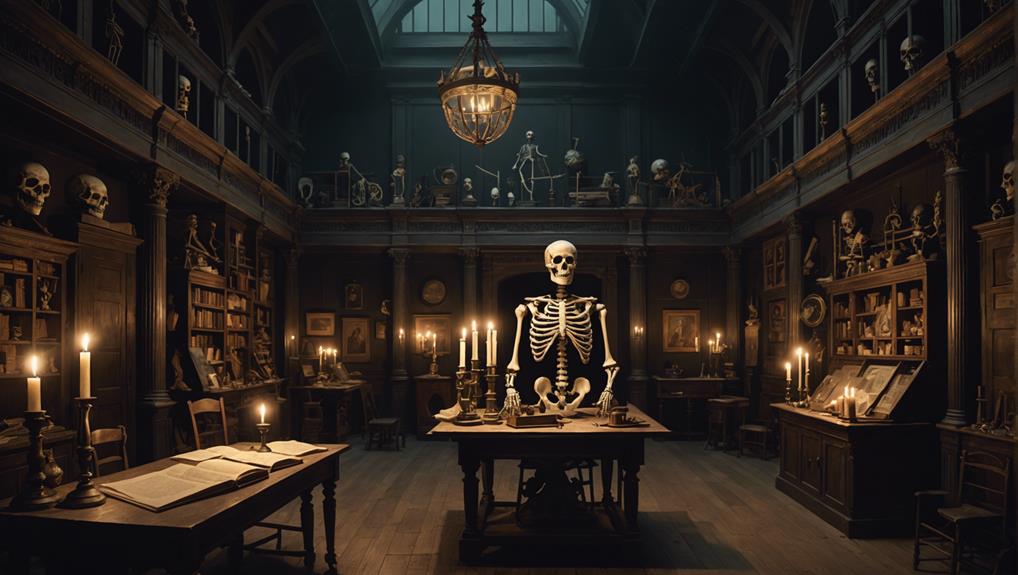
As you step into the dark alleys and crumbling streets of 19th-century Edinburgh, you'll uncover a sinister world where poverty, desperation, and social inequality fueled a climate of crime and moral ambiguity. The city's true nature reveals itself in urban decay, where high society's polished facade hides crime and the line between good and evil is constantly blurred. You'll discover how the Industrial Revolution led to rapid urbanization, and how the wealthy elite exploited the poor, forcing them into illegal activities. As you explore the darker side of history, you'll find that the more you uncover, the more you'll realize the gravity of human nature's darkest aspects.
Dark Roots of Burke and Hare
You explore the dark roots of Burke and Hare in 19th-century Scotland, where the desperate and the downtrodden were preyed upon by the notorious duo. The streets of Edinburgh's Old Town were treacherous, and the poor and vulnerable were easy targets for the cunning pair. Historical parallels can be drawn between the social ills of the time and the crimes committed by Burke and Hare. The poverty, overcrowding, and lack of opportunities created an environment where the forgotten outcasts of society were ripe for exploitation.
As you investigate further into the dark roots of Burke and Hare, you begin to understand the social and economic context that enabled their crimes. The Industrial Revolution had brought about rapid urbanization, leading to overcrowding and poverty in Scotland's cities. The working class was struggling to make ends meet, and the poor were forced to live in squalid conditions. It was the perfect storm for opportunistic criminals like Burke and Hare to thrive.
The forgotten outcasts of society, including prostitutes, beggars, and the mentally ill, were easy prey for the duo. They targeted those who were marginalized and invisible, knowing that their disappearance would go unnoticed. Burke and Hare's crimes were a symptom of a larger problem – a society that had failed to protect its most vulnerable members. As you explore the dark roots of Burke and Hare, you're forced to confront the harsh realities of 19th-century Scotland and the historical parallels that still resonate today.
The Anatomy of a Murder
As you explore the twisted minds of Burke and Hare, you'll discover the sinister thoughts that drove them to commit heinous crimes. You'll uncover the motives behind their murders, and how they manipulated their victims to get what they wanted. By examining the anatomy of their crimes, you'll gain a chilling understanding of what drove these notorious killers.
Murderous Intentions Unveiled
Exploring the twisted minds of Burke and Hare, their murderous intentions are exposed, revealing a calculating precision that would send shivers down the spines of even the most hardened criminals. As you uncover the threads of their dark secrets, you'll discover a web of deadly obsessions that fueled their heinous crimes. Their cold, calculating logic is both fascinating and terrifying, a true masterclass in the art of manipulation.
You'll find yourself drawn into a world of macabre fascination, where the boundaries of morality are pushed to the limits. Burke and Hare's partnership was forged in the depths of hell, with a shared passion for the darker side of human nature. Theirs was a bond built on a foundation of deceit, manipulation, and a deadly obsession with power. As you explore deeper into their twisted world, you'll begin to understand the intricacies of their dark secrets, and the true extent of their murderous intentions. Prepare to be unsettled, for in the world of Burke and Hare, nothing is as it seems, and the line between good and evil is constantly blurred.
Motives Behind the Crime
Burke and Hare's partnership, forged in the depths of hell, was driven by a complex web of motives that ultimately led to the gruesome murders that would shock Edinburgh. As you explore the minds of these notorious criminals, you'll uncover a tangled web of motivations that fueled their deadly actions.
Here are three key motives that drove Burke and Hare's criminal behavior:
- Fatal obsession with wealth: Their desire for financial gain led them to commit heinous crimes, exploiting the vulnerable and marginalized for their own benefit.
- Social deviance and moral ambiguity: Burke and Hare's willingness to defy societal norms and blur the lines between right and wrong enabled them to justify their deadly secrets and hidden agendas.
- Criminal psychology of thrill-seeking: The thrill of getting away with murder, coupled with a sense of power and control, fueled their deadly obsession, propelling them to continue their killing spree.
Victims of the Past
Your fascination with the darkest corners of history leads you to the doorstep of Burke and Hare's victims, ordinary people whose lives were brutally cut short by the duo's sinister endeavors. As you investigate further, you begin to uncover the forgotten souls who fell prey to their crimes. These hidden narratives, once lost to time, are now being brought to light, revealing the devastating impact of Burke and Hare's actions.
You can't help but wonder about the lives of these victims, their dreams, aspirations, and the loved ones they left behind. The more you learn, the more you realize that their stories are a reflection of the darker aspects of human nature. The victims of Burke and Hare were more than just names in a history book; they were people with hopes, fears, and desires, whose lives were brutally silenced.
As you explore the anatomy of their murder, you're forced to confront the harsh realities of the past. It's a somber reminder that, even in the darkest of times, there are stories waiting to be uncovered, and it's up to us to give voice to the forgotten souls who deserve to be remembered.
19th-Century Edinburgh's Dark Underbelly
As you explore the cobblestone streets of 19th-century Edinburgh, the city's polished façade gives way to a dark underbelly of poverty, crime, and corruption that lurks in every shadow. The Gothic landscape of towering tenements and crumbling buildings seems to whisper secrets in the foggy nights, drawing you deeper into the heart of darkness. Every step reveals a new layer of urban decay, hidden courtyards, and forgotten streets that seem to exist in a world of their own.
- Shadowed alleys: Narrow passageways that seem to swallow the light, leaving only the faint sound of midnight whispers and the rustling of unseen figures.
- Forgotten streets: Crumbling pavement and flickering gas lamps cast an eerie glow on the deserted streets, where the city's forgotten souls roam.
- Hidden courtyards: Secluded oases amidst the urban decay, where secrets are shared in hushed tones and the city's true nature is revealed.
In this world, the polished façade of Edinburgh's high society is but a thin veil, hiding the dark underbelly of crime and corruption that festers beneath. As you explore further, the city's true nature begins to reveal itself, and you're left to wonder: what secrets lie hidden in the shadows of Edinburgh's dark underbelly?
Poverty and Desperation Fuel Crime
You're about to uncover the darkest corners of 19th-century Edinburgh, where poverty and desperation fueled the most heinous crimes. As you explore the city's impoverished alleys, you'll realize that starvation and hopelessness drove people to commit unthinkable acts. In this bleak environment, crime became a last resort for survival, and you'll see how it led to some of the most shocking crimes in history.
Starvation Drives Desperate Acts
In the bleak landscape of 19th-century Scotland, the pangs of starvation drove people to commit crimes they never thought themselves capable of, revealing the darkest aspects of human nature. You might think you're above such desperate acts, but when your stomach's growling and your family's crying, you'd be surprised what you're capable of.
The desperation born from famine can drive even the most upright citizens to commit famine crimes. You're forced to explore the harsh realities of survival ethics, where the lines between right and wrong blur in the face of hunger.
Here are three ways starvation can lead to desperate acts:
- Theft for sustenance: When the choice is between stealing a loaf of bread or watching your child starve, the decision becomes eerily simple.
- Prostitution for survival: In a world where women's rights are scarce, the vulnerable become easy prey for exploitation.
- Murder for gain: When the stakes are high and the rewards are great, the boundaries of morality are easily breached.
As you investigate further into the world of Burke and Hare, you'll find that the darkness that drove these crimes is still very much alive today, waiting to be uncovered.
Crime as Last Resort
Starvation’s grip on Scotland’s poor led to a disturbing trend: poverty and desperation fueling crime as a last resort, often leaving victims and perpetrators alike trapped in a vicious cycle of survival. You can’t help but wonder, what drives someone to cross the line from desperation to desperation-fueled crime? The answer lies in the criminal psyche, where social pressures and the struggle to survive create a toxic mix. When survival is uncertain and hunger gnaws relentlessly, moral boundaries begin to blur, making theft or deception seem like the only escape. In such dire circumstances, even the smallest relief—whether a stolen loaf of bread or an act of defiance—can feel like a triumph against an unforgiving world. Interestingly, even in hardship, moments of respite can be found; for instance, studies have shown how dance improves your mood, offering a temporary escape from the crushing weight of poverty and despair.
| Desperation Level | Crime Committed | Consequences |
|---|---|---|
| Hunger pangs | Theft of food | Imprisonment, shame |
| Rent overdue | Burglary | Family separation, guilt |
| Illness without care | Fraud | Financial ruin, anxiety |
| No education | Prostitution | Loss of dignity, disease |
| No job prospects | Violence | Injury, trauma |
In this bleak landscape, you're forced to confront the darkest aspects of human nature. The lines between right and wrong blur, and the desperation to survive becomes an all-consuming force. As you explore further into the world of Burke and Hare, you begin to realize that crime as a last resort is a symptom of a larger disease – one that can only be cured by addressing the root causes of poverty and desperation.
Class Inequality and Social Hierarchy
Two centuries ago, Britain's rigid social hierarchy relegated the poor to the fringes of society, where they were forced to eke out a meager existence amidst squalor and decay. You lived in a world where your birth determined your fate, and social mobility was a distant dream. The wealthy elite held the reins of power, while the working class struggled to make ends meet.
As you navigated the treacherous landscape of class inequality, you faced:
- Economic oppression: The wealthy controlled the means of production, leaving the poor with limited access to resources and opportunities.
- Class warfare: The struggle between the haves and have-nots was palpable, with the ruling class using their power to maintain the status quo.
- Wealth disparity: The income gap between the rich and the poor was staggering, with the wealthy accumulating wealth at the expense of the working class.
In this era of cultural elitism, racial tensions simmered beneath the surface, and power dynamics favored those at the top of the social ladder. You lived in a world where your social standing was predetermined, and the odds were stacked against you. The class system was a rigid framework that restricted social mobility, perpetuating the cycle of poverty and wealth. As you navigated this complex web of inequality, you realized that the only way to survive was to challenge the existing power structures.
Exploiting the Vulnerable for Gain
As you struggled to survive in a society rigged against you, you became acutely aware that the most vulnerable members of society were often exploited for the gain of those already in power. You saw how the wealthy elite preyed on the desperation of the poor, using their power dynamics to manipulate and control. You witnessed how the vulnerable were coerced into dangerous and illegal activities, such as grave robbing, to serve the interests of those in power.
| Vulnerable Group | Exploitation | Beneficiary |
|---|---|---|
| Poor and homeless | Forced into illegal activities | Wealthy elite |
| Women and children | Coerced into prostitution | Powerful men |
| Uneducated and illiterate | Deceived into signing unfair contracts | Landowners and employers |
You realized that social manipulation was a powerful tool used by those in power to maintain their grip on society. They would use propaganda, misinformation, and even violence to keep the vulnerable in line. As you navigated this treacherous landscape, you began to understand the dark underbelly of history, where the powerful exploited the weak for their own gain. The story of Burke and Hare serves as a stark reminder of the dangers of unchecked power and the importance of protecting the vulnerable from those who would seek to exploit them.
Killing for Anatomical Science
As you explore the dark underbelly of history, you'll discover that the pursuit of anatomical knowledge was often shrouded in secrecy and morally reprehensible acts. You'll find that the demand for cadavers led to a sinister trade, where bodies were stolen or even murdered to satisfy the need for dissection. You're about to uncover the shocking truth behind the anatomical advancements of the time, and the horrific price that was paid for them.
Bodies for Dissection
By the late 18th century, you're likely to stumble upon a gruesome underground economy where fresh corpses were being sold to anatomists, fuelling a dark trade that would eventually entangle Burke and Hare. This illicit market was driven by the growing demand for cadavers in medical schools, where students were keen to learn the intricacies of human anatomy. However, the shortage of legal corpses led to a thriving black market, where grave robbers and body snatchers would steal freshly buried bodies to sell to anatomists.
Here are three key takeaways about the dark trade of bodies for dissection:
- Medical ethics were compromised: The desperation for corpses led to a disregard for medical ethics, as anatomists turned a blind eye to the illegal sourcing of bodies.
- Grave robbing was rampant: Body snatchers would dig up graves, often within hours of burial, to supply the demand for fresh corpses.
- The poor were disproportionately affected: The vulnerable and impoverished were more likely to have their bodies stolen, as they were often buried in shallow graves or in areas with inadequate security.
As you investigate further into this dark chapter of history, you'll begin to understand the twisted motivations that drove Burke and Hare to commit their heinous crimes.
Murder for Knowledge
You'll soon discover that the lucrative market for corpses led Burke and Hare to take their criminal enterprise to the next level, murdering innocent people to supply the demand for fresh bodies. Their morbid curiosity drove them to commit atrocities, feeding a deadly obsession that consumed them. The duo's gruesome acts were fueled by the need for anatomical knowledge, which was in high demand during the 19th century. As the medical field advanced, the demand for fresh corpses skyrocketed, and Burke and Hare saw an opportunity to capitalize on it. They preyed on the vulnerable, targeting those who wouldn't be missed, and supplied the medical community with fresh bodies. Their heinous crimes were a reflection of the lengths people would go to satisfy their curiosity, no matter the cost in human life.
Anatomical Advancements
The exploration of anatomical knowledge drove medical professionals to dissect and examine corpses, fueling a lucrative market that Burke and Hare exploited to deadly effect. You're likely aware that the duo's infamous crimes were motivated by the high demand for cadavers in medical schools. What you might not know is that this dark period in history contributed to significant medical breakthroughs and surgical innovations.
Here are three ways the pursuit of anatomical knowledge led to medical advancements:
- In-depth understanding of human anatomy: The increased availability of corpses for dissection allowed medical professionals to gain a deeper understanding of human anatomy, leading to more effective surgical techniques.
- Advancements in surgical procedures: The knowledge gained from dissecting corpses led to the development of new surgical procedures, improving patient outcomes and saving countless lives.
- Enhanced medical education: The increased access to cadavers enabled medical schools to provide more thorough training, producing better-equipped medical professionals who could tackle complex medical cases.
While Burke and Hare's crimes were unquestionably heinous, they inadvertently contributed to the advancement of medical science. As you explore further into the darker side of history, you'll discover that even the most sinister events can have unexpected consequences that shape the course of human progress.
The Commodification of Human Life
In the shadowy corners of 19th-century Scotland, body snatching and murder became a lucrative business, where human life was reduced to a commodity that could be bought and sold. You might think this is the stuff of horror movies, but it's a dark reality that's rooted in history. The infamous duo, Burke and Hare, capitalized on the demand for fresh corpses, supplying the University of Edinburgh's anatomy department with stolen bodies. But their enterprise didn't stop there. They soon turned to murder, preying on the vulnerable and the poor, to meet the demand for cadavers.
As you explore further into this sinister world, you'll realize that the commodification of human life is a theme that persists even today. Human trafficking, where people are treated as mere objects to be exploited, is a stark reminder that the value of human life can be reduced to a price tag. Organ harvesting, where body parts are extracted and sold on the black market, is another disturbing example of this phenomenon. It's a sobering thought, but one that's essential to confront. By examining the darker aspects of human history, you'll gain a deeper understanding of the forces that drive human behavior and the consequences of reducing human life to a commodity.
The Blurred Lines of Morality
As Burke and Hare's gruesome business flourished, their moral compass eroded, raising questions about what drives ordinary people to cross the threshold into depravity. You might wonder, what triggers this exploration into darkness? Is it the lure of easy money, the thrill of getting away with something, or something more sinister?
The lines of morality begin to blur when circumstances create an environment where the ends justify the means. When Burke and Hare started selling corpses to medical schools, they likely didn't think they were doing anything wrong. They were providing a service, after all. But as they continued down this path, their actions became more and more heinous.
Here are a few key takeaways about the blurred lines of morality:
- Moral ambiguity is a slippery slope: Once you start justifying small transgressions, it's easier to rationalize bigger ones.
- Ethical boundaries are easily distorted: When circumstances create an environment where the rules don't apply, it's easy to lose sight of what's right and wrong.
- The threshold into depravity is often gradual: It's not always a sudden, dramatic change; rather, it's a series of small compromises that eventually lead to moral decay.
As you investigate further into the world of Burke and Hare, you'll realize that their story is less about two monstrous individuals and more about the circumstances that allowed them to thrive. It's a cautionary tale about the dangers of moral ambiguity and the importance of maintaining clear ethical boundaries.
History Repeating Itself Today
You might be surprised to find that the same moral ambiguities that enabled Burke and Hare's crimes still permeate modern society, often in unexpected ways. It's as if we're afflicted with cultural amnesia, forgetting the lessons of the past and doomed to repeat them. Historical parallels are eerily evident in today's world.
Take, for instance, the corporate scandals that rocked the financial world in the early 2000s. Didn't the Enron and WorldCom debacles bear an uncanny resemblance to Burke and Hare's exploitation of the vulnerable for personal gain? The willingness to compromise ethics for profit, the lack of accountability, and the devastating consequences for innocent people – it's a chilling echo of the past.
Similarly, the recent debates around euthanasia and assisted dying raise uncomfortable questions about the value of human life. Burke and Hare's crimes were, in part, a product of a society that devalued certain lives. Today, as we navigate the complex moral landscape of end-of-life care, we'd do well to remember the dangers of moral relativism and the importance of upholding the inherent dignity of every human being.
It's time to acknowledge that history is not just a dusty relic of the past but a living, breathing entity that informs our present. By recognizing the historical parallels and confronting our cultural amnesia, we can break the cycle of moral compromise and forge a brighter future.
Unsettling Reflections of Human Nature
Burke and Hare's gruesome exploits hold a mirror to humanity, reflecting our darkest impulses and forcing us to confront the unsettling truth that we're all capable of moral compromise when self-interest comes into play. As you explore the twisted world of these notorious serial killers, you're forced to acknowledge the darker aspects of human nature. The lines between good and evil begin to blur, and you're left wondering: what drives people to commit such heinous crimes?
The answer lies in the domain of Dark Psychology, where the complexities of human duality come into play. You see, we're all capable of both good and evil, and it's the circumstances that push us towards one end of the spectrum or the other.
Here are three ways Burke and Hare's story highlights the unsettling reflections of human nature:
- Moral flexibility: The duo's ability to justify their crimes as a means to an end reveals how easily moral boundaries can be stretched when self-interest is involved.
- The duality of human nature: Burke and Hare's contrasting public and private personas demonstrate how effortlessly we can switch between good and evil, often without even realizing it.
- The power of circumstance: The fact that these two men were driven to murder by their environment and circumstances raises questions about the role of situational factors in shaping our behavior.
As you navigate the twisted world of Burke and Hare, you're forced to confront the darker aspects of human nature. It's a reflection that's both unsettling and thought-provoking, leaving you to ponder the age-old question: what lies at the heart of human darkness?
Frequently Asked Questions
What Drove Burke and Hare to Commit Their Heinous Crimes?
As you explore the twisted minds of Burke and Hare, you'll uncover a perfect storm of psychological motives and social pressures that drove them to commit their heinous crimes. Like a ticking time bomb, their dark desires were ignited by the poverty and desperation of 19th-century Scotland. The weight of their circumstances, coupled with their own moral decay, created a deadly cocktail that led them down a path of murder and mayhem.
Were Burke and Hare Solely Responsible for the Murders?
As you explore the case of Burke and Hare, you're left wondering: were they solely responsible for the murders? It's essential to ponder moral culpability within the historical context. The duo's actions were unquestionably heinous, but were they solely to blame? Or did the societal pressures of the time, coupled with the anatomy schools' demand for cadavers, contribute to their crimes? You must weigh the complexities of their situation to fully understand their role in the atrocities.
How Did the Public React to the Discovery of the Murders?
As you explore the dark past, you'll find that the public's reaction to the discovery of Burke and Hare's murders was one of utter shock and disgust. Public outrage erupted, sparking a moral panic that spread like wildfire. The news of the heinous crimes committed by the duo sent shockwaves throughout the community, leaving people reeling in horror. The gruesome details of the murders fueled a sense of collective outrage, demanding justice and sparking a call to action.
Were There Any Consequences for the Anatomists Who Purchased the Cadavers?
You're transported back to the 19th century, where gas lamps flicker and horse-drawn carriages rattle down cobblestone streets. Now, let's dig into the consequences for those anatomists who bought cadavers from Burke and Hare. Surprisingly, they faced little to no repercussions. The lack of ethical implications and medical accountability is staggering. It was a dark time, and the pursuit of scientific progress seemingly trumped moral obligation. You can't help but wonder, would modern medical ethics have made a difference?
What Is the Lasting Impact of Burke and Hare's Crimes on Society?
You might wonder how Burke and Hare's crimes still affect us today. Their gruesome deeds sparked a moral panic, leading to significant social reform. You see, their crimes exposed the dark underbelly of the medical field, prompting changes in anatomy laws and sparking a greater respect for human life. As a result, you now benefit from stricter regulations on body procurement, ensuring a more ethical approach to medical education and research.
About the Author


