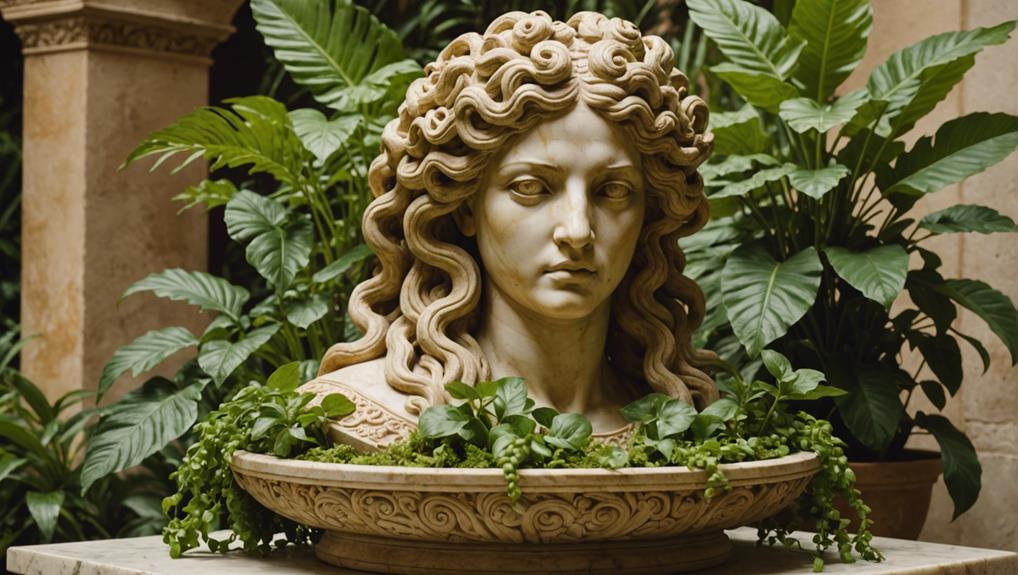
Medusa's enchanting gaze, showcased in classical art at The Met Fifth Avenue, embodies the alluring charm of beauty and the terrifying power of the monstrous feminine. Born from chaos, her story serves as a cautionary tale against unchecked power. Her piercing stare symbolizes inner turmoil, beauty, and horror, inviting exploration of her character. As an icon of self-acceptance and female empowerment, Medusa's enigmatic persona continues to fascinate artists and audiences. With her deadly beauty and eternal fascination, Medusa's allure only grows stronger – and there's more to uncover behind her mesmerizing visage.
The Birth of a Monster
In ancient Greek mythology, Phorcys and Ceto, the sea deities, spawned Medusa, a monster so hideous that a single glance could petrify even the bravest of heroes. This monstrous birth was a result of the Cosmic Chaos that reigned in the early days of the universe. The primordial fear that Medusa inspired was a reflection of the ancient Greeks' own fears of the unknown and the untamed power of nature.
Medusa's grotesque appearance was a manifestation of the darkest aspects of human psyche. Her snakes for hair and piercing gaze embodied the destructive forces that lay beneath the surface of human civilization. The myth of Medusa served as a cautionary tale, warning against the dangers of unchecked power and the devastating consequences of succumbing to one's baser instincts.
As an embodiment of primordial fear, Medusa's legend has endured for centuries, intriguing the imagination of artists and storytellers alike. At the Met Fifth Avenue, visitors can marvel at the various artistic interpretations of Medusa, each one a tribute to the timeless allure of this monstrous creature. From ancient Greek vases to modern sculptures, Medusa's image continues to inspire and unsettle, a reminder of the enduring power of myth to tap into our deepest fears and desires.
Seductive Gaze of the Goddess
As the Met's classical art collection reveals, Medusa's gaze is more than just a petrifying stare – it's a complex, multifaceted expression that has captivated artists and audiences alike. Her piercing eyes seem to convey a sense of mystery, inviting the viewer to explore the enigmatic smile that hints at a deeper, more sinister beauty. By examining the artistic interpretations of Medusa's gaze, we can unravel the intricate layers of her deadly beauty, a beauty that has been both mesmerizing and terrifying for centuries.
Medusa's Piercing Stare
With an unblinking gaze, Medusa's piercing stare has captivated artists and art enthusiasts for centuries, elevating her to an iconic status in classical art. Her intense, feminine intensity radiates from her eyes, drawing viewers in with an irresistible force. This expressive horror, frozen in time, conveys the mythological creature's raw power and emotion. Medusa's stare is a masterclass in conveying emotion without words, a proof to the enduring power of classical art.
In many depictions, Medusa's gaze is not just a physical trait but a symbol of her inner turmoil. Her eyes seem to hold a deep sadness, a sense of being trapped in a monstrous form. This paradox of beauty and horror has captivated artists, who have sought to capture the complexity of her emotions. Through her piercing stare, Medusa communicates a sense of vulnerability, making her a more relatable and human figure. As a result, her image has become an archetype, symbolizing the duality of human nature.
Enigmatic Smile Hides
Medusa's enigmatic smile hints at a seductive goddess, a subtle contrast to her monstrous reputation, and a proof of the complexity of her character. This subtle, knowing smile suggests that there's more to Medusa than meets the eye. Her mysterious intentions are hidden behind a veil of beauty, making her a fascinating and alluring subject.
- Her smile is a window into her inner world, revealing a glimpse of her hidden emotions, tantalizingly out of reach.
- It's an invitation to explore the depths of her character, to uncover the secrets she keeps hidden behind her gaze.
- This enigmatic smile is a tribute to the power of Medusa's allure, drawing us in with its seductive promise of secrets yet to be revealed.
As we gaze upon her smile, we're drawn into a world of mystery and intrigue, where nothing is as it seems. Medusa's smile is a siren's call, beckoning us to explore the complexities of her character, and to unravel the tangled threads of her mysterious intentions.
Deadly Beauty Revealed
Her piercing gaze, a mesmerizing blend of beauty and menace, reveals the deadly allure of the goddess, beckoning victims into her snare. In Greek mythology, Medusa embodies the complexities of feminine power, where beauty and danger converge. Artists throughout history have been fascinated by her enigmatic persona, capturing her essence in various forms of artistic expression.
| Artistic Expression | Cultural Significance | Symbolic Meaning |
|---|---|---|
| Sculptures | Representing feminine power in ancient Greek society | Beauty and danger intertwined |
| Paintings | Highlighting the cultural significance of Medusa in mythology | Fear and fascination with the unknown |
| Jewelry | Adorning the goddess with symbolic meanings | Protection and empowerment |
Through these various forms of artistic expression, Medusa's visual representation has evolved, reflecting the historical context and cultural significance of her character. Her aesthetic appeal lies in the contradictions she embodies, making her a fascinating subject for artists and art enthusiasts alike.
Medusa's Many Faces
Rending her monstrous visage from a beautiful maiden's face, Classical artists transformed Medusa into a multifaceted icon. This transformation was not just physical, but also symbolic, as Medusa's image became a cultural phenomenon, embodying both feminine power and terror.
Medusa's many faces reflect the complexities of her character, revealing the contradictions of her nature.
- Her snakes, often depicted as hissing and spitting, symbolize the destructive power of femininity, yet also represent the life-giving force of female energy.
- Her gaze, capable of petrifying men, is a potent symbol of feminine power, challenging the patriarchal norms of ancient Greece.
- Her beauty, juxtaposed with her monstrous features, highlights the tension between the Apollonian and Dionysian aspects of human nature, reflecting the struggle between reason and passion.
Through their artistic expressions, Classical artists captured the essence of Medusa, infusing her image with cultural significance that transcended her mythological origins. In the historical context of ancient Greece, Medusa's image served as a symbol of the feared and revered feminine power, embodying the complexities of human nature. By exploring Medusa's many faces, we gain insight into the societal values and cultural norms of the time, as well as the timeless appeal of this enigmatic figure.
From Beast to Beauty
As the myth of Medusa evolved, so did her depiction in classical art. From a fearsome beast to an enchanting beauty, Medusa's transformation is evident in the Met's collection. In exploring her mythic origins and serpentine allure, one can uncover the complexities of this enigmatic figure.
Mythic Origins
In ancient Greek mythology, the story of Medusa's transformation from a beautiful maiden to a monstrous creature unfolded through a series of tragic events. According to myth, Medusa was once a stunning priestess of Athena, but her beauty caught the eye of Poseidon, who ravished her in Athena's sacred temple. This sacrilegious act enraged Athena, who transformed Medusa into a monstrous creature with snakes for hair and a gaze that could petrify.
Medusa's mythic origins have significant cultural implications, as her story represents the struggle between divine authority and primordial power. Her transformation serves as a cautionary tale about the dangers of unchecked power and the importance of respecting ancient mythology.
Some key aspects of Medusa's mythic origins include:
- Her initial beauty and innocence, which underscore the tragedy of her transformation
- The role of divine authority in shaping her fate
- The primordial power of the gods, which can both create and destroy
Serpentine Allure
Through the centuries, Medusa's serpentine allure has captivated artists, who transformed her monstrous visage into a symbol of mysterious beauty. Her snakes, once a symbol of terror, became an integral part of her exotic charm. The snake charm that once petrified onlookers now mesmerized them, drawing them in with an irresistible force. As the forbidden fruit of Greek mythology, Medusa's beauty was both enchanting and deadly, making her an eternal enigma.
Artists, enthralled by her mystique, reimagined Medusa as a seductress, her snakes now a symbol of her feminine power. Her gaze, once a deadly stare, was reinterpreted as a sultry glance, beckoning the viewer in. This transformation from beast to beauty was a tribute to the power of art to redefine and reimagine the narratives of the past. As visitors to the Met Fifth Avenue gaze upon Medusa's serpentine allure, they're reminded that even the most fearsome creatures can be reimagined as objects of desire, their forbidden fruit-like allure forever captivating our imagination.
The Power of Femininity
Medusa's iconic serpentine locks, often depicted as a symbol of feminine fury, empowered her to embody a potent femininity that captivated artists and audiences alike. Her powerful presence has been a timeless muse, inspiring artworks that celebrate the Goddess Archetype. In classical art, Medusa's image has been used to represent Female Empowerment, challenging patriarchal norms and embracing the complexity of femininity.
- Her gaze, often depicted as petrifying, is a symbol of feminine strength, capable of rendering even the strongest opponents powerless.
- As a symbol of femininity, Medusa's snakes have been interpreted as a representation of female intuition, creativity, and transformation.
- By embracing her monstrous beauty, Medusa has become an icon of self-acceptance, encouraging women to embrace their individuality and reject societal norms.
Through her depiction in art, Medusa has become a powerful symbol of femininity, embodying both beauty and strength. Her image continues to inspire artists, challenging traditional notions of femininity and celebrating the complexity of female experience. As a cultural icon, Medusa remains a potent symbol of Female Empowerment, inspiring generations of women to embrace their individuality and celebrate their unique beauty.
Eternal Fascination With Evil
Darkness has an uncanny ability to captivate human imagination, and Medusa, as the embodiment of evil, continues to fascinate artists and audiences alike. The eternal fascination with evil is a phenomenon that transcends time and culture, and Medusa's dark allure is a proof of this enduring fascination. Her serpentine locks and petrifying gaze have become synonymous with malevolence, yet, paradoxically, they also exert a strange attraction.
Medusa’s moral ambiguity is a significant factor in her enduring appeal. She is both monster and victim, a creature born of gods and goddesses, yet cursed to roam the earth as a monstrous outcast. This ambiguity allows artists to explore the complexities of human nature, where good and evil are not mutually exclusive, but intertwined. The Met Fifth Avenue’s collection of classical art featuring Medusa showcases this duality, with depictions ranging from the grotesque to the sublime. These artistic representations capture the tension between power and vulnerability, illustrating how Medusa’s story resonates across different cultures and eras. Similarly, contemporary works like Glenn Gould The Opera explore the complexities of human identity, blurring the lines between genius and isolation. By delving into such multifaceted characters, both classical and modern art invite audiences to reflect on the dualities within themselves.
Frequently Asked Questions
Is Medusa a Purely Greek Mythological Figure?
Like a snake shedding its skin, the myth of Medusa has evolved over time. Is Medusa a purely Greek mythological figure? Not entirely. While her cultural significance and mythological origins are rooted in ancient Greece, her legend has been influenced by other cultures. The Romans, for instance, adopted and adapted her story, making her a symbol of feminine power and beauty. As a result, Medusa's identity has become a rich tapestry of diverse cultural influences.
What Inspired the Concept of Medusa's Snakes for Hair?
She explores the mysterious domain of Ancient Symbolism, where serpents embody rebirth and renewal. In Hair Mythology, tangled locks often signify chaos and the untamed. It's possible that the concept of Medusa's snakes for hair emerged from this symbolic fusion. By entwining serpents with Medusa's tresses, ancient Greeks may have conveyed the monstrous fusion of chaos and beauty, underscoring the myth's darker themes of transformation and the unknown.
Are There Any Historical Records of Medusa's Existence?
She searches for historical accuracy, scouring ancient texts and ruins for a glimpse of Medusa's existence. Archaeological evidence, however, remains scarce. Despite the myth's widespread influence, there's no concrete proof of Medusa's historical reality. The lack of tangible records leaves her existence shrouded in mystery, a tribute to the power of myth and legend. Freedom from concrete evidence allows the myth to thrive, enchanting imaginations across the ages.
Can Medusa's Gaze Turn People to Stone in Reality?
In the domain of reality, the petrifying gaze of Medusa remains a mythical concept, far from a tangible threat. While Petrification myths have captivated human imagination, Scientific explanations debunk the notion that a single stare can turn humans to stone. In reality, the only 'stone-cold' truth is that Medusa's gaze is a product of ancient storytelling, not a real-world phenomenon. Freedom from fear lies in understanding the distinction between myth and reality.
Is Medusa a Symbol of Good or Evil in Classical Art?
In classical art, Medusa's symbolism is complex, defying simplistic categorization as purely good or evil. She embodies both Feminine Power and Dark Femininity, representing a multifaceted, autonomous female force. Her gaze, a potent symbol of feminine rage, challenges patriarchal norms. Medusa's depiction often conveyed a sense of feminine empowerment, subverting traditional gender roles. This duality makes her an enduring, enigmatic figure, inspiring both fascination and fear.
About the Author