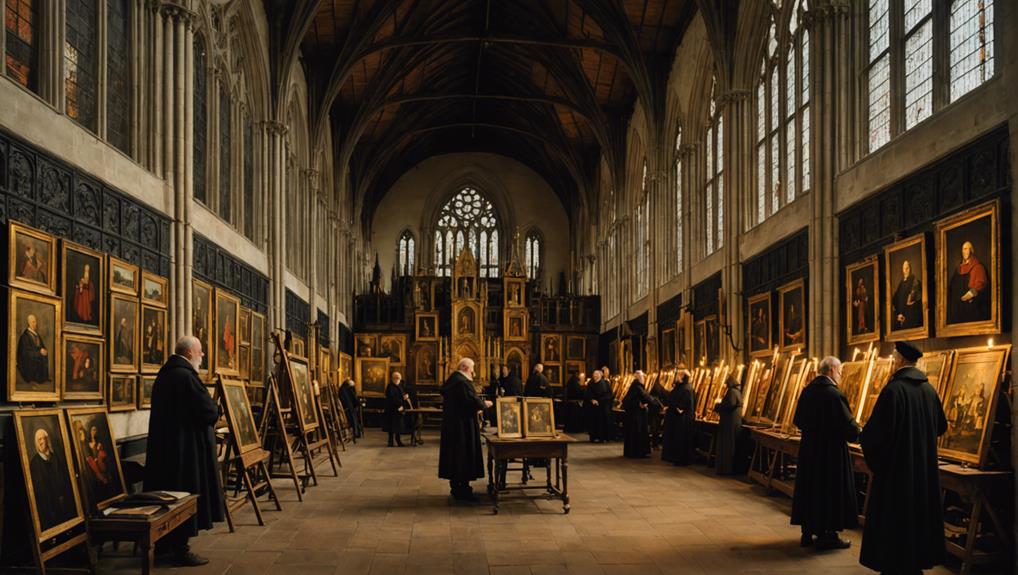
In 15th-century Bruges, a cultural and artistic renaissance flourished, led by innovators Jan Van Eyck, Petrus Christus, and Jan Vos. The Charterhouse of Bruges, founded in 1388, played a significant role in this era, emphasizing prayer, contemplation, and manual labor. Van Eyck's mastery of oil painting and light manipulation revolutionized art, while Christus's delicate details and glazing techniques added depth to Netherlandish painting. Vos humanized religious figures, shaping sacred art's depiction. The Frick Collection proudly houses their masterpieces, showcasing the era's unparalleled excellence. As we explore this artistic legacy, we uncover the intricate threads of a cultural tapestry waiting to be unraveled.
The Charterhouse of Bruges Background
Founded in 1388 by the Count of Flanders, Louis de Male, the Charterhouse of Bruges was established as a Carthusian monastery, becoming one of the earliest and most prominent Charterhouses in Europe. This medieval monastery, situated in the heart of Bruges, Belgium, played a significant role in shaping the city's spiritual and cultural landscape. As a Carthusian monastery, the Charterhouse of Bruges was dedicated to a life of prayer, contemplation, and manual labor. The monks lived a simple, austere life, adhering to the principles of poverty, chastity, and obedience.
The Charterhouse of Bruges was more than just a monastery; it was a hub of intellectual and artistic activity. The monks were known for their expertise in manuscript illumination, and their work was renowned for its beauty and precision. The monastery's scriptorium was a hub of creative activity, where monks spent hours copying manuscripts and creating exquisite works of art.
The Charterhouse of Bruges holds immense historical significance, not only for its stunning architecture but also for its role in preserving knowledge and art during the Middle Ages. As a reflection of its importance, the monastery has been beautifully restored and now serves as a museum, offering visitors a glimpse into the lives of the Carthusian monks who once called it home. The Charterhouse of Bruges remains an enduring symbol of monastic life, artistic innovation, and historical significance, inspiring generations to come.
Jan Van Eyck's Artistic Innovations
During his time in Bruges, Jan Van Eyck revolutionized the art world with innovative techniques that transformed the way artists represented reality. His groundbreaking methods allowed for unprecedented levels of realism, creating a sense of depth and dimensionality that captivated audiences. One of the most striking aspects of Van Eyck's work is his use of optical illusions. By manipulating light and shadow, he created the illusion of three-dimensionality, drawing the viewer into the scene.
This mastery of optical illusions was a hallmark of Van Eyck's style, and it paved the way for a new era of artistic expression. His innovative techniques sparked an artistic revival, inspiring a generation of artists to experiment with new methods and push the boundaries of what was possible. Van Eyck's use of oil paints, for example, allowed for a level of detail and precision that was previously unattainable.
The impact of Van Eyck's innovations was felt far beyond Bruges, sparking a wave of artistic innovation that spread throughout Europe. His influence can be seen in the work of later masters, such as Petrus Christus and Jan Vos, who built upon his innovations to create their own masterpieces. As a result, Van Eyck's artistic innovations continue to inspire and influence artists to this day, cementing his legacy as one of the greatest painters of all time.
The Virgin and Child Masterpiece
Jan Van Eyck's iconic 'The Virgin and Child with Canon van der Paele' serves as a testament to his innovative techniques, demonstrating his mastery of oil painting and unparalleled attention to detail. This masterpiece, created in 1436, showcases the artist's ability to capture the subtleties of human emotion, particularly in the Child's gaze. The Virgin's iconicity is reinforced by her serene expression, exuding a sense of calm and maternal love.
| Characteristics | Description | Symbolism |
|---|---|---|
| Virgin's Expression | Serene, calm, and maternal | Inner peace and devotion |
| Child's Gaze | Direct, curious, and playful | Innocence and purity |
| Canon van der Paele | Attentive, reverent, and humble | Devotion and reverence |
| Background | Rich, intricate, and ornate | Opulence and luxury |
The painting's intricate details, such as the Virgin's ornate cloak and the Canon's elaborate robes, demonstrate Van Eyck's attention to detail and mastery of oil painting. The Child's gaze, directed at the viewer, creates a sense of intimacy and connection, drawing the observer into the scene. The Virgin's iconicity is reinforced by her central position, radiating a sense of calm and serenity. This masterpiece is a reflection of Van Eyck's innovative techniques and his ability to capture the essence of the human experience.
Petrus Christus's Artistic Style
Petrus Christus's artistic style is characterized by his innovative use of devotional image types, which often featured intimate, quiet moments between the Virgin and Child. His Netherlandish painting techniques, such as the subtle play of light and shadow, added depth and emotion to these scenes. By combining these elements, Christus created a distinctive style that captivated audiences and solidified his reputation as a master of Early Netherlandish painting.
Devotional Image Types
How did Petrus Christus's innovative approach to devotional image types revolutionize the art of his contemporaries? By pushing the boundaries of traditional devotional art, Christus created a new wave of sacred imagery that resonated deeply with the faithful. His unique approach to devotional image types not only reflected the spiritual fervor of the time but also inspired a new generation of artists.
Some of the distinctive features of Christus's devotional image types include:
- Intimate, private chapels nestled within ornate Gothic architecture
- Sacred icons bathed in soft, golden light, evoking a sense of reverence and awe
- Delicate, lace-like details that adorned the borders of his paintings, symbolizing the intricate web of faith
- The use of subtle, muted colors to convey a sense of contemplation and introspection
- The incorporation of subtle symbols and motifs, inviting the viewer to engage with the artwork on a deeper level
Netherlandish Painting Techniques
Christus's masterful command of Netherlandish painting techniques infused his artwork with a level of depth and luminosity that captivated his contemporaries. His innovative use of painting mediums, such as oil and tempera, allowed him to achieve a remarkable level of detail and texture. By layering thin glazes over a base coat, Christus was able to create a sense of depth and luminosity that added an extra dimension to his paintings.
Christus's glazing techniques, in particular, were a hallmark of his style. By applying multiple thin layers of translucent paint, he was able to achieve a level of subtlety and nuance that was unparalleled in his time. This technique allowed him to capture the intricate play of light on fabric, metal, and other surfaces, adding a level of realism to his paintings that was unmatched by his contemporaries.
Through his innovative use of painting mediums and glazing techniques, Christus was able to create a unique visual language that continues to captivate art lovers to this day. His mastery of Netherlandish painting techniques has inspired generations of artists and continues to influence artistic expression to this day.
Saint Elizabeth and John the Baptist
Saint Elizabeth and John the Baptist, depicted in exquisite detail, occupy a prominent position in the Frick Collection's Charterhouse of Bruges, their gentle, serene faces a demonstration of the artist's mastery of capturing the subtleties of human emotion.
In this masterpiece, the two saints are positioned in a serene, idyllic landscape, evoking a sense of peace and tranquility. The artist’s use of Baptismal Symbolism is evident in the depiction of John the Baptist, who is often associated with water and spiritual rebirth. This symbolism is reinforced by the inclusion of the lamb, a traditional Christian symbol of innocence and purity. The soft, diffused lighting enhances the ethereal quality of the scene, drawing the viewer into a moment of quiet reflection. The composition subtly echoes the grandeur of sacred spaces like the Cathedral of St John the Divine, where art and spirituality intertwine to create a transcendent experience. Through delicate brushwork and harmonious color choices, the artist conveys a deep sense of reverence and devotion.
- The delicate folds of Saint Elizabeth's robes, intricately rendered in shades of blue and gold, seem to shimmer in the light.
- The gentle, knowing gaze of John the Baptist, his eyes filled with a deep wisdom and compassion.
- The soft, feathery texture of the trees, their leaves a vibrant green, providing a sense of depth and dimensionality to the scene.
- The delicate, lace-like quality of the flowers, scattered throughout the landscape, adding a touch of whimsy and playfulness to the composition.
- The subtle, nuanced expressions of the two saints, their faces radiating a sense of calm and contemplation.
Through the masterful use of color, composition, and symbolism, the artist has created a work that not only tells a story from the Biblical Narrative, but also invites the viewer to step into a world of serenity and contemplation.
Jan Vos's Contribution to Art
Jan Vos's artistic style, characterized by subtle color palettes and intricate details, greatly influenced the iconography of his time. His works, often featuring soft, gentle expressions, humanized religious figures and added an air of approachability to sacred art. As a result, Vos's unique style has had a profound impact on the art world, shaping the way artists represent religious subjects.
Artistic Style Emerges
Vibrant colors and intricate details began to characterize the artistic style of Bruges, largely due to Jan Vos's innovative contributions. His artistic breakthroughs paved the way for a new era of Renaissance-inspired art, rooted in the city's rich cultural heritage. As a result, the art of Bruges flourished, reflecting the city's values of freedom and creativity.
Some notable features of this emerging style include:
- Delicate gold leaf accents that shimmered in the light
- Expressive facial expressions that conveyed deep emotions
- Elaborate backgrounds that transported viewers to another world
- Intricate folds of fabric that seemed to ripple and flow
- Symbolic motifs that whispered secrets to those who looked closely
Jan Vos's artistic style emerged as a beacon of innovation, illuminating the path for future generations of artists. His work embodied the spirit of freedom and creativity that defined Bruges, inspiring a new wave of artistic expression that would echo throughout the ages.
Influences on Iconography
As Bruges' artistic style flourished, Jan Vos's innovative approach to iconography began to reshape the visual narrative of the city's art, infusing it with subtle yet powerful symbolic meanings. His contributions to the art world didn't go unnoticed, as his unique perspective on iconic symbolism paved the way for a new era of artistic expression. Jan Vos's work didn't just reflect the world around him; it challenged the status quo, asking questions about the nature of divine representation in art.
Through his work, Jan Vos redefined the boundaries of sacred art, imbuing it with a sense of freedom and creativity. His use of symbolic imagery was both subtle and powerful, allowing the viewer to draw their own conclusions about the divine. This innovative approach to iconography not only influenced the art of his contemporaries but also left a lasting impact on the art world as a whole. As a result, Jan Vos's contributions to the world of art continue to inspire and provoke, offering a glimpse into the mind of a true visionary.
The Cultural Landscape of Bruges
Bruges' rich cultural landscape, shaped by its medieval history and artistic heritage, unfolds like a tapestry of intricate beauty. This Flemish city's unique blend of historical preservation and artistic innovation has created a cultural landscape that is both enthralling and thought-provoking.
Some of the city's most striking features include:
- The majestic Church of Our Lady, with its soaring Gothic spire and intricate stone carvings
- The picturesque canals, lined with medieval merchant houses and ornate bridges
- The grand Markt, with its imposing Belfry tower and vibrant market stalls
- The serene Begijnhof, a tranquil oasis in the heart of the city
- The stunning City Hall, with its ornate Gothic facades and grand ceremonial halls
As visitors wander through Bruges' winding streets and picturesque canals, they are surrounded by the remnants of a rich medieval past. The city's dedication to historical preservation has ensured that many of its medieval architectural treasures remain intact, offering a glimpse into the lives of its ancient inhabitants. From the grandeur of its civic buildings to the intimate charm of its domestic architecture, Bruges' cultural landscape is a reflection of the power of art and history to shape our understanding of the world around us.
15th-Century Artistic Collaborations
During the 15th century, artistic partnerships flourished in Bruges, leading to the development of some of the most iconic works of the time. Masters of oil painting, such as Jan van Eyck and Hans Memling, collaborated on projects that showcased their exceptional skill and attention to detail. These artistic collaborations not only elevated the careers of individual artists but also contributed to the city's reputation as a hub of artistic innovation.
Artistic Partnerships Flourish
In 15th-century Bruges, artists like Jan van Eyck and Hans Memling frequently collaborated with other masters, fostering a spirit of creative cooperation that benefited their craft. This collaborative dynamic allowed them to share ideas, techniques, and inspiration, ultimately elevating their art to new heights.
Some examples of these artistic partnerships include:
- Jan van Eyck and Petrus Christus working together on the Ghent Altarpiece, combining their skills to create a masterpiece of medieval art
- Hans Memling's workshop, where artists like Jan Provoost and Gerard David honed their skills and contributed to iconic works like the Triptych of the Virgin
- The exchange of artistic ideas between Jan van Eyck and Rogier van der Weyden, influencing the development of Netherlandish painting
- The joint ventures between artists and patrons, resulting in commissioned works that showcased their collective genius
- The mutual inspiration that fueled the creation of intricate, detailed, and awe-inspiring works of art that continue to inspire us today
Through these artistic partnerships, the masters of Bruges tapped into a collective genius, fostering a creative synergy that still resonates with art lovers today.
Masters of Oil Painting
As the art of oil painting flourished in 15th-century Bruges, masters like Jan van Eyck and Hans Memling perfected their craft, pushing the boundaries of this relatively new medium. These pioneers of oil painting revolutionized the art world, experimenting with innovative techniques to achieve unprecedented levels of realism and depth. The Oil Painting Evolution was in full swing, with artists constantly seeking new ways to express themselves.
Jan van Eyck's mastery of glazing, a technique that involved applying multiple thin layers of translucent paint, allowed him to achieve an unparalleled level of luminosity in his works. Meanwhile, Hans Memling's use of sfumato, a technique that created a soft, hazy effect by layering thin glazes, added a sense of depth and volume to his paintings. These innovative Painting Techniques, born from the artistic collaborations of the time, paved the way for future generations of artists. As masters of oil painting, van Eyck, Memling, and their contemporaries left an indelible mark on the art world, their contributions continuing to inspire and influence artists to this day.
The Frick Collection Exhibition
The Frick Collection Exhibition showcases a selection of masterpieces from the Charterhouse of Bruges, offering visitors a unique glimpse into the artistic and cultural heritage of the region. This exhibition is a proof of the power of art to transcend time and borders, allowing us to connect with the past and appreciate the beauty of human creativity.
- Delicate brushstrokes dancing across canvas, evoking emotions and telling stories
- Rich colors and textures, a feast for the senses, transporting us to a bygone era
- Elegant lines and curves, a symphony of form and composition, a celebration of the human experience
- Soft light illuminating intricate details, revealing the subtleties of the human hand
- Ancient techniques and modern sensibilities, blending in harmony, a true masterpiece of art conservation
The exhibition is a result of careful museum politics, where curators and conservators work together to preserve and showcase these masterpieces for the public. It's a delicate balance between art conservation and accessibility, ensuring that these treasures are protected for future generations while still being available for us to appreciate today. The Frick Collection Exhibition is a triumph of collaboration and dedication, offering a unique opportunity to experience the beauty and craftsmanship of the Charterhouse of Bruges.
Uniting Three Masterpieces Together
Three majestic works of art, each a masterpiece in its own right, come together in a harmonious union that showcases the artistic prowess of the Charterhouse of Bruges. The Frick Collection has brought together Jan van Eyck's 'The Virgin and Child with St. Barbara and Jan Vos,' Petrus Christus's 'A Goldsmith in His Shop,' and Jan Vos's 'Memento Mori' to create a symphony of artistic harmony. This demonstration of the power of art to transcend time and space, bringing together three masters of the Northern Renaissance in a celebration of beauty and craftsmanship.
As visitors wander through the exhibition, they are struck by the way these three works of art seem to converse with one another, their subtle nuances and intricate details revealing new facets of the artists' vision. The intricate precision of van Eyck's painting, the meticulous attention to detail in Christus's work, and the haunting beauty of Vos's Memento Mori all come together to create a rich tapestry of artistic expression.
This union of masterpieces is more than just a sum of its parts – it's a demonstration of the curatorial vision that brought them together. By uniting these three works, the Frick Collection has created a space where art lovers can lose themselves in the beauty and complexity of the Northern Renaissance. As visitors immerse themselves in this artistic harmony, they'll discover new depths and meanings in these iconic works, and emerge with a deeper appreciation for the artistic genius of the past.
A Glimpse Into the Renaissance
During the Northern Renaissance, artists like Jan van Eyck, Petrus Christus, and Jan Vos pioneered a new era of artistic innovation, pushing the boundaries of technique and creativity. This cultural and artistic movement, known as Renaissance Humanism, emphasized the potential of human beings to achieve great things through education, reason, and individualism. As a result, art became a significant tool for self-expression and a means to convey complex emotions and ideas.
In this era of artistic innovation, patronage played an essential role in shaping the artistic landscape. Wealthy patrons, often members of the clergy or nobility, commissioned artworks that reflected their status, power, and values. This led to the creation of exquisite pieces that not only showcased the artists' skills but also the patrons' refined tastes.
Some notable aspects of this era include:
- Elaborate altarpieces adorned with intricate carvings and ornate details
- Delicate, lace-like patterns and textures achieved through innovative painting techniques
- Rich, vibrant colors and subtle, nuanced expressions that conveyed deep emotions
- Intricate, symbolic details that told stories and conveyed moral messages
- Innovative uses of perspective, proportion, and composition that created a sense of depth and space
Artistic Legacy of the Era
Frequently, art historians and enthusiasts alike marvel at the profound impact of the Northern Renaissance on the development of Western art, as its innovations and masterpieces continue to inspire and influence artists to this day. The era's artistic legacy is a confirmation of the power of creative expression, fostering an atmosphere of freedom and innovation that resonated across the continent.
The Artistic Renaissance of the 15th century, marked by the works of Jan van Eyck, Petrus Christus, and Jan Vos, among others, not only revitalized the art world but also sparked a Cultural Revival that permeated every aspect of society. The era's emphasis on humanism, individualism, and realism paved the way for a new wave of artistic masters, who would go on to shape the course of art history.
The Northern Renaissance's artistic legacy extends beyond the world of art itself, as it influenced architecture, literature, and even politics. The era's cultural revival sparked a renewed interest in classical antiquity, leading to a resurgence of intellectual curiosity and critical thinking. As a result, the Northern Renaissance played a pivotal role in shaping the modern world, fostering an environment of creative freedom that continues to inspire generations of artists, thinkers, and innovators.
Frequently Asked Questions
What Is the Significance of the Charterhouse of Bruges in Art History?
She recognizes the Charterhouse of Bruges as a significant milestone in art history. As a monastic complex, it exemplifies exceptional Monastic Architecture, showcasing harmony between spiritual and artistic pursuits. This haven of artistic expression fostered Artistic Patronage, as monks and patrons collaborated to create breathtaking works. The Charterhouse's influential legacy continues to inspire, embodying the spirit of creative freedom that unites artists and patrons across centuries.
How Did Jan Van Eyck's Innovations Influence Later Artists?
Jan van Eyck's innovations revolutionized oil painting, sparking an artistic evolution that inspired future generations. His mastery of oil glazes and wet-on-wet techniques allowed for unprecedented depth and luminosity. Later artists, such as Petrus Christus, built upon Van Eyck's discoveries, further refining oil painting techniques. This artistic evolution freed artists to explore new modes of expression, liberating them to push boundaries and create groundbreaking works of art.
What Inspired Petrus Christus's Unique Artistic Style?
Petrus Christus's unique artistic style was inspired by the Northern Renaissance's emphasis on realism and attention to detail. His work often blended devotional iconicity with everyday life, creating a sense of intimacy and humanity. This fusion of the sacred and mundane allowed Christus to craft a distinctive visual language that resonated with his contemporaries. His innovative approach paved the way for future artists, freeing them to experiment and express themselves more freely.
What Role Did Jan Vos Play in the Art World of 15th-Century Bruges?
In 15th-century Bruges, Jan Vos played a subtle yet significant role, quietly weaving his artistic influence behind the scenes. As a master illuminator, Vos crafted exquisite devotional art, illuminating manuscripts that whispered prayers to the faithful. Amidst the intricate guild politics, Vos navigated the complex web of patronage, never seeking to outshine his contemporaries, yet leaving an indelible mark on the art world. His understated genius allowed others to shine, while he worked tirelessly in the shadows, a true unsung hero of Bruges' artistic golden age.
How Does the Frick Collection Exhibition Preserve Renaissance Art?
She believes the Frick Collection exhibition preserves Renaissance art by prioritizing conservation efforts, ensuring artistic authenticity for future generations. Through meticulous restoration and precise environmental control, the museum safeguards delicate masterpieces, maintaining their original essence. By doing so, the exhibition allows visitors to experience the unbridled beauty of Renaissance art, unshackled from the constraints of time and decay.
About the Author