
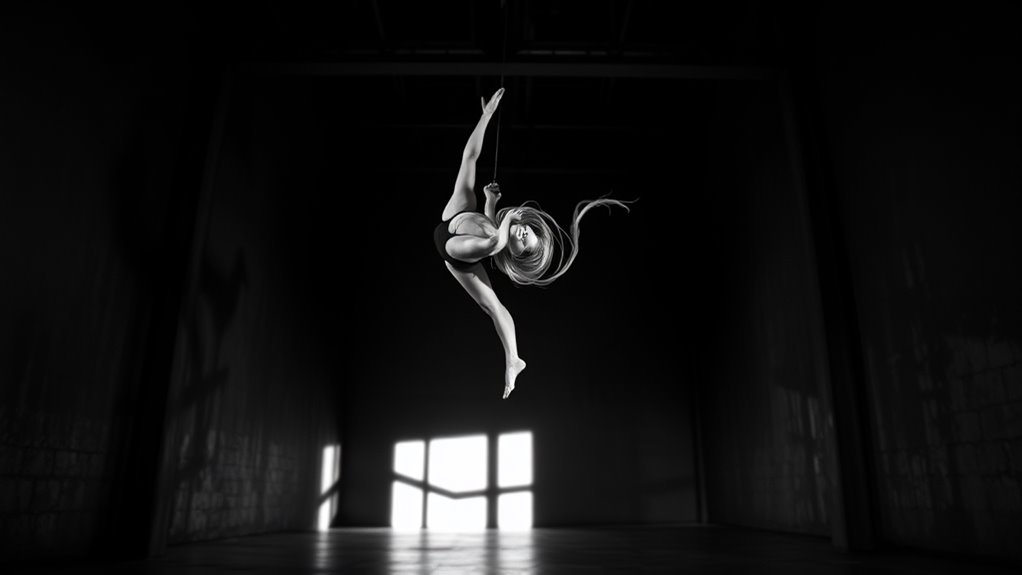
Dance critics evaluating innovative use of space in contemporary dance performances must adapt their assessment frameworks to reflect on the dynamic interplay between the dancer's body, environment, and audience perspective. Spatial relationships, architectural integration, and technology integration all play an essential role in shaping the narrative and aesthetic of a performance. Critics must analyze how choreographers utilize the environment to convey meaning, and how the audience's presence influences the dancers' movements and responses. As the boundaries between performer, space, and spectator continue to blur, critics must develop new frameworks for evaluation, and explore the nuances of immersive experiences that redefine the possibilities of dance performance.
Spatial Storytelling in Dance
In the domain of dance, spatial storytelling emerges as a strong tool for conveying narratives and evoking emotions. By carefully crafting the relationship between the dancer's body and the surrounding environment, choreographers can create immersive experiences that transport audiences to new emotional terrains. This narrative movement transcends traditional storytelling methods, allowing dancers to convey complex emotions and ideas through the subtle manipulation of space.
Effective spatial storytelling in dance relies on a deep comprehension of the interplay between the dancer's movement, the set design, and the audience's perspective. Choreographers must consider how the dancer's body occupies and navigates the performance space, using proximity, distance, and orientation to convey meaning. The strategic use of levels, pathways, and boundaries can likewise be employed to create a rich narrative texture, guiding the audience's attention and emotional response.
As a result, spatial storytelling in dance can evoke intense emotional responses, drawing the audience into the narrative and encouraging a deeper connection with the performance. By utilizing the potential of space, choreographers can craft innovative and engaging works that push the boundaries of dance as a storytelling medium. Through its ability to evoke emotions, convey narratives, and create immersive experiences, spatial storytelling has become a fundamental element of contemporary dance practice.
Site-Specific Works and Context
In site-specific dance works, the environment plays an essential role in shaping the narrative, and the choice of location can greatly impact the overall aesthetic and meaning of the piece. The space itself can become a character, influencing the movement and emotional tone of the dancers, and even informing the choreography. As dancers and choreographers increasingly seek to integrate their work with architectural spaces, the relationship between dance and environment becomes a vital aspect of the creative process.
Environmental Impact Matters
As dance companies increasingly venture beyond traditional proscenium arches, they must confront the environmental consequences of their site-specific performances, which often rely on temporary installations, energy-intensive lighting, and large crews. This shift in the direction of site-specific works raises important questions about the ecological footprint of dance productions. Critics must consider the environmental impact of these performances, evaluating the extent to which they incorporate sustainable choreography and ecological awareness.
Innovative use of space is not just about artistic expression but is also about responsible stewardship of the environment. Dance companies must balance their creative vision with the need to reduce waste, energy consumption, and carbon emissions. Critics should assess the measures taken to minimize the environmental impact of site-specific performances, such as the use of energy-efficient lighting, sustainable materials, and locally sourced resources.
Space as Character
When I think about site-specific dance performances, I am struck by the way the space itself becomes an integral part of the narrative, often taking on a character of its own. This phenomenon is particularly evident in site-specific works where the dance space is not just a backdrop but an active participant in the performance. The space influences the dancers' movements, and in turn, the dancers' movements shape the audience's perception of the space.
| Space | Character Dynamics | Emotional Resonance |
|---|---|---|
| Abandoned warehouse | Industrial, gritty, and unforgiving | Sense of desolation and neglect |
| Lush forest | Organic, natural, and serene | Feeling of connection to nature |
| Urban rooftop | Modern, edgy, and rebellious | Thrill of the unknown and freedom |
In these performances, the dance space becomes a character that interacts with the dancers, influencing their movements and emotions. The audience is then drawn into this dynamic, experiencing the performance on a deeper level. By acknowledging the space as a character, critics can better understand the nuances of site-specific dance performances and evaluate their innovative use of space.
Architectural Integration
Beyond the dynamic between dancers and space, site-specific performances often showcase a profound integration with the architectural context, wherein the built environment becomes an extension of the choreographer's vision. This integration, known as architectural integration, transforms the performance space into a living, breathing entity that engages in an architectural dialogue with the dancers. By doing so, the choreographer can manipulate the spatial aesthetics of the site, drawing attention to specific architectural features or creating new ones through clever use of lighting, costumes, and movement.
In site-specific works, the boundaries between architecture and dance blur, creating a symbiotic relationship that enhances both art forms. The built environment influences the choreography, and vice versa, resulting in a unique spatial narrative that cannot be replicated in a traditional proscenium arch setting. By embracing the site's idiosyncrasies, choreographers can craft an immersive experience that resonates deeply with the audience, blurring the lines between performer, space, and spectator. This fusion of dance and architecture yields a rich, multidimensional experience that redefines the role of space in dance.
Immersive Experiences and Boundaries
I find myself drawn to immersive experiences in dance that deliberately blur the boundaries between performer and audience, creating an environment where the distinction between observer and participant becomes increasingly ambiguous. This ambiguity allows for a more dynamic and engaging experience, as the audience is no longer confined to a traditional spectator role. In these immersive installations, the dancer's body becomes an integral part of the spatial design, inviting the audience to become an active participant in the performance.
The success of such experiences hinges on effective audience engagement, which is often achieved through clever spatial manipulation. By cleverly designing the performance space, choreographers can create an atmosphere that encourages audience members to move freely, exploring the environment and interacting with the dancers. This interaction can take many forms, from gentle touch to full-body immersion, further blurring the lines between performer and audience.
In evaluating immersive experiences, critics must consider the level of audience engagement and the effectiveness of the spatial design in creating a cohesive and engaging performance. By doing so, we can better understand the ways in which innovative use of space can improve the overall dance experience, pushing the boundaries of traditional performance and creating new and exciting ways to engage with dance.
The Role of Architecture in Dance
The spatial design of immersive experiences is intricately tied to the architecture of the performance space, which can either facilitate or hinder the audience's engagement with the dance. The dance architecture of a space plays an essential role in shaping the audience's perception of the performance. A well-designed space can improve the fluidity of movement, allowing dancers to seamlessly shift between sequences and create a enthralling visual narrative.
On the other hand, a poorly designed space can restrict the dancers' movement, creating awkward shifts and disrupting the overall flow of the performance. The layout of the performance space can additionally influence the audience's perspective, with clever use of levels, corners, and angles creating a more dynamic and engaging experience.
Furthermore, the architecture of the space can also impact the dancer's own experience, with factors such as floor texture, lighting, and acoustics affecting their ability to perform. A space that is attuned to the needs of the dancers can improve their movement fluidity, allowing them to fully express themselves and connect with the audience.
Ultimately, the role of architecture in dance is to create a harmonious relationship between the performance space, the dancers, and the audience. By carefully considering the spatial design of the performance space, dance companies can create immersive experiences that engage and inspire their audience, as well as supporting the creative expression of the dancers.
Technology Integration and Design
As immersive dance experiences continue to push boundaries, the strategic integration of technology becomes increasingly vital, allowing choreographers and dancers to experiment with novel modes of expression and audience engagement. The fusion of technology and dance enables the creation of innovative and enthralling performances that redefine the audience's experience.
Digital choreography, for instance, allows artists to generate intricate patterns and shapes using algorithms and computer-generated imagery. This enables dancers to interact with virtual environments, blurring the lines between the physical and digital domains. Interactive environments, such as motion-sensing technology and projection mapping, further improve the immersive experience, inviting the audience to engage with the performance on a deeper level.
The incorporation of technology additionally expands the possibilities for storytelling and narrative development. Choreographers can employ virtual reality, augmented reality, or 3D projections to create immersive narratives that transport the audience to new worlds. Furthermore, technology integration enables the creation of site-specific performances that respond to the unique characteristics of a particular space, further emphasizing the interplay between dance, architecture, and technology.
Ultimately, the thoughtful integration of technology into dance performances offers a rich landscape for innovation and experimentation, allowing artists to push the boundaries of their craft and create novel, enthralling experiences for the audience.
Choreographing for Unconventional Spaces
Beyond the traditional proscenium arch, choreographers are increasingly drawn to unconventional spaces that challenge their creative vision and push the boundaries of dance performance. These non-traditional venues, such as warehouses, public parks, or even streets, offer a blank canvas for choreographers to reimagine the relationship between dancer, audience, and environment. By abandoning the constraints of a traditional stage, choreographers can create immersive experiences that blur the lines between performer and spectator.
Choreographing for unconventional spaces requires a unique approach to movement fluidity. Dancers must adapt to irregular surfaces, uneven terrain, and varying levels of visibility, all during maintaining the fluidity and expressiveness of their movements. This demands a heightened sense of spatial awareness and responsiveness to the environment. In turn, the audience's experience is transformed, as they are no longer passive observers but active participants in the performance.
Audience interaction becomes an essential element in these unconventional spaces. Choreographers often incorporate elements of improvisation or participatory elements, allowing the audience to influence the performance in real-time. This dynamic interaction creates a sense of community and shared experience, as the audience becomes an integral part of the performance. By embracing the challenges and opportunities of unconventional spaces, choreographers can create innovative and engaging works that redefine the possibilities of dance performance.
The Audience-Performer Dynamic Shift
The Audience-Performer Dynamic Shift transforms the dance experience by employing immersive environmental design, which envelops the audience in a shared spatial encounter. This fusion of performance and environment blurs the traditional borderlines between the audience and performers, creating a more participatory and dynamic exchange. As a result, the focus points of the performance shift, allowing the audience to engage with the dance from diverse perspectives and nurturing a more nuanced comprehension of the art form.
Immersive Environmental Design
Through deliberate manipulation of the performance environment, immersive environmental design dissolves the traditional boundaries between audience and performer, instead cultivating a symbiotic relationship that redefines the dynamics of the dance experience. This innovative approach enables the audience to become an integral part of the performance, nurturing a deeper connection with the dancers and the space itself. By cleverly incorporating elements such as lighting, sound, and set design, the environment is transformed into an immersive entity that envelops the audience, facilitating movement immersion and sensory engagement. The audience is no longer a passive observer but an active participant, influencing the performance through their presence and energy. As a result, the dancers can respond and adapt to the audience's reactions, creating a dynamic and reciprocal exchange that heightens the emotional impact of the dance. This symbiotic relationship between the audience, performers, and environment redefines the traditional dance experience, offering a more engaging, interactive, and memorable encounter.
Blurred Borderlines
Seven decades of traditional audience-performer segregation have been upended by the immersive environmental design, giving rise to the blurred borderlines phenomenon. This shift has led to a radical redefinition of the audience-performer dynamic, where the once-clear distinctions between observer and participant have become increasingly ambiguous. As a result, dance critics must adapt their evaluation frameworks to accommodate this new paradigm.
The blurred borderlines phenomenon enables dynamic interactions between performers and audience members, encouraging a sense of communal engagement and shared experience. In this situation, critics must consider how the performers' movements and gestures intersect with the audience's physical and emotional responses. Additionally, the immersive environment encourages audience members to become active participants, influencing the performance through their presence and reactions.
To effectively evaluate these innovative productions, dance critics must develop new conceptual frameworks that account for the fluid boundaries between performer and audience. By doing so, they can provide nuanced insights into the ways in which the blurred borderlines phenomenon is redefining the very fabric of dance performance.
Shifting Focus Points
As immersive environmental design continues to dissolve the traditional boundaries between audience and performer, a new dynamic emerges, where the audience's gaze is no longer fixed solely on the stage. In this shifting terrain, the audience's perspective is reoriented, and their attention is drawn to multiple focal points. The performer, once the sole center of attention, now shares the spotlight with the surrounding environment.
This dynamic layering of focus points challenges traditional notions of audience engagement, as viewers are encouraged to explore and interact with the performance space. The critic's task is to evaluate how effectively the choreographer utilizes this shift to create a rich and immersive experience. By considering the ways in which the audience's gaze is directed and redirected, the critic can assess the success of the performance in creating a dynamic, multidimensional experience. In the end, the innovative use of space demands a corresponding shift in the way critics approach their evaluation, one that takes into account the complex interplay between performer, environment, and audience perspective.
Evaluating Spatial Relationships in Dance
Spatial awareness is a vital aspect of dance, and evaluating spatial relationships is crucial in comprehending the intricate dynamics between dancers, their surroundings, and the audience. In dance, spatial relationships refer to the way dancers occupy, navigate, and interact with the performance space. Evaluating these relationships involves analyzing how dancers use embodied perception to perceive and respond to their surroundings, alongside the relational dynamics that emerge between them.
When evaluating spatial relationships, dance critics consider how dancers manipulate their physical presence to create a sense of intimacy, distance, or tension. They observe how the dancers' movements and positioning influence the audience's perception of the performance space, creating a shared experience that is unique to each viewer. In addition, critics examine how the choreographer's use of spatial relationships reveals the dancers' relationships with each other, the audience, and the performance space itself.
Innovative Use of Scale and Proportion
Choreographers who experiment with scale and proportion often create striking spatial awareness shifts, where dancers' bodies appear to change size or shape in relation to their surroundings. These manipulations can likewise introduce proportional harmony disruptors, which challenge the audience's expectations of balance and symmetry. By subverting traditional notions of scale and proportion, dancers can access new modes of expression and meaning-making.
Spatial Awareness Shifts
Often, dance choreographers venture into uncharted territories by manipulating scale and proportion to reshape the audience's perception of space. This innovative approach enables them to create spatial awareness shifts, reorienting the viewer's comprehension of the performance environment. By altering the scale and proportion of movements, choreographers can change the kinesthetic perception of the audience, creating a more immersive experience.
Dynamic movement patterns can be amplified or diminished by manipulating the scale of the dancers' movements. For instance, a grand, sweeping gesture can be reduced to a minute, intricate action, drawing the audience's attention to the subtleties of the performance. Conversely, a small, delicate movement can be magnified to fill the entire performance space, creating a sense of expansiveness.
These spatial awareness shifts redefine the audience's perception of space and challenge their expectations of the dance itself. By cleverly manipulating scale and proportion, choreographers can craft a unique and enchanting performance that engages the audience on multiple levels.
Proportional Harmony Disruptors
Innovative use of scale and proportion can additionally challenge the audience's perception of the performance space. For instance, a dancer may use expansive movements to fill a small space, or conversely, use restrained movements in a large space. This play with proportion can create a sense of unease or surprise, keeping the audience engaged and invested in the performance. By disrupting the expected harmony of scale and proportion, dance innovators can create a unique and enthralling visual language that redefines the boundaries of the performance space.
Lighting Design and Spatial Impact
Three fundamental elements of dance – space, time, and energy – are greatly influenced by lighting design, which can either improve or detract from the overall spatial impact of a performance. Effective lighting design can enhance the spatial resonance of a piece, creating an immersive experience for the audience. Conversely, poor lighting can disrupt the harmony between the dancers and their surroundings, diminishing the overall impact of the performance.
Lighting effects play an essential role in shaping the audience's perception of space. By strategically manipulating light and shadow, choreographers can create the illusion of expanded or contracted space, guiding the audience's attention and influencing their emotional response. For instance, a dramatic change in lighting can signal a shift in mood or atmosphere, whereas sustained illumination can create a sense of continuity and flow.
Furthermore, lighting design can impact the dancers' spatial awareness and movement quality. By adjusting the intensity, color, and direction of light, choreographers can influence the dancers' sense of spatial orientation, affecting their movement patterns and overall performance. A well-designed lighting scheme can therefore become an integral component of the choreography, enhancing the spatial impact of the performance and improving the audience's experience.
Dance Criticism in the 21st Century
As I reflect on the evolving scenery of dance, it becomes clear that dance criticism in the 21st century faces unprecedented challenges. The traditional role of dance critics as gatekeepers of taste and opinion is being disrupted by the proliferation of social media and online platforms. This shift has led to a democratization of dance criticism, where anyone with an internet connection can share their thoughts and opinions.
| Challenge | Impact | Opportunity |
|---|---|---|
| Decline of traditional print media | Loss of authoritative voices | Rise of online dance publications |
| Increased virtual engagement | Shift from live to online performances | New avenues for dance criticism |
| Cultural influences on dance styles | Homogenization of dance forms | Richness of diverse perspectives |
| Changing role of the dance critic | From evaluator to facilitator | Broader scope for dance criticism |
Dance critics must adapt to these changes by engaging with online communities, acknowledging the diversity of cultural influences on dance, and embracing their new role as facilitators rather than gatekeepers. This requires a willingness to learn, adapt, and evolve alongside the dance environment. By doing so, dance critics can continue to provide valuable insights and perspectives, nurturing a deeper comprehension and appreciation of dance in the 21st century.
Rethinking Traditional Dance Venues
Critics must consider how effectively a dance piece utilizes its chosen venue to improve the overall performance. Does the space inform the choreography, or does the choreography adapt to the space? How does the venue shape the audience's perception of the performance? By examining these factors, critics can provide a more nuanced evaluation of a dance piece's use of space. In the end, the shift in the direction of alternative venues presents an opportunity for dance critics to reevaluate their criteria for evaluating innovative uses of space and to develop new language for describing these unique performances.
Frequently Asked Questions
How Do Dance Critics Balance Innovation With Audience Accessibility?
When steering the delicate dance between artistic vision and audience appeal, critics must employ a nuanced approach. To strike a balance, they consider the audience's perception of innovation, weighing its novelty against its intelligibility. By establishing clear innovation criteria, critics can evaluate the work's boldness as they ensure it remains accessible to the viewer. This thoughtful assessment enables critics to provide constructive feedback, guiding artists in the direction of a harmonious blend of creativity and crowd-pleasing appeal.
Can Dancers Truly Improvise in Highly Structured Spatial Designs?
In highly structured spatial designs, dancers' improvisational freedom is often perceived as compromised. Nevertheless, skilled performers can navigate these constraints to uncover pockets of spontaneity. By internalizing the structured choreography, dancers can respond intuitively to the environment, injecting moments of freshness into the predetermined framework. This delicate balance between freedom and constraint can yield exciting results, as dancers cleverly exploit the tension between improvisation and structure to create something truly innovative.
Do Immersive Experiences Compromise Traditional Dance Criticism Methods?
Like a puzzle, traditional dance criticism methods are being reshaped by immersive experiences, forcing critics to rethink their approach. Immersive experiences blur the lines between audience and performer, making it challenging to provide objective feedback. Critics must adapt, focusing on spatial interpretation and immersive feedback to fully capture the essence of these innovative performances. By doing so, they can provide a more thorough grasp of the artistic vision, rather than relying on traditional methods that may no longer apply.
How Does Cultural Background Influence Spatial Storytelling in Dance?
Cultural background greatly influences spatial storytelling in dance, as it shapes the way dancers and choreographers conceive and utilize space. Different cultural perspectives bring unique spatial narratives, reflecting the community's values, beliefs, and traditions. For instance, African diasporic dance often employs call-and-response patterns, whereas Asian-inspired choreography may incorporate intricate, geometric formations. By acknowledging these cultural nuances, critics can better appreciate the rich diversity of spatial storytelling in dance.
Can Dance Critics Be Trained to Evaluate Spatial Innovation Objectively?
"The proof is in the pudding" is a fitting adage when considering whether dance critics can be trained to evaluate spatial innovation objectively. The answer lies in establishing clear, objective criteria that prioritize spatial awareness. By doing so, critics can move beyond personal biases and focus on the intentional use of space, allowing for a more nuanced comprehension of a choreographer's vision. With thorough training, critics can develop the skills to assess spatial innovation with precision and clarity.
About the Author


