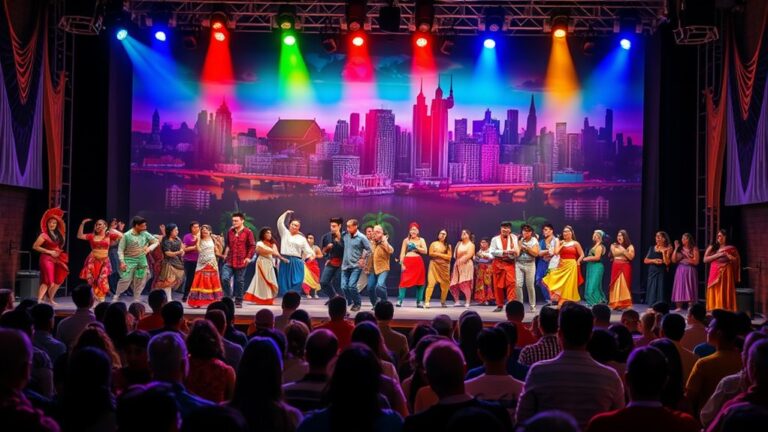
We're about to dive deeper into the world of Mean Girls on Broadway, where the flashy pink facade hides complex teenage struggles, social hierarchies, and uplifting female friendships. Beneath the catchy tunes and candy-colored outfits, characters like Cady, Regina, and Gretchen confront relatable vulnerabilities and insecurities. The show navigates high school social dynamics, toxic cliques, and the power of female bonds. As we explore the musical, we'll uncover the true meaning behind the Burn Book, the impact of The Plastics' influence, and Cady's journey to self-discovery. There's more to uncover – let's get beyond the pink hued facade together.
Beyond the Pink Hued Facade
As we uncover the layers of the Mean Girls musical, it becomes clear that beneath the sugary sweet, pink-hued facade lies a complex web of social hierarchies, cliques, and power struggles. We're not just talking about high school drama; we're talking about the intricacies of human relationships, where one misstep can send shockwaves throughout the entire social ecosystem.
We're drawn to the Plastics, with their razor-sharp wit and seemingly impenetrable bond. But as we explore further, we realize that even within this tight-knit group, there are fault lines waiting to be exploited. Regina George's grip on power is tenuous at best, and Cady's arrival sets off a chain reaction of events that exposes the fragility of their carefully constructed hierarchy.
We see ourselves in these characters, in their struggles to fit in, to stand out, and to survive in a world where social status is everything. We recognize the desperation to belong, to be seen, and to be heard. And as we watch these characters navigate the treacherous landscape of high school, we're forced to confront our own insecurities, our own fears of rejection and abandonment.
The Mean Girls musical may masquerade as a fluffy, feel-good romp, but beneath the surface lies a rich tapestry of human experience. As we uncover the layers, we find a world that's both familiar and unsettling, a world that challenges us to confront our own vulnerabilities and biases.
Unpacking Teenage Angst on Stage
As we explore the world of teenage angst on stage, we’re drawn to the rebellious spirit of those who refuse to conform. We’re about to unravel the complexities of teen drama, where high school hierarchies and social pressures take center stage. By examining these themes, we’ll uncover the authentic, angsty experiences that make this musical so relatable. Through raw emotion and heartfelt performances, this production captures the essence of youthful defiance and self-discovery. Much like Naked Boys Singing Musical, which embraces bold storytelling and uninhibited expression, this show challenges societal norms while celebrating individuality. By immersing ourselves in these narratives, we gain a deeper understanding of the struggles and triumphs that define adolescence.
Rebel Heartbeats Unite
We're drawn to Cady, Regina, and Gretchen's relatable struggles, which serve as a mirror to our own teenage experiences, reminding us that even the 'popular' kids grapple with self-doubt and uncertainty. Their stories resonate deeply, and we can't help but reflect on our own high school days, when social hierarchies and cliques seemed to define our identities. As we watch these characters navigate the treacherous landscape of adolescence, we're reminded that we're not alone in our struggles.
Some of the most poignant moments in Mean Girls come when the characters let their guard down and reveal their true selves. These moments of vulnerability are what make the show so relatable and impactful. For instance:
- When Cady's insecurities about her identity come to the forefront, we're forced to confront our own self-doubt.
- When Regina's facade begins to crack, we're reminded that even the most confident among us struggle with uncertainty.
- When Gretchen's desperation for acceptance is laid bare, we're struck by the desperation that lies beneath our own social masks.
- When Janis's quiet strength inspires us to stand up for ourselves, we're reminded of the power of self-acceptance.
Teen Drama Unraveled
By witnessing these characters' struggles, we're propelled onto a stage where teenage angst unfolds, and the complexities of high school relationships are laid bare. We're not just watching a show; we're reliving our own memories of awkward hallway encounters, crushes, and cafeteria dramas. The characters' insecurities, desires, and fears become our own, and we're forced to confront the messy, emotional landscape of adolescence.
As we immerse ourselves in the world of Mean Girls, we're reminded that high school can be a minefield of social hierarchies, cliques, and unspoken rules. The Plastics, with their razor-sharp wit and precision-crafted insults, embody the toxic side of teenage social politics. But beneath the glossy surface, we find vulnerability, insecurity, and a desperate quest for validation. We see ourselves in Janis's rebellious spirit, Cady's wide-eyed innocence, and Regina's fragile ego. Their struggles become our own, and we're compelled to confront the raw, unfiltered emotions we thought we'd left behind.
Angst in High Heels
Slipping into the high heels of Mean Girls' characters, we're thrown into a world where teenage angst is served up with a side of sass and style. As we explore deeper into the lives of Cady, Regina, and Janis, we're met with a rollercoaster of emotions that's all too relatable. We've all been there – maneuvering through the treacherous halls of high school, trying to fit in, and dealing with the drama that comes with it.
But what makes Mean Girls so iconic is its ability to tap into that angst, to articulate the feelings we couldn't quite express as teenagers. It's a show that's equal parts humorous and heartbreaking, a true reflection of the ups and downs of adolescence.
Some of the most poignant moments in the show include:
** Cady's struggle to find her identity in a new environment
**Regina's vulnerability beneath her queen bee facade
- Janis's quiet strength in the face of adversity
- The Plastics' toxic friendship dynamics that are all too familiar
Social Hierarchy in Action
One glance at the Reginald Davenport High School cafeteria during lunchtime reveals a social hierarchy in action. We're not just talking about the usual cliques, either. No, this is a finely tuned ecosystem, with each group staking its claim on a specific table or corner. The Plastics, led by Regina George, occupy the central table, effortlessly exuding confidence and popularity. They're the ones who dictate the trends, from fashion to music to who's in and who's out.
We're drawn to their table, mesmerized by their poise and charm. But if we're being honest, we're also intimidated. Who wouldn't want to be part of the "in crowd"? Yet, as we observe the cafeteria dynamics, we notice the subtle yet significant power struggles. The Burn Book, a notorious gossip journal, serves as a tool for social manipulation, where rumors and secrets are used to maintain the hierarchy. It's a delicate balance of power, where one misstep can lead to social suicide.
As we navigate this complex web, we're forced to confront our own insecurities and desires. Do we crave acceptance and popularity, or do we dare to challenge the status quo? The social hierarchy in action is a constant reminder that high school is a microcosm of the real world, where social politics and relationships shape our experiences. We're left wondering: where do we fit in, and at what cost?
The Power of Female Friendship
As we navigate the complex social hierarchy of North Shore High School, we're reminded that even the most powerful cliques, like the Plastics, are built on a foundation of female friendship. At its core, Mean Girls is a story about the bonds between women – the ways we support, uplift, and sometimes tear each other down.
In the midst of all the drama and catty conflicts, it's easy to overlook the deep connections that exist between the female characters. But these relationships are the lifeblood of the show, providing a sense of belonging and identity for the characters.
** We see it in the way Regina George rules the Plastics with an iron fist, but also in the way she relies on Gretchen and Karen for emotional support.
**We see it in the way Cady, a newcomer, is drawn into the fold and becomes an integral part of the group.
- We see it in the way Janis, an outcast, forms an unlikely bond with Cady, and together they plot to take down Regina.
- We see it in the way the female characters, despite their differences, come together to support each other in times of need.
Through these relationships, Mean Girls shines a light on the power of female friendship – its ability to uplift, empower, and transform. So, let's not be fooled by the pink and the petty drama; at its heart, Mean Girls is a celebration of women supporting women, and that's something to be cherished.
Cady's Journey to Self Discovery
As we explore Cady's journey to self-discovery, we're struck by her struggles to find her place in a new world. We see ourselves in her quest to figure out who she is, beyond her relationships and circumstances. As we follow her path, we're forced to ask: what does it mean to be true to ourselves, and how do we get there?
Finding Her Identity
We observe Cady's transformation from a wide-eyed outsider to a confident individual as she navigates the complexities of high school and wrestles with her own identity. As we explore further into her journey, we realize that Cady's struggle to find her identity is a relatable and authentic portrayal of adolescent angst.
Through her experiences, we're reminded that self-discovery is a messy and ongoing process. We see Cady trying on different personas, from the 'mathlete' to the 'Plastic,' as she attempts to fit in and find her place. Along the way, she confronts the harsh realities of high school social politics, mean girls, and the pressures of conformity.
- We witness Cady's initial naivety and innocence as she's swept up in the 'Plastics'' world.
- We see her struggle to reconcile her old self with her new persona.
- We feel her frustration as she's torn between her loyalty to her friends and her desire to fit in.
- We empathize with her as she grapples with the consequences of her choices.
Embracing Her True Self
Through a tumultuous exploration of high school's treacherous social landscape, Cady ultimately discovers that embracing her true self requires letting go of the need for external validation. We've all been there – trying to fit in, seeking approval from our peers, and molding ourselves to fit someone else's mold. But Cady learns that conforming to the norms of the "Plastics" or any other clique isn't the key to happiness. As she navigates the complexities of adolescence, she comes to realize that true freedom lies in embracing her quirks, flaws, and all.
We see ourselves in Cady's journey, don't we? We've all struggled to find our place in the world, to figure out who we are and where we belong. And in that struggle, we often lose sight of what truly matters – our own authenticity. Cady's story is a powerful reminder that embracing our true selves, imperfections and all, is the greatest act of self-love we can give ourselves. By letting go of the need for external validation, we can finally be free to be ourselves, unapologetically and unconditionally.
The Plastics' Toxic Influence
Regina George's clique, The Plastics, exert a toxic influence over North Shore High School, warping the social hierarchy and manipulating their peers with calculated cruelty. We can't help but feel drawn to their glamour and charisma, but beneath the surface lies a sinister web of manipulation and control. As we explore further into the world of Mean Girls, it becomes clear that The Plastics' influence is far more insidious than we initially thought.
- They dictate the trends and norms, forcing their peers to conform to their standards of beauty and behavior.
- They use their charm and wit to lure in vulnerable outsiders, only to discard them when they're no longer useful.
- They manipulate and gaslight their friends, making them question their own sanity and self-worth.
- They perpetuate a culture of gossip, rumor-mongering, and sabotage, tearing down anyone who dares to challenge their status quo.
As we observe The Plastics in action, we can't help but feel a sense of unease. Their toxic influence seeps into every corner of North Shore High, poisoning the social atmosphere and turning students against each other. We may be tempted to laugh at their antics, but deep down, we understand that their behavior is far from funny. It's time to take a closer look at the real damage The Plastics are causing, and to ask ourselves: what's the true cost of their reign of terror?
Unraveling the Burn Book Mystery
Exploring the Burn Book's mysterious pages, we're faced with a labyrinth of secrets, scandals, and sabotaged reputations. As we dive deeper, we realize that this book is more than just a repository of gossip and rumors – it's a tool of control, wielded by the Plastics to manipulate and dominate their peers. We can't help but wonder, what drives these mean girls to create such a sinister artifact?
As we browse through the Burn Book's pages, we're struck by the sheer cruelty and malice that oozes from every scribbled note and crass cartoon. It's clear that the Burn Book is more than just a mean-spirited prank – it's a calculated attempt to destroy reputations and crush spirits. We're left wondering, what kind of person would take pleasure in causing such pain and humiliation?
Yet, as we continue to unravel the mystery of the Burn Book, we begin to uncover a more complex narrative. We see glimpses of insecurity, of desperation, of a deep-seated need for validation and control. The Burn Book is more than just a tool of cruelty – it's a reflection of the darkness that lurks within us all. And as we gaze deeper into its pages, we're forced to confront the uncomfortable truth: we're all capable of mean-spiritedness, and it's only by acknowledging this darkness that we can begin to heal and move forward.
Empowerment Through Song and Dance
As we shift from the dark world of the Burn Book to the vibrant domain of song and dance, we find ourselves tapping our feet to the rhythm of empowerment. The music and choreography in Mean Girls the musical are more than just entertaining – they're a powerful tool for self-expression and confidence. We see this in the way the Plastics, led by Regina George, use song and dance to assert their dominance and control over the school. But we also see it in the way the outcasts, like Janis and Damian, use music to express their individuality and reject the status quo.
Through song and dance, the characters in Mean Girls are able to tap into their emotions and find their own unique voice. We see this in numbers like "Meet the Plastics" and "Fearless", where the characters use music to assert their identities and claim their space. We also see it in the way the ensemble comes together to celebrate their differences and individuality.
Some notable examples of empowerment through song and dance in Mean Girls include:
** "Meet the Plastics", where the Plastics assert their dominance and confidence through a catchy and upbeat number.
**"Fearless", where Janis finds her voice and stands up to Regina George.
- "Someone Gets Hurt", where the characters process their emotions and come together in a powerful display of unity.
- "I'd Rather Be Me", where Janis celebrates her individuality and rejects the pressure to conform.
Frequently Asked Questions
How Did the Broadway Show Adapt the Movie's Iconic Fashion?
As we explore the world of self-discovery, we find ourselves pondering the transformative power of fashion. In the Broadway adaptation, the iconic styles of the movie are reimagined with a fresh twist. We see the Plastics' signature pink ensembles reinterpreted with a modern flair, blending nostalgia with contemporary chic. The costume designers cleverly weave in nods to the original, while still making the looks feel fresh and youthful, much like the characters themselves.
Are the Stage Actors the Same Age as Their Characters?
We're curious about the ages of the stage actors playing the iconic mean girls. Honestly, it's hard to believe they're still in high school, right? As it turns out, the actors are mostly in their early to mid-twenties, which isn't a huge age gap, but still notable. We're impressed by their ability to channel their inner teenagers, bringing the characters to life with such authenticity. It's a proof of their talent!
Can I Attend the Show if I'm Under 13 Years Old?
We remember when our little cousin tried to sneak into a PG-13 movie – let's just say it didn't end well! Similarly, we've got to advise you that Mean Girls on Broadway has a minimum age requirement of 13 years old. It's not that we don't love young fans, but the show's themes and language might not be suitable for under-13s. So, sorry kiddo, but you'll have to wait a bit before getting your "Jingle Bell Rock" on with Cady and the Plastics!
Are There Any Trigger Warnings for Sensitive Audiences?
We totally get it – some shows can be overwhelming. To give you a heads-up, Mean Girls on Broadway does tackle mature themes, strong language, and some suggestive content. If you're easily triggered by bullying, body shaming, or sexual harassment, you might want to exercise caution. We're not saying it's not fun, but we want to make sure you're prepared.
Can I Take Pictures or Record During the Performance?
We're excited to capture memories of our night out, but sadly, no, we can't take pictures or record during the performance. It's a policy to preserve the magic and respect the performers. We get it, it's tempting, but let's just be present and enjoy the show! Our phones will be happy to stay in our pockets, and we'll have plenty of time for selfies outside the theater.
About the Author