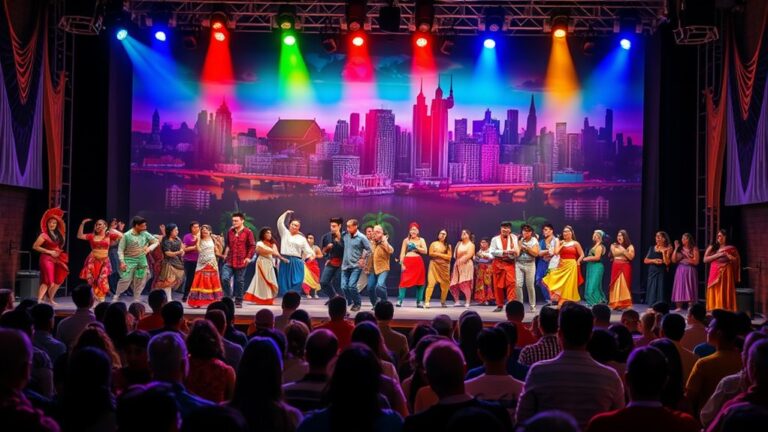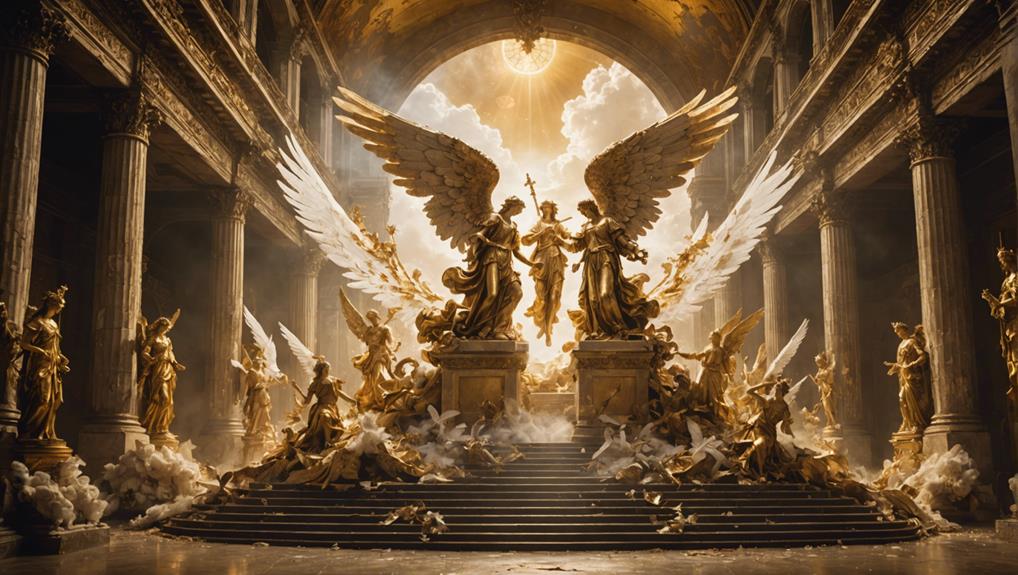
As we take our seats for the Broadway revival of Angels in America, we're transported to the tumultuous 1980s era of upheaval and change. Tony Kushner's poetic script paints vivid pictures, blending the fantastical with the mundane. The production tackles the AIDS crisis head-on, unflinchingly portraying the devastating human toll and refusing to shy away from brutal realities. With its unapologetic humor, complex characters, and nuanced exploration of identity, this masterpiece still resonates profoundly today. Want to know what makes this revival truly soar?
A Masterclass in Storytelling
As we settled into our seats, the lights dimmed, and the curtain rose on a sweeping epic that would prove to be a masterclass in storytelling, with Tony Kushner's poetic script painting vivid pictures in our minds. We were immediately transported to the 1980s, a time of great upheaval and social change. Kushner's masterful script weaved a complex tapestry of characters, each with their own rich backstory and motivation.
As we delved deeper into the world of Angels in America, we were struck by the way Kushner's writing effortlessly blended the fantastical with the mundane. The characters' struggles, desires, and fears were expertly woven into the fabric of the narrative, creating a sense of depth and emotional resonance that resonated deeply with us. The script's poetic language was both beautiful and brutal, conjuring up images that lingered long after the curtain call.
Throughout the performance, we found ourselves completely absorbed in the world of the play. Kushner's masterful storytelling had us laughing, crying, and reflecting on the human condition. It was clear that every element of the production – from the set design to the performances – was meticulously crafted to bring this epic tale to life. As we left the theater, we couldn't help but feel that we had experienced something truly special – a testament to the power of great storytelling to move, inspire, and transform us.
Unflinching Portrayal of AIDS Crisis
As we reflect on the revival of Angels in America, we're struck by its unflinching portrayal of the AIDS crisis. We're compelled to acknowledge the play's courage in shattering the silence surrounding this devastating epidemic, and we're moved by its heart-wrenching depiction of the human toll. By tackling this painful chapter in American history, the play gives voice to those who suffered in silence.
Shattering Silence Around AIDS
Twenty-five years after its premiere, Angels in America still boldly tackles the AIDS crisis, unflinchingly portraying the devastating consequences of a nation's silence and inaction. We're struck by the play's unwavering commitment to confronting the darkest aspects of the epidemic. By refusing to shy away from the brutal realities of AIDS, Tony Kushner's masterpiece shatters the silence that once surrounded the disease. We're forced to confront the pain, fear, and discrimination that defined an era. The revival's unflinching portrayal of the crisis is a tribute to the power of art to spark necessary conversations. As we watch, we're reminded of the lives lost, the families torn apart, and the communities ravaged by the disease. The silence that once enabled the crisis to spread is replaced by a chorus of voices demanding justice, compassion, and action. In this revival, we're witness to a powerful indictment of a nation's failures and a celebration of the resilience of the human spirit.
Devastating Human Toll
Through its unvarnished depiction of the AIDS crisis, this revival lays bare the devastating human toll of the epidemic, forcing us to confront the anguish, desperation, and utter despair that ravaged countless lives. We're not just talking about statistics; we're talking about real people, with families, friends, and loved ones. The show doesn't shy away from the brutal reality of the disease, and it's in these moments that the production truly shines.
| Impact | Reality | Emotional Toll |
|---|---|---|
| Loss of loved ones | Funerals, hospital visits, and endless goodbyes | Unrelenting grief, guilt, and anger |
| Social isolation | Abandonment, rejection, and ostracism | Crushing loneliness, shame, and fear |
| Stigma and shame | Discrimination, prejudice, and silence | Internalized shame, self-blame, and despair |
As we're immersed in this world, we're forced to confront our own mortality, and the fragility of life. The show's unflinching portrayal of the AIDS crisis is a powerful reminder of the devastating human toll of the epidemic, and the importance of empathy, compassion, and understanding.
Unflinching Dramatic Portrayal
We're witnessing a theatrical gut-punch with this revival's unflinching dramatic portrayal of the AIDS crisis, which refuses to sanitize the brutal realities of the disease. This isn't a sugarcoated, feel-good production; it's a raw, emotional wallop that leaves us reeling. The playwright's words are given new life by the talented cast, who bring a sense of urgency and desperation to their performances. We're not spared the graphic details of the disease's ravages on the human body, nor are we shielded from the crushing despair that comes with diagnosis. It's a reflection of the production's bravery that we're forced to confront the darkest aspects of human suffering. Yet, even in the midst of such devastation, there's a glimmer of hope – a sense that, no matter how bleak things seem, there's always a way to find solace in the human connection. It's a powerful, unflinching portrayal that will leave us changed forever.
Reagan-Era Politics Take Center Stage
As we reflect on the Broadway revival of Angels in America, we're struck by how the play's portrayal of Reagan-era politics still resonates today. We see how Reagan's right-wing agenda, rooted in fear and intolerance, paved the way for the devastating handling of the AIDS crisis. By shedding light on the dark underbelly of power and corruption, the play reveals the far-reaching consequences of political ideologies that prioritize ideology over humanity.
Reagan's Right-Wing Agenda
During the Reagan era, his right-wing agenda loomed large, permeating every aspect of American life, including the gay community, which was already reeling from the AIDS epidemic. We remember the fear, the uncertainty, and the feeling of being abandoned by our government. It was as if our lives didn't matter, that we were disposable. The Reagan administration's inaction and indifference to the AIDS crisis are a dark stain on our nation's history.
We see echoes of this era in the revival of Angels in America, where the characters struggle to survive in a world that seems determined to erase them. The play's portrayal of the AIDS epidemic is a powerful reminder of the human cost of political ideology.
Here are just a few ways Reagan's right-wing agenda affected the gay community:
- Silence equals death: The Reagan administration's refusal to acknowledge the AIDS epidemic until 1987, six years into the crisis, is a stark reminder of the deadly consequences of political ideology.
- Lack of funding: The administration's reluctance to provide adequate funding for AIDS research and treatment only exacerbated the crisis.
- Stigma and shame: The Reagan era's emphasis on traditional values and morality further stigmatized the gay community, making it harder for people to come out and seek help.
Fear of the Unknown
Fear permeates every scene of Angels in America, as the characters' struggles to survive in a world that seems determined to erase them mirror the fear we felt during the Reagan era, when the government's inaction and indifference to the AIDS crisis made us feel like we were living on borrowed time. It's impossible not to sense a feeling of dread as we watch Prior Walter, a young gay man, grapple with his diagnosis, and Roy Cohn, a ruthless lawyer, revel in his own brand of toxic masculinity. The uncertainty of their futures is palpable, and it's a sensation with which we are intimately familiar. We've been there, wondering if we'd make it through the night, the week, the month. The fear of the unknown is a constant companion, lurking in every shadow, haunting every conversation. It's a feeling that's hard to shake, even now, all these years later. But in this revival, we're reminded that even in the darkest of times, there's beauty to be found, and that's what makes Angels in America so unforgettable.
Power and Corruption
We find ourselves entangled in a web of deceit and corruption, where the Reagan-era politics of greed, homophobia, and moral hypocrisy take center stage. The politics of the time are a perfect storm of corruption, where those in power prioritize their own interests over the well-being of the people. It's a world where the privileged few reap the benefits, while the marginalized are left to suffer.
As we explore further into the world of Angels in America, we're forced to confront the harsh realities of the time. We see how the corrupt systems in place perpetuate inequality and injustice. We're reminded that:
- Power corrupts, and those who wield it often prioritize their own interests over the greater good.
- Fear and ignorance are used to control and manipulate the masses.
- Silence is complicity, and those who remain silent in the face of injustice are just as guilty as the perpetrators.
In this revival, we're not just watching a play – we're holding up a mirror to the darkest aspects of our own society. We're forced to confront the uncomfortable truths about ourselves and the world we live in.
Identity Crisis in the 80s
As we navigated the tumultuous landscape of 1980s America, our sense of self was constantly being reshaped by the clashing ideologies of the era. We were caught between the conservative backlash of the Reagan administration and the progressive ideals of the counterculture movement. It was an era of contradictions, where the rise of neoliberalism and the AIDS epidemic created a sense of uncertainty and confusion.
We struggled to define ourselves amidst the chaos, torn between the desire for social change and the comfort of traditional values. The gay community, in particular, faced an identity crisis as they fought for visibility and acceptance in the face of adversity. The characters in Angels in America embody this struggle, as they grapple with their own identities and sense of belonging.
Roy Cohn, the ruthless lawyer, is a symbol of the toxic masculinity that dominated the era, while Prior Walter, the gay man living with AIDS, represents the marginalized and oppressed. Their stories, intertwined with those of other characters, paint a vivid picture of the 1980s identity crisis. We see ourselves in their struggles, their fears, and their desires. The play becomes a reflection of our own search for identity, a reminder that our sense of self is constantly evolving in response to the world around us.
The Power of Kushner's Script
As we explore the power of Kushner's script, we're struck by the way his poetic language weaves together the complexities of American identity with the urgent need for queer representation. We're drawn to how Kushner's words capture the essence of a nation in crisis, grappling with its own demons. Through his script, we're forced to confront the harsh realities of the 80s, and the struggles that still resonate today.
Kushner's Poetic Language
Tony Kushner's masterful script wields a poetic language that conjures vivid imagery, rendering the fantastical and the mundane equally believable. We're swept away by the lyrical prose, which effortlessly weaves together the surreal and the everyday. Kushner's language is both whimsical and grounded, making the impossible seem possible.
But what makes Kushner's poetic language so effective? Here are a few reasons why:
- Imagery-rich descriptions: Kushner's script is filled with evocative descriptions that transport us to another world. His use of sensory details is masterful, making us feel like we're right there with the characters.
- Musicality of language: Kushner's dialogue has a musical quality, with a rhythm and cadence that's both poetic and natural. It's a joy to listen to, and the actors bring it to life beautifully.
- Emotional resonance: Kushner's language is infused with a deep emotional resonance, making us feel the characters' pain, joy, and despair. It's a truly immersive experience.
Kushner's poetic language is a key element of what makes Angels in America so unforgettable. It's a true masterpiece of playwriting, and we're grateful to experience it on stage once again.
American Identity Crisis
We find ourselves grappling with the fractured state of the American dream in Angels in America, where Kushner's script masterfully dissects the nation's identity crisis. As we explore the world of Roy Cohn, Joe Pitt, and Harper, we're compelled to confront the darker aspects of our collective psyche. Kushner's script is a mirror held up to the nation's soul, revealing the cracks and fissures that threaten to shatter the illusion of American exceptionalism.
Through the characters' struggles, we see reflections of our own anxieties, our own disillusionments. We're reminded that the American dream is a myth, a construct built on shaky ground. Kushner's script strips away the veneer of patriotism, revealing the rot of racism, sexism, and xenophobia that's always lurked beneath the surface.
As we navigate the complexities of Angels in America, we're compelled to confront our own complicity in the nation's identity crisis. We're asked to ponder the consequences of our actions, the costs of our silence, and the toll of our indifference. Kushner's script is a clarion call to acknowledge the fractures, to confront the darkness, and to begin the difficult work of healing.
Queer Representation Matters
Harnessing the power of queer representation, Kushner's script revolutionizes the theatrical landscape by crafting complex, multidimensional characters that shatter stereotypes and reclaim narratives. We're drawn to the authenticity of these characters, who embody the messy, beautiful complexity of queer lives. Kushner's refusal to simplify or tokenize his characters is a demonstration of the power of representation.
Here are just a few ways Kushner's script gets it right:
- No tokenization: Kushner's characters aren't reduced to their sexuality or gender identity. They're multifaceted, with desires, fears, and motivations that drive the plot forward.
- Intersectionality: The script acknowledges the intersections of race, class, and sexuality, highlighting the unique experiences of queer people of color and those living with HIV/AIDS.
- No stereotypes: Kushner's characters defy tropes and stereotypes, instead embracing the complexity and diversity of queer experiences.
Unforgettable Performances Shine
With its talented cast, this revival of Angels in America brings to life the complex, multifaceted characters that make this play so unforgettable. We're blown away by the performances that transport us to a world of love, loss, and identity. The entire cast shines, but some standouts deserve special mention.
| Actor | Character |
|---|---|
| Andrew Garfield | Prior Walter |
| Nathan Lane | Roy Cohn |
| Denise Gough | Harper Pitt |
| Lee Pace | Joe Pitt |
Andrew Garfield's Prior Walter is a showcase in vulnerability, conveying the pain and fear of living with AIDS in the 1980s. Nathan Lane's Roy Cohn is a tour-de-force of charisma and menace, bringing depth to a character that could've easily been one-dimensional. Denise Gough's Harper Pitt is a revelation, capturing the fragility and desperation of a woman trapped in a loveless marriage. And Lee Pace's Joe Pitt is a perfect blend of awkwardness and charm, making his character's struggles with identity all the more relatable.
Each performance is a tribute to the power of this play, which weaves together themes of identity, community, and resilience. As we watch these characters navigate the complexities of their lives, we're reminded of the importance of empathy and compassion. The entire cast comes together to create a truly unforgettable experience, one that will stay with us long after the curtain call.
Set Design Transcends Expectations
The set design of this revival is a masterclass in evocative storytelling, transporting us to the tumultuous world of 1980s New York City. We're swept away by the clever use of minimalistic sets, cleverly crafted to evoke the sense of chaos and disorder that defined the era. The attention to detail is stunning, from the worn, vintage hospital equipment to the faded, graffiti-covered city streets.
What truly impresses, however, is the way the set design seamlessly weaves together the fantastical and the real. The Angel's ethereal domain is conjured with an otherworldly elegance, while the gritty realism of the characters' everyday lives is rendered with a stark, unflinching honesty.
Here are just a few ways the set design elevates the production:
- Layered storytelling: The set's clever use of multiple levels and compartments allows for a rich, layered storytelling that mirrors the play's complex themes and characters.
- Atmospheric immersion: The set's meticulous attention to detail creates an immersive atmosphere that draws us in, refusing to let go.
- Emotional resonance: The set's thoughtful design amplifies the emotional impact of the characters' journeys, making their struggles and triumphs all the more poignant.
As we take in the breathtaking vistas and intimate, claustrophobic spaces, we're struck by the set design's profound influence on our emotional connection to the story. It's a true masterclass in evocative storytelling.
A True Theatrical Experience
As we're enveloped by the set design's masterful storytelling, we're primed for a theatrical experience that will leave an indelible mark on our senses. The revival of Angels in America is a visceral, immersive experience that envelops us in its world, refusing to let go. We're not just passive observers; we're active participants, drawn into the swirling vortex of emotions, ideas, and imagery.
The staging is a masterclass in evocative storytelling, conjuring the fantastical and the mundane with equal ease. We're transported to a world of angels, demons, and mortal men, where the boundaries between reality and fantasy blur and dissolve. The actors' performances are raw and unflinching, laying bare their characters' deepest fears and desires. We're confronted with the darkest aspects of human nature, and yet, we're also offered glimmers of hope and redemption.
Throughout the performance, we're constantly reminded that theater can be a transcendent, life-changing experience. It's a tribute to the power of live performance to move, to provoke, and to inspire. We're not just watching a play; we're living it, breathing it, and feeling it in our very bones. This revival of Angels in America is a true theatrical experience, one that will haunt us long after the curtain falls.
Unapologetic and Unrelenting Humor
Throughout the performance, we're struck by the playwright's fearless use of humor, which slices through the darkness with a sharp, unapologetic wit that leaves us laughing, often uncomfortably, at the most inopportune moments. This unrelenting humor is a hallmark of Tony Kushner's masterpiece, and it's a confirmation to the production's bravery that it never shies away from the uncomfortable or the absurd.
The humor is a cleverly crafted mechanism that not only provides comic relief but also serves as a scathing commentary on the era's politics and social norms. It's a humor that's both irreverent and incisive, never afraid to tackle the taboo or the uncomfortable.
Here are a few examples of how this humor manifests:
- The biting satire of Reagan-era politics, which is both laugh-out-loud funny and eerily prescient.
- The campy, over-the-top antics of the Angel, which serve as a clever commentary on the excesses of 1980s culture.
- The wickedly funny portrayals of characters like Roy Cohn, which are both hilarious and terrifying in their accuracy.
This unapologetic humor is a key part of what makes Angels in America so groundbreaking, and it's a validation why this revival is such a triumph. It's a true masterclass in how to balance humor and heart, and it's a major reason why this production will linger in our minds long after the curtain falls.
Themes of Identity and Belonging
We're struck by how Kushner's humor gives way to an even more profound exploration of identity and belonging, one that penetrates the soul of America's psyche. As we immerse ourselves deeper into the world of Angels in America, we find ourselves confronted with the most fundamental questions: Who am I? Where do I belong? These are the questions that Kushner poses, and it's astonishing how relatable they still feel today. We see ourselves in Prior Walter's struggle to reconcile his gay identity with his Jewish heritage, in Belize's quest to find a sense of community amidst the chaos of the AIDS epidemic, and in Harper's desperate search for meaning in a world that seems to be falling apart.
What's remarkable about Kushner's exploration of identity and belonging is how it refuses to offer easy answers. Instead, he presents us with a kaleidoscope of characters, each with their own unique struggles and triumphs. We're forced to confront our own biases and prejudices, to question our assumptions about what it means to be American, to be human. It's a profoundly uncomfortable experience, but also a deeply necessary one. As we watch these characters navigate the complexities of identity and belonging, we're reminded that these are questions that have no easy answers – but that's what makes them so worth exploring.
A Timeless Masterpiece Reborn
The revival of Angels in America on Broadway is a tribute to the enduring power of Kushner’s masterpiece, its themes and characters remaining remarkably relevant in today’s America. We’re reminded that the struggles we face today – the struggle for identity, the search for belonging, and the fight for justice – are not new, but rather a continuation of the struggles of the past. This revival is a powerful validation of the timelessness of Kushner’s work, and we’re grateful to experience it anew. The production’s stellar cast brings fresh energy to the play, making its emotional depth even more resonant for contemporary audiences. Seeing such complex and deeply human stories unfold on stage reminds us why theater remains a vital force for reflection and change. Much like past iconic performances by laura linney and cynthia nixon, this revival features actors who breathe new life into Kushner’s unforgettable characters, ensuring their struggles and triumphs continue to inspire.
As we sit in the audience, we're struck by the ways in which this play speaks to our current moment. We see ourselves in the characters, in their fears and desires, in their struggles and triumphs. We're compelled to confront the harsh realities of our world, and to reflect on the ways in which we can work towards a better future.
Here are just a few reasons why Angels in America remains a masterpiece:
- Universal themes: The play's exploration of identity, community, and morality continues to resonate deeply with audiences today.
- Timeless characters: The characters in Angels in America are complex, multifaceted, and relatable, making them feel both familiar and new.
- Prophetic vision: Kushner's play is a powerful warning, a call to action, and a beacon of hope for a better future.
As we watch this stunning revival, we're reminded of the power of art to transform and uplift us. We're grateful for this rebirth of Angels in America, and we can't wait to see how it will continue to inspire and challenge us in the years to come.
Frequently Asked Questions
Is Angels in America a Play or a Musical?
We're still reeling from the sheer scope of Tony Kushner's masterpiece! Is Angels in America a play or a musical, you ask? Let's set the record straight: it's a play, a sweeping, epic play that defies categorization. With its poetic language, fantastical elements, and unflinching exploration of the human condition, this play is an experience that will leave you breathless and yearning for more.
How Many Acts Does the Angels in America Revival Have?
We're intrigued by the structure of Angels in America, and rightly so! As we explore the revival, we find that it's divided into two parts: Millennium Approaches and Perestroika. Each part has multiple acts, with Millennium Approaches consisting of three acts and Perestroika comprising four acts. So, in total, the revival has seven acts that take us on an emotional journey of love, loss, and self-discovery.
Is the Play Suitable for All Ages or Mature Audiences Only?
As we explore the world of Tony Kushner's masterpiece, we're faced with the question: is this play suitable for all ages? We'd say, not quite. The themes of identity, morality, and mortality are woven with threads of complexity, making it more suitable for mature audiences. Think of it as a rich tapestry, where only those with a certain level of emotional maturity can truly appreciate its intricate beauty.
How Long Does the Angels in America Revival Performance Last?
"We're wondering how long we'll be sitting in those seats, and honestly, it's worth every minute. The Angels in America revival performance lasts around 7 hours and 30 minutes, including two 10-minute breaks and a 75-minute dinner break. Yes, it's a commitment, but trust us, the epic storytelling and phenomenal acting will keep us engaged and curious till the very end."
Is the Revival a Direct Adaptation of the Original 1993 Play?
We're curious about the revival's faithfulness to the original, so let's explore further! The 2022 revival is not a direct adaptation of the 1993 play. While it stays true to Tony Kushner's iconic script, the creative team made some tweaks to modernize the storytelling. They've updated the setting, added new music, and incorporated fresh perspectives, making this revival a reimagined masterpiece that still honors the spirit of the original.
About the Author