
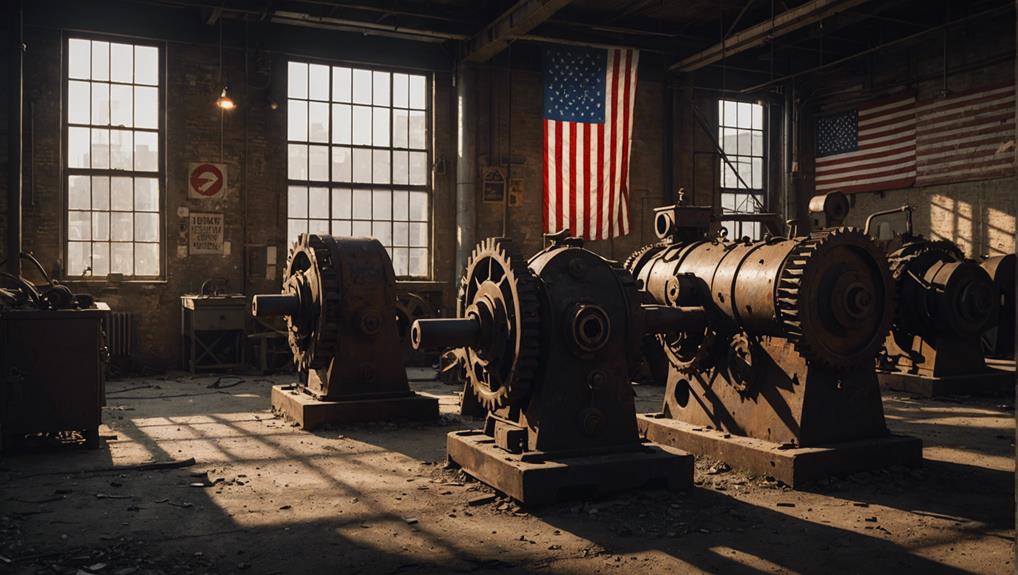
In Lynn Nottage's Sweat, you're transported to the once-thriving factory towns of Pennsylvania's Rust Belt, where the crumbling factories and shattered dreams of the American Dream are mirrored in the desperate lives of its residents. You'll witness how racial tensions simmer on the factory floor, fueled by biases and stereotypes. As you explore the lives of these factory workers, you'll see how their fears and frustrations are woven into the fabric of their relationships. The unraveling of the American Dream is palpable, and as you continue, you'll uncover the intimate struggles and emotions that will leave you questioning the very fabric of the American identity.
Crumbling Factory Towns and Dreams
As you explore the streets of Reading, Pennsylvania, the once-thriving factory town's decay and neglect are palpable, a stark contrast to the American Dream that was promised to its working-class residents. The streets, lined with abandoned factories and shuttered storefronts, whisper tales of a bygone era when industry thrived and jobs were plentiful. Now, the silence is deafening, and the only remnants of that era are the crumbling buildings, a proof of the industrial decay that has ravaged the town.
You can't help but feel the weight of forgotten communities, where the American Dream seems like a distant memory. The people of Reading, like many other Rust Belt towns, were promised a life of prosperity and stability, but what they got was a harsh reality check. The factories that once drove the economy have shuttered, leaving behind a trail of desperation and disillusionment.
Lynn Nottage's Sweat brings to life the struggles of these forgotten communities, where the decline of industry has ravaged the social fabric. As you explore the world of Sweat, you're forced to confront the harsh realities of industrial decay and the devastating consequences it has on the people who call these towns home. The play is a poignant reminder that the American Dream is not always within reach, and sometimes, it's the very systems that are meant to uplift that ultimately crush the spirits of those who need it most.
Racial Tensions and Factory Floors
As you explore the world of Lynn Nottage's Sweat, you'll notice the stark racial divisions that permeate the factory floor. You'll see how the once-united workers are now fragmented along ethnic lines, with tensions simmering just below the surface. At shift change, these tensions erupt into confrontations that expose the deep-seated prejudices and biases that threaten to destroy the very fabric of the community.
Workplace Ethnic Divisions
You step onto the factory floor, where the air is thick with tension, and racial divisions between coworkers simmer just below the surface. The hum of machinery and the clanging of metal create a sense of urgency, but it's the unspoken words and sidelong glances that really set the tone. You can't help but notice the cliques that have formed along ethnic lines, each group sticking to their own kind. The cultural clashes are palpable, as if the very fabric of the factory is being torn apart by ethnic stereotypes. You overhear snide comments about "lazy" Mexicans or "arrogant" whites, and you wonder how such deep-seated prejudices can coexist with the daily grind of production. It's clear that the factory floor is a microcosm of the world outside, where racial tensions simmer just below the surface. As you navigate the factory, you're struck by the realization that these divisions aren't just about race – they're about power, privilege, and the struggle for a sense of belonging.
Factory Floor Racism
On the factory floor, racial tensions simmer just below the surface, fueled by stereotypes and biases that permeate every interaction. You can't help but feel it, like a constant hum in the background. It's in the way coworkers glance at each other, in the whispered conversations, and in the unspoken assumptions. You sense it in the way some workers are given more responsibility, while others are relegated to menial tasks.
As you navigate the factory floor, you begin to realize that cultural bias and power dynamics are at play. Here, biases are reinforced by the hierarchical structure of the factory, where those in power often wield it to maintain their status quo.
- Racial slurs are casually tossed around, perpetuating harmful stereotypes.
- Certain workers are given preferential treatment, while others are marginalized.
- microaggressions become a norm, making it difficult for some workers to feel safe.
- The lack of diversity in leadership positions reinforces the existing power dynamics.
Tensions at Shift Change
What's striking about shift changes is how racial tensions seem to escalate, as if the brief downtime between shifts serves as a pressure valve for pent-up frustrations and biases. You can't help but feel the weight of underlying resentments as workers from different racial backgrounds cross paths, exchanging curt greetings or avoiding eye contact altogether. The tension is palpable, and you sense that one misstep could spark a confrontation.
Union conflicts simmer just below the surface, with some workers feeling their concerns are being ignored or dismissed by management. Supervisors, caught in the middle, prioritize maintaining production levels over addressing the growing animosity. As you stand amidst the chaos, you realize that these brief moments between shifts are a microcosm of the larger societal issues plaguing the Rust Belt. The factory floor becomes a battleground, where racial tensions, economic anxieties, and union conflicts collide. You can't help but wonder: what's the breaking point, and who will be left standing when the dust settles?
Lives in Free Fall, Pennsylvania
In the once-thriving factory town of Reading, Pennsylvania, the lives of its residents are in free fall, mirroring the economic decline that has ravaged their community. You can't help but feel the desperation that permeates every aspect of their lives. The small town struggles are palpable, and the sense of hopelessness is overwhelming. The local identities that once defined the town – the factory worker, the union member, the small business owner – are now mere shadows of their former selves.
As you explore further into the lives of these characters, you begin to realize that their struggles are not just about economic survival, but also about maintaining a sense of self-worth. The decline of the factory has not only taken away their livelihoods but also their sense of purpose.
** The streets are lined with shuttered storefronts and abandoned factories, a constant reminder of what's been lost.
**The once-strong community bonds are now frayed and fragile, as people turn against each other in desperation.
- The sounds of laughter and camaraderie have been replaced with the echoes of silence and despair.
- The American Dream, once within reach, now seems like a distant memory, a fleeting mirage on the horizon.
As you walk through the streets of Reading, you can't help but feel a sense of despair wash over you. The lives of its residents are in free fall, and it's hard to see a way out of the downward spiral.
Nottage's Masterful Storytelling Weaves
As you read through Sweat, you'll notice how Nottage's masterful storytelling weaves together character-driven dialogue, everyday life portrayed in stark realism, and emotions intertwined with the characters' struggles. You'll find yourself immersed in the lives of the characters, feeling their pain and frustration as they navigate the decline of their community. By expertly balancing these elements, Nottage creates a narrative that's both poignant and thought-provoking.
Character Driven Dialogue
You're drawn into the world of Reading, Pennsylvania, through Nottage's masterful storytelling, which weaves a rich tapestry of character-driven dialogue that reveals the intricacies of her characters' lives. As you explore further into the world of Sweat, you begin to feel an emotional intimacy with the characters, thanks to Nottage's authentic voices that leap off the page.
Through her dialogue, Nottage masterfully conveys the complexities of human relationships, exposing the raw emotions and vulnerabilities of her characters. You'll find yourself drawn to the authentic voices of the characters, resonating with their struggles and triumphs.
Here are just a few ways Nottage's character-driven dialogue stands out:
- Emotional intimacy: Nottage's dialogue creates a sense of closeness, as if you're eavesdropping on private conversations.
- Authentic voices: Each character's voice is distinct, reflecting their unique experiences and perspectives.
- Subtlety and nuance: Nottage's dialogue is rich in subtext, revealing character traits and relationships through subtle cues.
- Emotional resonance: The dialogue is infused with emotional depth, making the characters' struggles and triumphs feel deeply relatable.
Everyday Life Portrayed
Nottage's masterful storytelling explores a rich tapestry of everyday life in Reading, Pennsylvania, where the mundane routines and struggles of the characters' daily existence unfold with striking realism. As you immerse yourself in the world of Sweat, you're drawn into the domestic struggles of the characters, where the lines between personal and professional life blur. You see the worn-out factory workers, the struggles to make ends meet, and the family dynamics that are both a source of comfort and tension.
The playwright’s attention to detail is remarkable, capturing the intricacies of daily life in a way that feels deeply relatable. You’re invited into the characters’ living rooms, where the air is thick with unspoken emotions and the scent of burnt coffee. You witness the family dynamics that are both a source of strength and a catalyst for conflict. Through Nottage’s masterful storytelling, you’re reminded that the most profound struggles are often the ones we face in our own homes, and that the most heroic acts are the ones we undertake to keep our families afloat. Her ability to weave humor and heartbreak into her narratives makes the stories feel both intimate and universally resonant. As one of the leading voices in contemporary drama, she continues to push boundaries with groundbreaking new theater works that challenge societal norms and amplify underrepresented voices. Through her plays, Nottage not only entertains but also sparks important conversations about resilience, identity, and the complexities of human relationships.
Emotions Intertwined
Through her masterful storytelling, Lynn Nottage intricately weaves a complex web of emotions, where characters' personal struggles and relationships are inextricably linked, influencing one another in profound ways. As you explore the world of Sweat, you'll find yourself ensnared in a delicate dance of emotions, where the characters' inner turmoil is palpable. Nottage's writing is a gentle yet unflinching exploration of the human experience, laying bare the intricate emotional landscapes that shape our lives.
- The characters' emotions are expertly intertwined, creating a rich tapestry of relationships that ebb and flow like the tides.
- You'll find yourself drawn into the intimate world of the factory workers, where the lines between personal and professional blur.
- Nottage's writing is a masterclass in emotional nuance, capturing the subtle shifts in tone and mood that define our inner lives.
- As you navigate the emotional landscape of Sweat, you'll discover that the characters' struggles are, in fact, your own – a poignant reminder that our inner turmoil is never truly solitary.
Fears and Frustrations of Factory Workers
As you investigate the world of Reading, Pennsylvania's factory workers, the overwhelming sense of desperation and disillusionment that permeates their daily lives becomes palpable. You can't help but feel the weight of their fears and frustrations, which stem from the constant threat of layoffs and the erosion of their economic security.
The factory floor, once a symbol of stability and pride, has become a source of anxiety and uncertainty. You sense the dread that grips these workers as they wonder if they'll still have a job tomorrow, or if they'll be the next ones let go. The fear of job insecurity is suffocating, making it difficult for them to plan for the future or make ends meet.
Economic insecurity is a constant companion, as they struggle to make ends meet on dwindling wages and disappearing benefits. The once-reliable factory jobs, which were supposed to provide a comfortable life, have become a source of stress and uncertainty. You can feel the frustration and anger simmering beneath the surface, as these workers feel like they're being left behind in a rapidly changing economy.
As you explore further into their world, you realize that their fears and frustrations are not just about losing their jobs, but about losing their sense of purpose and identity. The factory, once a source of pride and community, has become a symbol of decline and abandonment.
Unraveling of the American Dream
You're witnessing the disintegration of the American Dream, where the promise of hard work leading to upward mobility and a better life is repeatedly broken. The once-thriving factories that fueled the Middle Class are now shuttered, leaving behind a trail of broken dreams and false promises. The workers who toiled for decades, believing that their sweat and sacrifice would be rewarded with a comfortable life, are now left with nothing but uncertainty.
The unraveling of the American Dream is a harsh reality that Lynn Nottage's Sweat so poignantly portrays. You're forced to confront the harsh truth that the system is rigged against the working class, and that the notion of upward mobility is nothing but a myth.
Some harsh realities to consider:
- The false promise of education being the key to success, when in reality, it's just a means to further indebt yourself.
- The illusion of social mobility, where the privileged few get to climb the ladder, while the rest are left in the dust.
- The erosion of the Middle Class, leaving behind a vast chasm between the haves and have-nots.
- The devastating consequences of globalization, where industries are sacrificed at the altar of profit.
As you're immersed in the world of Sweat, you can't help but wonder: what happened to the American Dream? Was it all just a myth, a false promise to keep the masses in line? The questions linger, but one thing is certain – the American Dream is dead, and it's time to confront the reality.
Frequently Asked Questions
What Inspired Lynn Nottage to Write Sweat?
As you explore the world of Lynn Nottage's Sweat, you'll uncover that her inspiration stems from personal experiences and the industrial decay that ravaged her hometown. You'll find that Nottage's own family's struggles, coupled with the decline of the manufacturing industry, sparked her creative flame. Her writing is a tribute to the power of storytelling, weaving a narrative that resonates deeply with those who've witnessed the devastating effects of industrial decay.
Is the Play Sweat Based on Real-Life Events?
As you explore Lynn Nottage's Sweat, you'll uncover it's deeply rooted in real-life events. You'll find echoes of the industrial decline that ravaged factory towns, leaving a trail of broken dreams and shattered lives. Nottage drew inspiration from the struggles of Reading, Pennsylvania, where the once-thriving factories now stand as haunting relics. Her play masterfully weaves these true stories into a powerful narrative that will leave you moved and disturbed.
What Is the Significance of the Title "Sweat"?
You step into the world of Lynn Nottage's Sweat, and the title screams at you – 'Sweat'. It's more than just a word; it's the grime, the toil, and the desperation of factory lives. It's the industrial decay that permeates every aspect of the characters' existence. As you explore further, you realize the title is a tribute to the blood, sweat, and tears shed by the working class, their stories woven into the fabric of this powerful play.
How Does the Play Portray the Decline of the American Dream?
As you explore the play, you'll notice how it portrays the decline of the American Dream. You'll see lost opportunities, a dwindling middle class, and shattered illusions. Forgotten towns, once thriving, now struggle to survive. Economic inequality is starkly evident, leaving you wondering what happened to the land of promise. It's a harsh reality check, forcing you to confront the harsh truth that the American Dream may be nothing more than an unattainable myth.
What Message Does Sweat Convey About Racial Tensions in America?
You're about to explore the threads of racial tensions in America, and Sweat's got a lot to say. Imagine a rusty, worn-out factory, a symbol of the American Dream's decay. As you investigate further, you'll find that Lynn Nottage's play conveys a powerful message: systemic oppression and cultural bias are the toxins that seep into the fabric of our society, perpetuating racial divisions. It's time to confront the harsh realities, and Sweat's unflinching portrayal is the wake-up call you need.
About the Author


