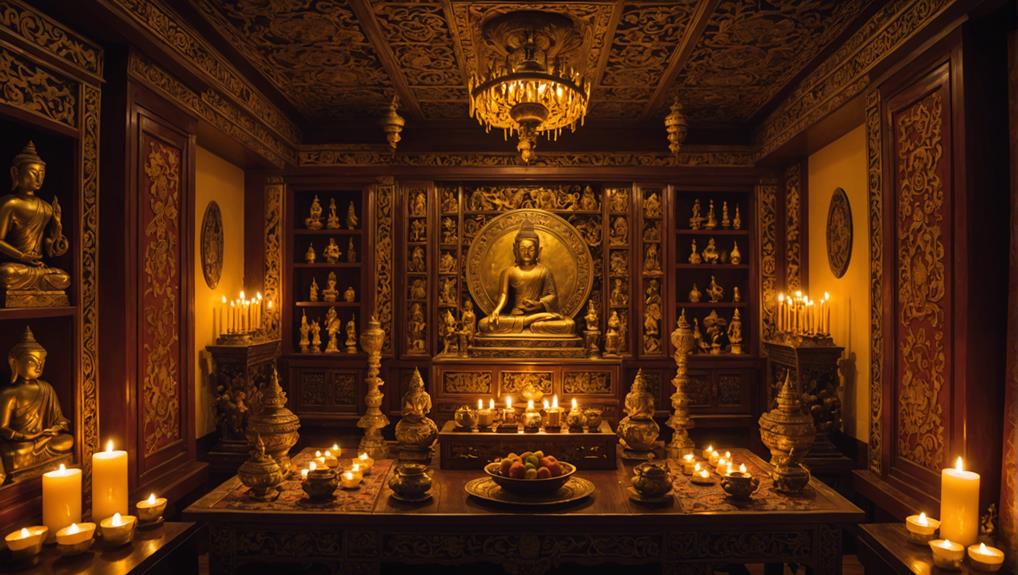
As you enter the Tibetan Buddhist Shrine Room at the Rubin Museum's Sacred Spaces exhibit, you're immersed in a tranquil atmosphere of vibrant colors, intricate details, and sacred geometry. The artistic expressions, from thangkas to sculptures, foster spiritual growth and self-discovery. Ambient lighting, spiritual architecture, and sensory engagement create serenity. You'll discover a culture that integrates art into daily life, where symbolic colors, rituals, and meditation practices converge to promote compassion and wisdom. As you explore further, you'll uncover the rich cultural heritage and philosophy of Tibet, and perhaps, uncover a deeper connection within yourself.
Discovering the Sacred in Art
As you enter the Rubin Museum’s Tibetan Buddhist Shrine Room, you’re immediately struck by the vibrant colors and intricate details of the sacred art that surrounds you. The room is a sensory feast, with intricate thangkas, rich tapestries, and ornate sculptures that transport you to a world of spiritual contemplation. Here, art is not just a form of creative expression but a powerful tool for spiritual growth and self-discovery. The dim lighting and the scent of incense further enhance the immersive experience, creating a serene atmosphere for reflection and meditation. Much like the Brooklyn Museum Arts of Korea exhibit, which showcases the deep spiritual and artistic traditions of Korean culture, the Rubin Museum’s shrine room highlights the profound connection between art and devotion. Every detail in the space is designed to evoke a sense of peace and reverence, inviting visitors to engage deeply with the spiritual traditions on display.
As you wander through the room, you begin to appreciate the artistic expression that permeates every aspect of Tibetan Buddhist culture. From the delicate brushstrokes on a thangka to the intricate carvings on a ritual object, every detail is imbued with symbolic meaning and spiritual significance. The art is not just visually stunning; it's a gateway to the spiritual journeys of Tibetan Buddhists.
In this sacred space, you're invited to start on your own spiritual journey, to explore the intersection of art and spirituality. The Rubin Museum's Tibetan Buddhist Shrine Room is more than just an exhibit – it's an immersive experience that encourages you to slow down, reflect, and connect with the sacred. As you explore the room, you'll discover that the artistic expression is not just a means of self-expression but a powerful catalyst for spiritual growth and transformation.
Journey Through Tibetan Culture
As you delve into this journey through Tibetan culture, you'll explore the intricate world of Tibetan art and symbolism, where every motif and color holds deep meaning. You'll also gain insight into Buddhist rituals and practices, which are woven into the fabric of daily life. Through meditation and mindfulness, you'll discover the profound impact of these practices on the Tibetan people's pursuit of inner peace and enlightenment.
Tibetan Art and Symbolism
Explore the vibrant world of Tibetan art, where symbolic motifs and intricate designs transport you to a domain of spiritual significance. As you investigate the domain of Tibetan art, you'll discover a rich tapestry of colors, shapes, and symbols that convey profound spiritual meaning. Tibetan Iconography, an essential aspect of Tibetan art, is an intricate system of symbols and motifs that convey complex spiritual ideas. You'll notice that Buddhist Aesthetics, the principles guiding Tibetan art, emphasize harmony, balance, and symmetry. Every element, from the curves of a Buddha's ear to the intricate patterns on a mandala, holds symbolic significance.
As you discover Tibetan art, you'll begin to recognize recurring motifs like the Wheel of Dharma, the Eight Auspicious Symbols, and the Five Buddhas. These symbols are woven together to create a visual language that communicates the essence of Tibetan Buddhism. Through Tibetan art, you'll gain insight into the rich cultural heritage of Tibet and the philosophy that underlies it. By immersing yourself in the vibrant world of Tibetan art, you'll open the doors to a deeper understanding of this enchanting culture.
Buddhist Rituals and Practices
Explore the sacred rituals and practices of Tibetan Buddhism, where you'll uncover a rich tapestry of devotional acts, meditation techniques, and ceremonies that guide practitioners along the path to enlightenment. As you investigate this rich cultural heritage, you'll discover the significance of mindful chanting, a powerful tool for cultivating mental clarity and spiritual growth. In Tibetan Buddhism, chanting is an integral part of daily practice, often accompanied by the rotation of prayer wheels and the burning of incense. You'll also encounter devotional offerings, an essential aspect of Tibetan Buddhist rituals. These offerings, often in the form of food, drink, or other items, are made to the deities and are believed to bring blessings, protection, and spiritual growth. By participating in these rituals and practices, you'll gain a deeper understanding of the Tibetan Buddhist path and its emphasis on compassion, wisdom, and spiritual awakening.
Meditation and Mindfulness
In the serene tranquility of a Tibetan Buddhist shrine room, you embark on a transformative journey of self-discovery through meditation and mindfulness, nurturing a profound awareness that ignites your inner wisdom.
As you sit comfortably, you begin to focus on mindful breathing, allowing your thoughts to settle like falling leaves. With each inhale, you invite calmness; with each exhale, you release tension. This intentional practice quiets your mind, allowing inner reflection to unfold.
Some key aspects of meditation and mindfulness to explore:
- Cultivating awareness: Develop a non-judgmental attitude towards your thoughts, emotions, and physical sensations.
- Letting go of distractions: Gently acknowledge and release mental chatter, focusing on the present moment.
- Embracing impermanence: Recognize that everything is ephemeral, including thoughts and emotions.
- Practicing compassion: Treat yourself and others with kindness, understanding, and patience.
- Nurturing gratitude: Reflect on the blessings in your life, fostering a sense of appreciation and contentment.
As you venture further into meditation and mindfulness, you'll discover a profound sense of inner peace and clarity, illuminating your path forward.
Designing a Sacred Environment
As you step into the Tibetan Buddhist Shrine Room, the design elements intentionally work together to envelop you in an immersive experience of tranquility and spirituality. Every aspect of the space, from the Ambient Lighting to the Spiritual Architecture, is carefully crafted to evoke a sense of serenity and contemplation. The soft, warm glow of the lighting creates an atmosphere of calmness, inviting you to slow down and let go of distractions. The Shrine Room's Spiritual Architecture, with its intricately carved wooden panels and ornate details, transports you to a domain of reverence and devotion.
As you explore the space, you'll notice that the design elements work in harmony to create a sense of balance and harmony. The carefully selected colors, textures, and patterns all contribute to a sense of cohesion, drawing your attention inward and upward. The subtle use of scent, sound, and texture further enhances the immersive experience, engaging your senses and deepening your connection to the space. The Shrine Room's designers have carefully considered every detail to create an environment that nurtures your spiritual growth and inner reflection. By intentionally designing a sacred environment, the Rubin Museum has created a space that encourages you to slow down, breathe deeply, and connect with your inner self.
The Role of Symbolism
As you enter the Tibetan Buddhist Shrine Room, you'll notice a rich tapestry of symbolic elements that transport you to a domain of spiritual significance. You'll start to uncover the meaning behind the vibrant color schemes, intricate geometric patterns, and ritual objects that adorn the space. By examining these symbols, you'll gain a deeper understanding of the profound principles they represent in Tibetan Buddhist philosophy.
Symbolic Color Schemes
Vibrant hues envelop you as you step into the Tibetan Buddhist Shrine Room, with symbolic color schemes guiding your journey through the sacred space. The colors surrounding you are not merely aesthetically pleasing, but carry deep symbolic meaning, woven into the fabric of Tibetan Buddhist culture.
As you explore the shrine room, notice the following symbolic colors:
- Red: symbolizes passion, energy, and life force, often associated with the deity's compassionate energy.
- Gold: represents wisdom, enlightenment, and spiritual wealth, often used to adorn sacred objects and statues.
- Blue: signifies the sky and space, representing the infinite and the ultimate truth.
- White: embodies purity, innocence, and clarity, often used in rituals and ceremonies.
- Green: symbolizes harmony, balance, and nature, representing the interconnectedness of all living beings.
These colors harmonize to create a visual representation of Tibetan Buddhist philosophy, reflecting the cultural identity of the practitioners. The deliberate use of color harmony in the shrine room creates a sense of balance and unity, guiding you through the sacred space.
Sacred Geometry Patterns
Beyond the symbolic color schemes, intricate patterns and geometric shapes begin to reveal themselves, drawing you deeper into the Tibetan Buddhist Shrine Room's rich tapestry of symbolism. As you explore the intricate designs, you start to notice the repetition of geometric shapes, which seem to unfold into fractal dimensions. This is not coincidental – in Tibetan Buddhism, geometric patterns are believed to hold the power to connect the practitioner with the divine. This is the essence of geometric mysticism, where the intricate patterns and shapes are thought to embody the harmony and balance that exist between the spiritual and physical worlds.
As you investigate further, you'll notice the recurring motifs of mandalas, lotus flowers, and wheels. These symbols are not merely decorative; they represent the interconnectedness of the universe and the path to enlightenment. The geometric patterns in the shrine room are more than just aesthetically pleasing – they're a gateway to a deeper understanding of the Tibetan Buddhist philosophy. By embracing the symbolism behind these patterns, you're invited to explore the mystical domain, where the boundaries between the sacred and the mundane dissolve.
Ritual Object Significance
You're drawn into a world of symbolic significance as you explore the ritual objects that adorn the Tibetan Buddhist Shrine Room, each one infused with meaning that reveals the secrets of the spiritual path. As you investigate the shrine, you begin to uncover the ritual meaning behind each object, and the cultural importance they hold in Tibetan Buddhism.
Some of the ritual objects that catch your attention include:
- Dorjes: symbolizing the indestructible nature of the Buddha's teachings
- Bells: representing the union of wisdom and compassion
- Thangkas: intricate paintings depicting the life of the Buddha and other important figures
- Offering bowls: used to make offerings to the Buddha and other deities
- Incense: symbolizing the purification of the mind and body
Each object holds a specific meaning and significance, revealing the complexities of Tibetan Buddhist philosophy. As you explore further into the world of ritual objects, you begin to understand the cultural importance they hold in Tibetan Buddhist tradition. The objects are not just mere decorations, but powerful symbols that guide practitioners on their spiritual journey.
Colors of the Himalayas
As you step into the Sacred Spaces exhibit, the Colors of the Himalayas envelop you in a kaleidoscope of hues inspired by the majestic landscapes and rich cultural heritage of the Himalayan region. You're immediately struck by the vibrant colors that seem to transport you to the towering mountain ranges, serene lakes, and lush valleys of the Himalayas.
The exhibit's color palette is deeply rooted in the region's natural beauty, with earthy tones reminiscent of the rugged terrain, turquoise blues evoking the crystal-clear waters, and emerald greens that mirror the lush forests. These hues are expertly woven into the intricate textiles on display, showcasing the region's rich cultural heritage.
The colorful textiles, adorned with intricate patterns and symbolic motifs, are a tribute to the Himalayan people's exceptional craftsmanship. You'll notice the bold reds and oranges that dominate the Tibetan and Nepalese fabrics, while the Indian and Bhutanese textiles feature softer, more muted tones. Each piece is a masterpiece, telling a story of the region's history, mythology, and spiritual practices.
As you explore the Colors of the Himalayas, you'll discover how the region's breathtaking landscapes have inspired some of the most stunning works of art. From the majestic Himalayan landscapes to the exquisite textiles, every aspect of this exhibit is a celebration of the region's incredible beauty and rich cultural heritage.
Tibetan Buddhist Rituals Explained
Your journey into the Tibetan Buddhist Shrine Room begins with an understanding of the rituals that take place within its sacred walls. As you step into this serene space, you're immersed in a world of vibrant colors, intricate artwork, and sacred symbols. But it's the rituals that bring this space to life, infusing the room with a sense of reverence and spirituality.
Here are some key aspects of Tibetan Buddhist rituals:
- Ritual Significance: In Tibetan Buddhism, rituals are an integral part of monastic life. They're a means of cultivating spiritual growth, purifying negative actions, and accumulating merit.
- Daily Chanting: Monks and nuns gather daily to recite sacred texts, mantras, and prayers, filling the air with the soothing sounds of chanting.
- Offerings and Sacrifices: Rituals often involve making offerings to deities, such as food, incense, or other sacred items, as a way of expressing gratitude and devotion.
- Purification Rites: These rituals aim to purify the mind, body, and environment, using techniques like meditation, visualization, and sacred rituals.
- Initiations and Empowerments: Senior monks and lamas bestow blessings and empowerments upon practitioners, allowing them to access higher levels of spiritual understanding.
As you explore the Tibetan Buddhist Shrine Room, remember that these rituals are woven into the fabric of monastic life, guiding practitioners on their path to enlightenment.
Creating a Sense of Community
In the Tibetan Buddhist Shrine Room, communal rituals foster a sense of community among practitioners, who come together to share in the spiritual journey. You, too, can become a part of this community by participating in volunteer opportunities at the Rubin Museum. By lending a hand, you'll not only contribute to the museum's mission but also connect with like-minded individuals. You might help with events, exhibitions, or even educational programs, allowing you to engage with the Tibetan Buddhist community on a deeper level.
As you volunteer, you'll discover that community outreach is an essential aspect of the Rubin Museum's philosophy. The museum aims to make Tibetan Buddhist art and culture accessible to everyone, regardless of their background or beliefs. By participating in community outreach initiatives, you'll help bridge the gap between the museum and the local community, promoting cross-cultural understanding and exchange.
As you become more involved, you'll find that the sense of community in the Tibetan Buddhist Shrine Room extends far beyond the museum's walls. You'll form connections with fellow practitioners, learn from their experiences, and share your own. Together, you'll create a supportive network that fosters growth, understanding, and spiritual exploration. So, take the first step – volunteer, participate, and become an integral part of this vibrant community.
Finding Inner Peace Within
You'll discover that the Tibetan Buddhist Shrine Room is not only a space for communal rituals, but also a sanctuary for cultivating inner peace. As you enter this sacred space, you're encouraged to leave the distractions of the outside world behind and begin a journey of self-discovery. The tranquil atmosphere and stunning artwork create the perfect setting for mindful reflections, allowing you to tune in to your thoughts, emotions, and desires.
To find inner peace within, consider the following:
- Practice mindfulness: Take a few moments to focus on your breath, letting go of worries and doubts.
- Cultivate self-awareness: Reflect on your values, goals, and motivations, and align them with your actions.
- Embrace impermanence: Recognize that everything is transient, and find comfort in the present moment.
- Nurture compassion: Treat yourself and others with kindness, understanding, and patience.
- Embody gratitude: Focus on the good things in your life, no matter how small they may seem.
As you explore the Tibetan Buddhist Shrine Room, remember that inner peace is a journey, not a destination. By embracing these principles, you'll be well on your way to cultivating a sense of calm, clarity, and contentment that will stay with you long after you leave the museum.
Frequently Asked Questions
Can Anyone Visit the Tibetan Buddhist Shrine Room?
You're curious about the Tibetan Buddhist Shrine Room, but wonder if it's open to everyone. Surprisingly, yes, anyone can visit! However, keep in mind accessibility concerns, as the shrine room is a sacred space. Be respectful of the tranquil atmosphere and observe visitor etiquette: remove your shoes, refrain from photography, and maintain a calm demeanor. By doing so, you'll guarantee a peaceful experience for yourself and others.
Are the Artifacts in the Shrine Room Authentic or Replicas?
As you wonder about the authenticity of the artifacts in the shrine room, you're right to question their legitimacy. Rest assured, the artifacts are genuine, showcasing exceptional artisan craftsmanship and historical accuracy. Each piece has been carefully selected for its cultural significance, and its provenance has been meticulously verified. You can trust that what you're witnessing is a faithful representation of Tibetan Buddhist traditions, allowing you to fully immerse yourself in the sacred space.
How Long Does It Take to Create a Tibetan Buddhist Sand Mandala?
Creating a Tibetan Buddhist sand mandala is like weaving a intricate tapestry, thread by thread. You'll need to cultivate artistic patience, as this meditative process can take anywhere from a few days to several weeks, depending on the complexity of the design. Monks and skilled artists meticulously place each grain of sand, pouring their hearts and souls into the creation.
Are There Guided Tours Available for the Sacred Spaces Exhibit?
You're wondering if guided tours are available for the Sacred Spaces exhibit. Yes, they are! The museum offers guided tours to help you navigate the exhibit and highlight its most impressive features. With a knowledgeable guide, you'll gain a deeper understanding of the exhibit's intricate details and symbolism. You'll get to explore the exhibit's highlights, like the Tibetan Buddhist Shrine Room, and uncover the stories behind the stunning artwork.
Can I Take Photographs Inside the Shrine Room for Personal Use?
You're wondering if you can take photos inside the shrine room for personal use. Generally, it's best to check with museum staff or signs before snapping away. Camera etiquette is key, so be mindful of flash restrictions to avoid disrupting the peaceful atmosphere. If allowed, feel free to capture memories, but remember to respect the sacred space and other visitors.
About the Author