
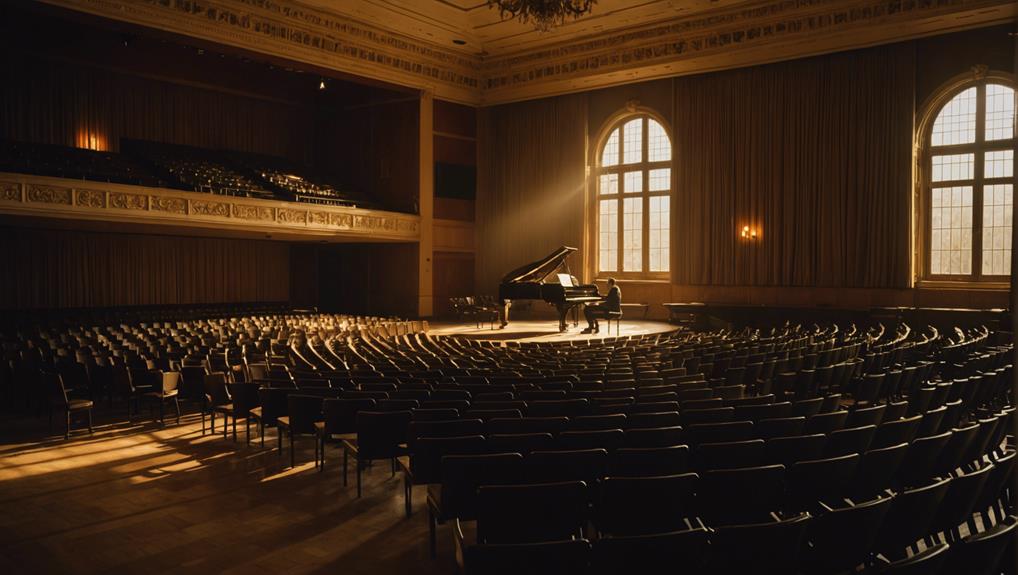
We experienced a truly unforgettable evening when soprano Miah Persson, baritone Florian Boesch, and pianist Malcolm Martineau joined forces for an all-Schumann program at Zankel Hall. The trio’s masterful performance showcased their profound understanding of Schumann’s works, with flawless vocals and nuanced piano accompaniment. The superior acoustics of Zankel Hall enhanced the music, fostering a deep connection between the performers and the audience. As we witnessed the synergy between Persson, Boesch, and Martineau, it was clear that this performance would stay with us for a long time. And there’s more to uncover about this unforgettable night. The evening’s emotional depth was further amplified by the trio’s ability to convey Schumann’s intricate storytelling through music. As we reflected on this remarkable concert, we couldn’t help but draw parallels to the gripping intensity of a Belcea Quartet Shostakovich performance, where technical brilliance meets profound expressivity. This night at Zankel Hall was a testament to the enduring power of live music to captivate and inspire.
Schumann's Lieder Take Center Stage
As we explored the all-Schumann program at Zankel Hall, the soprano Miah Persson and baritone Florian Boesch stunningly brought to life the composer's lieder, expertly traversing the emotional depths of his poetry. We were immediately struck by the rich Romantic Expression that permeated every note, every phrase, and every gesture. Schumann's lieder, often characterized by their introspective nature, require a deep understanding of the poet's nuances, and Persson and Boesch demonstrated a profound connection to the text.
Through their performances, we experienced the full gamut of human emotions, from the longing and yearning in "Frühlingsnacht" to the quiet reflection of "Mondnacht". Boesch's rich, sonorous voice brought gravity and intensity to the songs, while Persson's voice soared with a radiant lightness, perfectly capturing the whimsy and playfulness of Schumann's melodies. Pianist Malcolm Martineau provided sensitive and thoughtful accompaniment, expertly weaving together the complex harmonies and rhythms that underpin Schumann's masterpieces.
Throughout the evening, we were struck by the poetic nuances that Persson and Boesch brought to the performance. They captured the subtleties of Schumann's language, conveying the quiet intimacy and vulnerability that define his lieder. As we listened, we felt as though we were eavesdropping on private conversations, so profound was the connection between the performers and the music. It was a truly unforgettable experience, one that left us in awe of Schumann's genius and the artistry of the performers.
Vocal Mastery on Full Display
We were consistently impressed by the precision and control that Persson and Boesch brought to every phrase, their vocal mastery on full display throughout the evening. It was evident that both singers have dedicated countless hours to honing their craft, and it paid off in spades. Every note, every phrase, every gesture seemed carefully considered, yet still managed to convey a sense of spontaneity and emotional authenticity.
One of the most striking aspects of their performances was the attention to vocal nuance. They coaxed a staggering range of colors and textures from their voices, from the most delicate whispers to the most soaring climaxes. This level of subtlety and expressiveness is a hallmark of true artistic expression, and we were constantly impressed by the singers' ability to convey the emotional depth of Schumann's lyrics.
Some of the most memorable moments of the evening included:
- Persson's heart-wrenching rendition of "Widmung," which seemed to suspend time itself with its beauty.
- Boesch's dramatic intensity in "Die Löwenbraut," which brought the audience to the edge of their seats.
- The soaring duet "Ich grolle nicht," which showcased the singers' effortless blend and balance.
- The poignant final set, which left the audience in stunned silence before erupting into applause.
Throughout the evening, it was clear that Persson and Boesch are true masters of their craft, and we felt privileged to have witnessed such a stunning display of vocal mastery.
The Art of Collaborative Performance
Collaborating with pianist Malcolm Martineau, Persson and Boesch wove a rich tapestry of sound, their synergy sparking a palpable energy that elevated the entire performance. As we listened, it became clear that their artistic partnership was built on a foundation of creative trust. This trust allowed them to take risks, to push the boundaries of their craft, and to create something truly special.
Their musical camaraderie was palpable, a tangible force that connected them as they navigated the complexities of Schumann's music. It was as if they were having a conversation, each one listening and responding to the other in a beautiful dance of sound. Martineau's sensitive playing provided the perfect backdrop for Persson's soaring vocals and Boesch's rich baritone, and together, they crafted a performance that was greater than the sum of its parts.
As we watched, it was clear that this was no ordinary collaboration. This was a partnership born of mutual respect, of shared artistic vision, and of a deep understanding of the music. It was a true meeting of the minds, a coming together of three exceptional artists to create something truly remarkable. And as we sat there, entranced by the beauty of their performance, we knew that we were witnessing something truly special – the art of collaborative performance at its finest.
Exploring Schumann's Emotional Depths
Delving into Schumann's songbook, we uncovered a world of intense emotional complexity, where the poet's inner turmoil and private struggles found voice in the composer's masterful settings. As we immersed ourselves in the lyrics and melodies, we discovered a profound exploration of the human experience. Schumann's songs are a window into the poet's soul, revealing the darkest corners of his psyche and the most intimate moments of his emotional journey.
Schumann's Emotional Landscapes are a hallmark of his compositional style, where he masterfully weaves together words and music to evoke powerful emotions. Through his songs, we experience:
- Tormented longing: Schumann's settings of love poems reveal a deep sense of yearning and unfulfilled desire.
- Despair and desperation: His songs of loss and grief convey a sense of hopelessness, as if the poet is drowning in a sea of sorrow.
- Fleeting joy: Moments of happiness and elation are few, but all the more precious for their rarity.
- Resigned acceptance: Ultimately, Schumann's songs often resolve in a sense of quiet resignation, as if the poet has come to terms with his fate.
Through Schumann's music, we experience a form of Musical Catharsis, where the composer's emotional turmoil is transformed into a powerful expression of human emotion. As we listen to these songs, we are invited to confront our own emotional landscapes, and to find solace in the knowledge that we are not alone in our struggles.
A Musical Journey Through Time
As we explore the nuances of Schumann's songbook, we find ourselves navigating a rich tapestry of emotions, with each piece serving as a temporal portal to the poet's inner world. Through his timeless classics, we're transported to forgotten eras, where the struggles and triumphs of the human experience are laid bare. We're struck by the universality of his themes, which continue to resonate with us today.
As we investigate further into Schumann's oeuvre, we notice the way his music weaves together threads of love, loss, and longing. Each song becomes a chapter in a larger narrative, one that speaks to the complexities of the human heart. We're drawn into a world of intense emotional depth, where the poet's inner turmoil is laid bare.
Through Schumann's music, we're afforded a glimpse into the past, a window into the soul of a man who wore his heart on his sleeve. His songs become a form of time travel, allowing us to connect with the emotional landscape of a bygone era. And yet, despite the passage of time, his music remains remarkably relevant, speaking to our own hopes, fears, and desires. As we journey through Schumann's songbook, we're reminded that, despite the passing of time, the human experience remains a constant, a thread that weaves together the fabric of our collective humanity.
Triumphant Performance at Zankel Hall
We stepped into the intimate setting of Zankel Hall, where the anticipation was palpable, and were immediately enveloped by the warm, rich tones of soprano Miah Persson, baritone Florian Boesch, and pianist Malcolm Martineau. The hall's renowned acoustics allowed every note to resonate deeply, drawing us in and refusing to let go.
As the performance began, it was clear that the trio had risen to the challenge of meeting the house expectations. The pressure to deliver a flawless performance was evident, but they exceeded all expectations with their masterful interpretation of Schumann's works. Persson's soprano soared with effortless elegance, while Boesch's baritone brought depth and nuance to the performance. Martineau's pianism provided the perfect accompaniment, weaving the entire program together with precision and sensitivity.
The key factors that contributed to this triumphant performance were:
- Hall Acoustics: Zankel Hall's superior sound design allowed the audience to fully absorb the music.
- Stage Presence: The trio's confidence and charisma commanded the stage, drawing the audience in.
- Performance Pressure: The pressure to deliver a flawless performance brought out the best in the trio.
- Audience Reaction: The audience's enthusiastic applause and cheers were a sign of the trio's success.
As we left the hall, we couldn't help but feel grateful to have experienced such a memorable performance in a venue steeped in history. The trio's success at Zankel Hall will surely be remembered for a long time to come.
Frequently Asked Questions
What Inspired Schumann to Compose so Many Lieder?
We're often curious about what sparked Schumann's prolific lieder composition. Think of it like a burst of creative confetti – his music was a vibrant expression of his inner world. Romantic expression poured out of him, driven by melodic innovation and poetic influences. It was as if he was having an intimate conversation with his piano, and the resulting lieder were like whispers of his soul. This musical introspection led to some of his most beloved works, a demonstration of the power of art to convey the depths of human emotion.
How Do Singers Prepare for an All-Schumann Program?
When we prepare for an all-Schumann program, we dive deep into the composer's world. We start with vocal coaching to perfect our tone, phrasing, and dynamics. Then, we immerse ourselves in the language, studying German diction and poetry to bring the lyrics to life. We also explore Schumann's life and inspirations to connect with the music on a deeper level. This thorough preparation helps us convey the emotions and stories behind the lieder, creating a compelling performance.
Are There Any Challenges to Performing at Zankel Hall?
We are aware that performing at Zankel Hall comes with its own set of challenges. One of the biggest hurdles is maneuvering the acoustic challenges of the space. The hall's intimate design can make it difficult to project our voices, and we need to be mindful of our tone and dynamics. Additionally, the stage intimacy can be intimidating, making it essential for us to connect with each other and the audience on a deeper level.
Can You Explain the Historical Context of Schumann's Work?
As we step into the world of Schumann's music, we're transported to 19th-century Germany, where the Romantic Era's sweeping melodies and German Nationalism's fervor entwined. We envision candlelit salons, where intellectuals and artists debated the nation's identity. Schumann's work reflects this era's emphasis on emotion, individuality, and the struggle for national unity. His compositions, like "Dichterliebe" and "Frauenliebe und -leben", echo the era's passion and sentimentality, inviting us to experience the tumultuous spirit of 19th-century Germany.
How Do the Musicians Balance Individuality With Collaboration?
As musicians, we understand that balancing individuality with collaboration is key to a successful performance. We endeavor to maintain our creative freedom while still blending our unique voices into ensemble harmony. It's a delicate balance, but when achieved, the result is truly magical. By respecting each other's strengths and weaknesses, we can create a unified sound that's greater than the sum of its parts.
About the Author


