
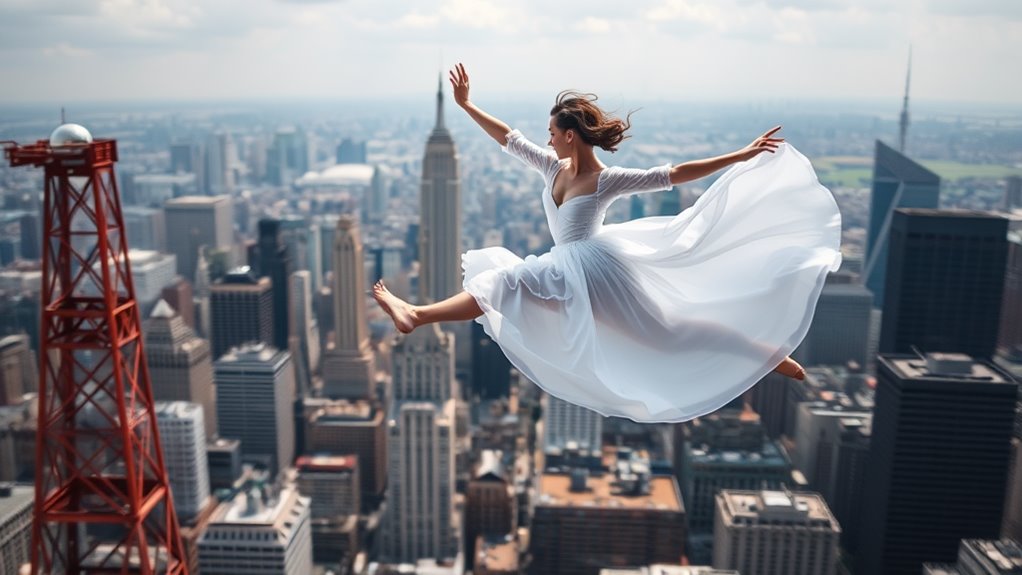
In recent global art events, dance has emerged as a potent medium for artistic innovation, social commentary, and immersive storytelling, pushing the boundaries of traditional performance art and redefining its role in the modern cultural environment. Through fusion with technology, dance has enabled innovative performances, interactive installations, and immersive experiences that blur the lines between reality and fantasy. As a reflection of societal issues, dance has become a formidable tool for inspiring change and challenging norms, amplifying marginalized voices and celebrating diversity. As the art form continues to evolve, its significance within the broader artistic environment is solidified, revealing new dimensions of creativity and expression awaiting exploration.
Dance Meets Visual Art
In the sphere of global art events, the intersection of dance and visual art has given rise to a unique and fascinating form of expression. This fusion has led to the creation of mesmerizing performances that engage audiences on multiple sensory levels. Dance aesthetics, which encompass the visual and spatial aspects of movement, are carefully crafted to harmonize with the visual art elements, resulting in a rich and immersive experience.
The integration of choreography into visual art installations has become a hallmark of this fusion. Choreographers are collaborating with visual artists to create site-specific performances that respond to the surrounding environment. This synergy allows the dance to become an integral part of the visual narrative, rather than simply being a standalone performance. The careful consideration of dance aesthetics guarantees that the movement vocabulary complements the visual elements, creating a cohesive and thought-provoking experience.
The fusion of dance and visual art has likewise led to the development of new and innovative storytelling methods. By combining movement, visual projections, and installation art, artists are able to convey complex ideas and emotions in a way that transcends traditional narrative forms. As this genre continues to evolve, it is likely to push the boundaries of what is possible in the sphere of global art events, offering audiences a unique and enchanting experience that lingers long after the performance has ended.
Blurring Boundaries and Genres
As the fusion of dance and visual art continues to evolve, it has become increasingly evident that the boundaries between genres are growing indistinct. This blurring of boundaries has led to the development of new and innovative forms of artistic expression. One of the most significant consequences of this trend is the emergence of hybrid art forms that defy categorization.
Dance improvisation, for instance, has become a key component of many contemporary art performances. By incorporating improvisational elements, dancers are able to respond to their surroundings and create unique, site-specific performances that blur the lines between dance, theater, and visual art. This approach has enabled artists to explore new modes of expression and push the boundaries of traditional genres.
Genre exploration has additionally become a hallmark of contemporary art events. Artists are no longer confined to a single medium or discipline, but instead, are free to experiment and explore different genres and styles. This has led to the creation of innovative and often provocative works that challenge our perceptions and comprehension of art.
The blurring of boundaries and genres has further facilitated greater collaboration and exchange between artists from different disciplines. As a result, we are witnessing the emergence of new and exciting art forms that are redefining the role of dance in global art events. By embracing this trend, artists are able to tap into new sources of creativity and innovation, leading to a more dynamic and diverse artistic terrain.
The Rise of Immersive Experiences
In recent years, global art events have witnessed a significant shift in the direction of immersive experiences that combine dance with innovative storytelling techniques, interactive art installations, and sensory experience design. This convergence of art forms enables audiences to engage with performances on a deeper level, transcending traditional spectatorship. By incorporating immersive elements, dance companies and artists can create multisensory experiences that captivate and resonate with diverse audiences.
Immersive Storytelling Techniques
Through the fusion of technology and artistry, immersive storytelling techniques have transformed the way audiences experience dance performances in global art events. This innovative approach has enabled choreographers to craft rich, narrative choreography that resonates deeply with viewers. By combining dynamic visuals, evocative soundscapes, and engrossing dance movements, immersive storytelling techniques have heightened emotional engagement to new heights.
Audiences are no longer passive observers, but active participants in the performance, fully immersed in the narrative. The boundaries between dancer, audience, and environment have dissolved, creating an experiential connection that transcends traditional theatrical experiences. As a result, dance performances have become more visceral, more intimate, and more memorable. The fusion of technology and artistry has revealed new possibilities for storytelling, allowing choreographers to push the boundaries of their craft and create truly unforgettable experiences. By utilizing the strength of immersive storytelling techniques, dance performances in global art events have become more engaging, more emotive, and more impactful than ever before.
Interactive Art Installations
Beyond the domain of traditional stage performances, interactive art installations have emerged as a state-of-the-art medium for dance artists to engage audiences in global art events. These immersive experiences blur the lines between performer and spectator, inviting audience participation and redefining the role of the viewer. Interactive choreography allows dance artists to craft bespoke experiences that respond to the audience's movements, creating a dynamic dialogue between the two.
This shift in the direction of interactivity has enabled dance artists to push the boundaries of their craft, experimenting with new forms of expression and collaboration. By incorporating sensors, cameras, and other technologies, dance artists can create complex, responsive environments that adapt to the audience's presence. This fusion of dance, technology, and architecture has given rise to a new generation of interactive art installations that are redefining the setting of global art events.
Through interactive art installations, dance artists are able to tap into the collective energy of the audience, nurturing a sense of community and shared experience. As a result, these immersive experiences have become a hallmark of global art events, offering a unique and enthralling way to engage with dance and performance art.
Sensory Experience Design
Sensory Experience Design has emerged as a significant aspect of global art events, elevating dance performances from mere visual spectacles to immersive experiences that envelop the audience. This shift in focus has enabled artists to craft multi-dimensional experiences that engage spectators on a deeper level. By incorporating sensory elements such as sound, light, and texture, dance performances can evoke strong emotional responses and nurture a sense of connection between the performer and the audience.
Experiential design plays a vital role in this process, as it enables artists to carefully curate every aspect of the performance environment. From the layout of the performance space to the selection of props and costumes, every detail is carefully considered to create an immersive experience that draws the audience in. By prioritizing sensory engagement, dance performances can transcend the boundaries of traditional entertainment and become truly transformative experiences. As a result, Sensory Experience Design has become a fundamental component of global art events, allowing artists to push the boundaries of creative expression and audience engagement.
Challenging Traditional Art Formats
Dance performances are increasingly pushing the limits of traditional art formats by breaking physical boundaries and redefining performance spaces. This shift is evident in the use of unconventional venues, such as public parks, streets, and industrial sites, which challenge the notion of a fixed, proscenium-arch stage. By inhabiting and transforming these spaces, dance artists are able to engage audiences in innovative and immersive ways.
Breaking Boundaries Physically
Several art forms have traditionally dominated global art events, but dance is increasingly challenging these conventions by breaking boundaries physically. By pushing the limits of the human body, dance is redefining the way we experience and interact with art. Through innovative body movement and spatial exploration, dancers are transforming traditional performance spaces and engaging audiences in new and dynamic ways. This physical boundary-pushing is allowing dance to transcend traditional art forms, creating a more immersive and interactive experience for spectators. By exploring new ways of moving and occupying space, dancers are challenging our perceptions of what is possible and broadening the possibilities of artistic expression. As a result, dance is emerging as an influential force in global art events, offering a unique and enthralling form of artistic expression that is redefining the boundaries of traditional art forms.
Redefining Performance Spaces
As I step into a contemporary dance performance, I am struck by the unconventional use of space, which challenges my expectations of traditional art formats. The fusion of performance architecture and site-specific choreography creates an immersive experience, blurring the lines between audience and performer. Unconventional venues, such as abandoned buildings or urban environments, become dynamic stages, nurturing a deeper connection between the dancers and their surroundings.
This shift in performance spaces encourages audience engagement and community collaboration. Pop-up performances in nature-inspired spaces, for instance, invite spectators to engage with the natural world in new and innovative ways. Ephemeral installations, often integrated into these performances, add an element of participatory design, allowing the audience to influence the artistic narrative.
Through these innovative approaches, dance is redefining traditional art formats, pushing the boundaries of what is possible in performance spaces. Urban dance, in particular, is thriving in these unconventional settings, as it often incorporates the surrounding environment into its choreography. By challenging traditional norms, dance is not only broadening its artistic scope but also nurturing a more inclusive and interactive relationship between the performers, audience, and space itself.
Dance as Social Commentary
Through the lens of movement, artists have long utilized the stage to reflect and respond to the world around them, often tackling pressing social issues with unflinching candor. Dance as social commentary has been a formidable tool for sparking conversation, raising awareness, and inspiring change. In recent years, this form of expression has been particularly evident in protest movements, where dance has been used to amplify marginalized voices and challenge societal norms.
One notable example is the use of dance in protests against systemic racism and police brutality. Choreographers have created formidable pieces that honor the lives lost to violence and oppression, during which they convey the urgency and frustration of the movement. These performances often incorporate elements of cultural identity, celebrating the richness and diversity of marginalized communities.
The Intersection of Art and Technology
Frequently, the boundaries of art are pushed to new frontiers when technology is incorporated into the creative process. The intersection of art and technology has transformed the realm of dance, giving rise to innovative and dynamic performances. Digital choreography has enabled artists to create complex and intricate movements that were previously unimaginable. Algorithmic performance, which relies on mathematical formulas to generate movements, has additionally opened up new avenues for exploration.
The incorporation of technology has not merely expanded the possibilities of dance but has additionally allowed for greater precision and control. Choreographers can now use software to precision-craft every detail of a performance, from the timing of movements to the placement of dancers on stage. Furthermore, technology has enabled the creation of immersive experiences that engage audiences in new and innovative ways. Virtual and augmented reality technologies, for instance, have allowed dancers to perform in entirely new dimensions, blurring the lines between reality and fantasy.
The fusion of art and technology has likewise facilitated collaboration and exchange between artists from diverse backgrounds. Online platforms have made it possible for dancers, choreographers, and technicians to share ideas and work together on projects that transcend geographical boundaries. As a result, the intersection of art and technology has given rise to a new era of creative expression, one that is characterized by innovation, experimentation, and limitless possibilities.
New Platforms for Performance Art
The evolution of digital technology has opened up new avenues for performance art, presenting opportunities for dancers to engage with global audiences in innovative ways. Virtual reality stages, for instance, allow artists to create immersive experiences that transcend physical boundaries. Meanwhile, online platforms are being repurposed to facilitate interactive performances that blur the lines between the physical and digital domains.
Virtual Reality Stages
Virtual reality (VR) technology is revolutionizing the performing arts, offering dancers and choreographers unprecedented creative freedom and innovative platforms for expression. Virtual reality stages provide a new canvas for artists to experiment with virtual choreography, pushing the boundaries of traditional dance performances. This digital immersion allows dancers to interact with virtual environments, creating novel and enchanting experiences for audiences.
In virtual reality, dancers can transcend physical limitations, experimenting with gravity, scale, and space. Choreographers can design intricate and complex movements that would be impossible to execute in the physical world. The virtual environment as well enables the incorporation of interactive elements, such as responsive lighting and soundscapes, further enhancing the immersive experience.
The virtual stage likewise offers new opportunities for collaboration and partnership. Dancers and choreographers can work together remotely, sharing virtual spaces and ideas. This global connectivity has the potential to nurture a new wave of artistic innovation, as creatives from diverse backgrounds come together to push the boundaries of dance and technology.
Immersive Online Experiences
Beyond the virtual reality stages, the digital realm is giving rise to immersive online experiences that redefine the boundaries of performance art. These platforms offer virtual dance performances that transcend geographical constraints, allowing for global collaboration and remote participation. Digital choreography is reimagined through interactive choreography, where audience engagement is heightened through real-time audience interaction. Online platforms facilitate transmedia storytelling, blurring the lines between digital art and traditional performance. Virtual festivals and events have become increasingly popular, providing dance accessibility to a broader audience. Collaborative performances are now possible between artists from diverse locations, encouraging global collaboration and creative exchange. The online environment enables immersive storytelling, where the audience is fully enveloped in the performance. As a result, the digital realm is revolutionizing the way we experience and engage with dance, pushing the boundaries of what is possible in the field of performance art.
The Body as a Canvas
As dancers navigate the intersection of art and movement, their bodies become a dynamic medium for creative expression, transcending the limitations of traditional canvas and paint. This fusion of body movement and artistic expression gives rise to a unique form of visual storytelling, where the physical narrative is woven into the fabric of the performance. Dance aesthetics play an essential role in shaping this embodied creativity, as dancers utilize their kinetic energy to convey emotions, ideas, and experiences.
Through somatic practices, dancers tap into their inner selves, allowing their bodies to become instruments of expression. This process enables them to craft expressive forms that are both personal and universal, speaking to the shared human experience. The movement culture that emerges from this process is characterized by its emphasis on the body as a canvas, where every gesture, movement, and pose is a brushstroke on the canvas of the performance.
In this context, the body is not just a medium for expression but an active participant in the creative process. It is a dynamic, ever-changing entity that responds to the dancer's inner world, external stimuli, and the audience's gaze. As a result, the boundaries between dancer, audience, and performance blur, creating a shared experience that is both intimate and collective. The body as a canvas becomes a significant tool for artistic expression, challenging traditional notions of creativity and pushing the boundaries of what is possible in the sphere of dance.
Collaborations and Fusions
Several groundbreaking collaborations have reshaped the dance environment, blurring disciplinary boundaries and giving rise to innovative fusions of movement, music, visual arts, and technology. These collaborative performances have enabled artists to push the limits of their respective disciplines, resulting in novel and enchanting experiences for audiences worldwide.
One notable example is the fusion of dance with digital technology. Choreographers have begun to incorporate virtual and augmented reality elements into their performances, creating immersive experiences that redefine the relationship between the dancer, the audience, and the performance space. Another example is the blending of dance with music from diverse cultural traditions, giving rise to unique soundscapes that reflect the intricacies of our globalized world.
Cultural exchanges have similarly played a significant role in shaping the dance environment. Artists from different cultural backgrounds have come together to share their knowledge, techniques, and artistic visions, resulting in the creation of new and innovative dance languages. These cultural exchanges have not just enriched the dance community but have also nurtured greater comprehension and appreciation of diverse cultural heritages. By embracing collaboration and fusion, dance has expanded its scope, relevance, and impact, solidifying its position as an essential component of global art events.
Redefining the Role of the Artist
The evolving dynamics of dance in global art events have led to a profound shift in the role of the artist, prompting a reevaluation of their creative agency, authorship, and relationship with the audience. This shift has led to a redefinition of the artist's identity, as they navigate the intricacies of collaboration, fusion, and interdisciplinary approaches. The artist is no longer seen as a solo creator, but rather as a facilitator, curator, and provocateur, who orchestrates the convergence of diverse artistic voices and perspectives.
Consequently, the artist's creative autonomy is being reexamined. With the increasing importance of collaboration and community engagement, the artist's role is broadening to encompass not just the creation of art but also the facilitation of dialogue, the cultivation of audience participation, and the negotiation of multiple stakeholders' interests. This expanded role requires a high degree of adaptability, sensitivity, and responsiveness, as artists must navigate the intricacies of diverse artistic languages, cultural contexts, and social agendas.
In this context, the artist's relationship with the audience is additionally undergoing a significant transformation. The artist is no longer seen as a solitary figure, but rather as a catalyst for collective creativity, social change, and community building. Therefore, the artist's role is becoming increasingly intertwined with that of the audience, as they co-create, co-author, and co-participate in the artistic experience. This shift has significant implications for the way we perceive artist identity, creative autonomy, and the role of dance in global art events.
The Future of Interactive Art
Nearly every corner of the global art scene is witnessing a surge in interactive art, which is redefining the boundaries of dance and its relationship with technology, audience, and environment. This shift is giving rise to new forms of artistic expression, where the lines between creator, participant, and observer are becoming increasingly blurred. The future of interactive art holds immense potential, with participatory design emerging as a key driver of this movement. By incorporating state-of-the-art technologies, such as virtual and augmented reality, into the creative process, artists are able to craft immersive experiences that invite audience engagement on a deeper level.
In this new paradigm, the audience is no longer a passive observer but an active participant, influencing the narrative and shaping the artistic outcome. The role of the artist is evolving, as they become facilitators of creative experiences rather than sole creators. This democratization of art is nurturing a sense of community and collaboration, as artists, technologists, and audiences come together to push the boundaries of what is possible. As interactive art continues to evolve, we can expect to see new forms of storytelling, new modes of expression, and new ways of engaging with the world around us. The future of interactive art is bright, and its potential to transform the way we experience and interact with dance is vast and exciting.
Frequently Asked Questions
How Can Dance Be Used to Convey Complex Emotional Narratives?
Did you know that 75% of people report feeling more emotionally expressive when engaging in physical activity? Dance, as a potent medium, can convey complex emotional narratives through nuanced emotional expression and innovative narrative techniques. By leveraging the body's ability to convey emotion, dance can tell rich, layered stories that resonate deeply with audiences. Through gesture, movement, and spatial relationships, dancers can evoke empathy, ignite imagination, and create a profound emotional connection with the viewer.
What Is the Relationship Between Dance and Mental Health?
The relationship between dance and mental health is deeply intertwined. Dance therapy has emerged as an influential tool for promoting emotional expression and well-being. By providing a platform for non-verbal communication, dance enables individuals to convey complex emotions and thoughts, often inaccessible through verbal means. Through dance, individuals can process and release pent-up emotions, nurturing a sense of catharsis and relaxation, eventually contributing to improved mental health outcomes.
Can Dance Be a Form of Political Activism?
Can dance be a strong catalyst for social change? The answer lies in the domain of protest choreography, where movement becomes a potent form of embodied resistance. Through deliberate gestures and intentional steps, dancers can convey messages of defiance, solidarity, and hope. As a form of non-verbal communication, dance can transcend linguistic and cultural barriers, mobilizing communities and inspiring collective action. By utilizing the emotional intensity of the human body, dance can become a forceful tool for political activism, sparking meaningful conversations and driving lasting impact.
How Does Dance Intersect With Other Art Forms Like Music?
In the domain of artistic expression, dance seamlessly intersects with music through dance collaboration, where choreographers and musicians work together to create a harmonious fusion of movement and sound. This synergy enables rhythmic expression to transcend traditional boundaries, giving rise to innovative and enchanting performances. As dancers and musicians co-create, they exchange ideas, pushing the limits of their respective art forms and yielding unique, multisensory experiences that engage and inspire audiences.
What Is the Role of Audience Participation in Dance Performances?
Audience participation plays a crucial role in dance performances, transforming passive spectators into active contributors. Through interactive engagement, spectators exert influence on the performance, nurturing a dynamic exchange between the dancer and the audience. This mutual influence blurs the line between performer and spectator, creating a shared experience that is unique to each performance. By surrendering to the moment, the audience becomes an integral part of the artistic expression, co-creating a memorable and immersive experience.
About the Author


