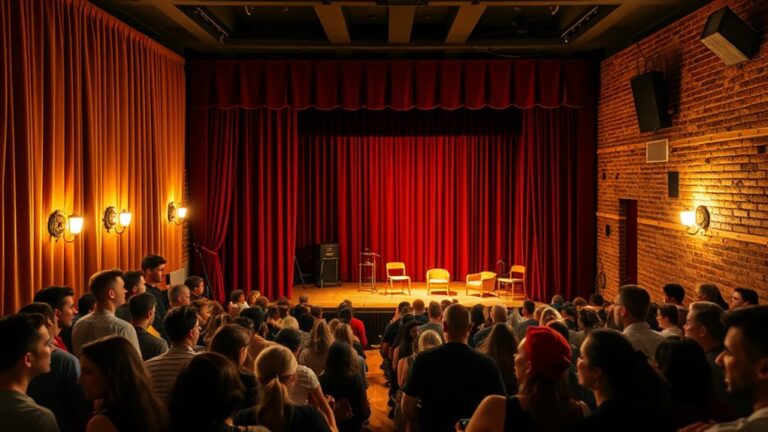

Workshops serve as crucial incubators for Off-Broadway theatre, promoting innovation and collaboration among emerging artists. They provide a space for experimentation with new ideas and narratives, allowing for a dynamic creative process that includes feedback loops among writers, directors, and performers. These workshops vary in structure, including developmental and staged readings, encouraging risk-taking and bold storytelling. By nurturing local engagement and promoting inclusivity, workshops contribute greatly to the evolution of Off-Broadway. This collaborative environment not only improves artistic quality but also strengthens industry networks, paving the way for continued exploration of creative possibilities. There's much more to discover about their impact.
Importance of Workshops
Workshops play an important role in the off-Broadway development process, serving as incubators for new ideas and creative expression. These dynamic environments promote innovation, allowing writers, directors, and performers to experiment with untested concepts and narratives. The workshop significance lies not just in the opportunity to refine a piece of work but in the cultivation of a collaborative atmosphere that encourages artistic growth.
In these settings, creators are encouraged to push boundaries and challenge conventional storytelling techniques. Participants engage in iterative feedback loops that facilitate the exploration of diverse perspectives, resulting in a more nuanced and compelling final product. This process is particularly significant in off-Broadway, where the emphasis is often on original and avant-garde productions that seek to resonate with contemporary audiences.
Moreover, workshops provide a platform for emerging artists to hone their craft, gain visibility, and build networks within the industry. The collaborative nature of workshops allows for mentorship opportunities, where seasoned professionals can share their expertise, thereby enriching the artistic environment. This exchange of ideas and feedback cultivates a sense of community that is important for artistic growth, as it encourages risk-taking and innovation.
Ultimately, workshops serve as important stepping stones in the off-Broadway development process, ensuring that new works are not just polished but deeply connected to the evolving cultural conversation. By prioritizing these creative spaces, the off-Broadway scene can continue to thrive as a bastion of innovation and artistic exploration.
Collaborative Creative Process
The collaborative creative process in Off-Broadway workshops is pivotal for nurturing ensemble collaboration dynamics, where each member contributes uniquely to the collective vision. This environment supports iterative script development, allowing for real-time feedback and adjustments that improve the narrative. Furthermore, the synergy between actors and writers cultivates a rich exchange of ideas, in the end raising the quality of the production.
Ensemble Collaboration Dynamics
Nurturing a collaborative creative process within an ensemble requires a delicate balance of trust, communication, and shared vision. Ensemble trust forms the foundation for innovative expression, allowing artists to explore uncharted territories in their work. When ensemble members feel secure in their relationships, they are more likely to contribute bold ideas and take creative risks.
Collaborative decision making is crucial in this dynamic, promoting an environment where every voice is valued. This process not only improves the quality of the artistic output but additionally strengthens interpersonal connections among the ensemble members. By engaging in open dialogues and actively seeking input from all participants, ensembles can break down hierarchical structures that often stifle creativity.
Furthermore, the use of workshops provides a unique platform for experimentation, where ensemble members can prototype their ideas in real-time and receive immediate feedback. This iterative process encourages a sense of ownership and investment in the project, further deepening ensemble trust. In the end, the synergy cultivated through effective collaboration paves the way for groundbreaking work, proving that the magic of Off-Broadway development often lies in the dynamics of ensemble collaboration.
Iterative Script Development
Through a process of iterative script development, ensembles can refine their narratives and characters in a collaborative environment. This innovative approach emphasizes the importance of ongoing dialogue between writers, directors, and performers, facilitating a creative ecosystem where ideas can evolve dynamically. By incorporating iterative feedback from multiple perspectives, participants are empowered to explore fresh interpretations and unearth the underlying themes of their work.
Workshops serve as a crucial crucible for this evolution, allowing for real-time experimentation and adjustment. As actors bring text to life, they provide invaluable insights that can lead to significant script refinement, enhancing both emotional depth and audience engagement. This iterative process not only sharpens the script but additionally nurtures a sense of ownership among all collaborators, encouraging a shared commitment to the project's success.
Moreover, the iterative nature of this development allows teams to pivot quickly, responding to challenges and opportunities as they arise. By embracing flexibility and creativity, Off-Broadway ensembles can cultivate works that resonate profoundly with audiences, ultimately pushing the boundaries of theatrical storytelling. This collaborative atmosphere paves the way for groundbreaking productions that reflect the lively, constantly changing terrain of contemporary theatre.
Actor-Writer Synergy
Encouraging a collaborative creative process, actor-writer synergy emerges as a crucial component in developing compelling Off-Broadway productions. This dynamic partnership cultivates an environment where ideas flourish and stories take on new dimensions, enabling both actors and writers to enhance their craft.
The benefits of actor-writer synergy include:
- Enhanced Character Depth: Actors provide invaluable insights into the emotional terrain of their characters, allowing writers to refine and enrich the narrative.
- Real-Time Feedback: Through workshops, writers receive immediate responses to dialogue and plot developments, enabling iterative improvements that resonate with audiences.
- Innovative Storytelling: The collaborative nature of actor collaboration encourages experimentation, leading to unique narratives that challenge conventional norms.
Types of Workshops
Diversity is a hallmark of the workshop environment in Off-Broadway development, reflecting the myriad approaches to cultivating new theatrical works. Workshops can be categorized into several types, each designed to encourage innovation through different methodologies and goals.
One prominent type is the developmental workshop, where writers and composers bring their works to life, focusing on audience engagement and eliciting feedback from both industry professionals and test audiences. This interactive setting allows for real-time thematic exploration, ensuring that the narrative resonates on multiple levels.
Another common format is the staged reading workshop. Here, a script is presented with minimal staging, allowing the text and performances to take center stage. This format encourages a thorough examination of character development and dialogue, facilitating discussions about pacing, emotional impact, and overall coherence.
Additionally, collaborative workshops often involve multidisciplinary approaches, inviting not just playwrights and actors but also directors, choreographers, and designers. This inclusivity sparks innovation, as various perspectives contribute to a richer conceptualization of the work.
Moreover, intensive workshops focus on specific elements, such as score composition or character arcs, often led by industry experts. These targeted sessions provide invaluable insights that can shape a piece's trajectory.
Benefits for Writers
Workshops in Off-Broadway development offer significant benefits for writers, including opportunities for skill improvement through targeted feedback and guidance. They likewise facilitate valuable networking and collaborations, allowing writers to connect with peers and industry professionals. Moreover, these workshops provide a creative experimentation space where writers can explore new ideas and refine their work without the pressures of a formal production.
Skill Enhancement Opportunities
Offering a collaborative environment, Off-Broadway workshops present invaluable skill improvement opportunities for writers at all stages of their careers. These workshops serve as incubators for innovation, allowing writers to experiment with new ideas and refine their craft. Participants engage in various skill-building techniques, nurturing creative confidence and pushing the boundaries of their artistic expression.
The benefits of these workshops include:
- Immediate Feedback: Writers receive constructive critiques from peers and seasoned professionals, enabling them to identify strengths and areas for growth.
- Diverse Perspectives: Collaborating with fellow writers from varied backgrounds encourages the exploration of unique narratives and styles, enriching the creative process.
- Focused Practice: Workshops often emphasize specific aspects of writing, such as dialogue, structure, or character development, allowing for targeted skill improvement.
Networking and Collaborations
Numerous opportunities for networking and collaboration arise within the Off-Broadway workshop environment, greatly benefiting writers by broadening their professional connections. These workshops serve as a fertile ground for establishing collaborative partnerships that can lead to innovative projects and shared creative visions. Writers not only interact with peers but also engage with directors, producers, and other industry professionals, cultivating dynamic creative networks.
The significance of these interactions can be summarized as follows:
| Benefits | Impact on Writers |
|---|---|
| Access to Diverse Expertise | Gaining insights from various perspectives improves storytelling. |
| Building Lasting Relationships | Collaborations can lead to future projects and referrals. |
| Exposure to New Ideas | Cross-pollination of concepts ignites originality in writing. |
| Strengthened Industry Position | A broader network increases visibility and credibility in the field. |
Creative Experimentation Space
Though writers often face the pressure of producing polished work, the Off-Broadway workshop environment provides a creative experimentation space that encourages risk-taking and innovation. This unique setting cultivates artistic exploration, allowing writers to break free from conventional constraints and embrace the creative freedom necessary for original storytelling.
The benefits of this creative experimentation space include:
- Encouragement of Bold Ideas: Writers can test unconventional narratives and characters without the fear of immediate judgment.
- Collaborative Feedback: Engaging with diverse artists nurtures a rich dialogue, enhancing the writer's perspective and refining their craft.
- Iterative Development: The workshop format allows for multiple drafts and revisions, promoting a cycle of continuous improvement.
Within this nurturing atmosphere, writers can explore uncharted territories of their imagination, eventually leading to more innovative and compelling works. The Off-Broadway workshop acts as a crucible for creativity where ideas can be examined, challenged, and transformed. By embracing this environment, writers can tap into the full potential of their artistic exploration, setting the stage for groundbreaking theatrical experiences.
Role of Directors
The role of directors in Off-Broadway development is fundamental, as they serve as the creative visionaries who guide a production from its initial concept to its final presentation. Their director vision is critical in shaping the narrative arc and ensuring that the thematic elements resonate with the audience. By nurturing an environment of collaboration and experimentation, directors exercise creative leadership, allowing writers and performers to explore new dimensions of storytelling.
In workshops, directors are instrumental in providing constructive feedback, balancing innovation with artistic integrity. They facilitate a dynamic atmosphere conducive to risk-taking, enabling the exploration of unconventional ideas that can lead to groundbreaking performances. The director's ability to articulate their vision during the evolving nature of a piece is what distinguishes successful productions in the Off-Broadway scene.
Here is a summary of the director's roles in Off-Broadway development:
| Role | Description |
|---|---|
| Visionary Leadership | Guides the overall aesthetic and tone of the production. |
| Collaborative Facilitator | Encourages experimentation among writers and performers. |
| Feedback Provider | Offers insights, cultivating growth and refinement throughout the workshop process. |
Directors not just shape the artistic vision but equally create a culture of innovation that is fundamental for the evolution of Off-Broadway theatre. Their multifaceted role is critical in transforming scripts into compelling live experiences that captivate audiences and push the boundaries of theatrical expression.
Impact on Performers
Frequently, performers in Off-Broadway workshops experience transformative growth as they engage with new material and collaborate closely with directors and writers. This dynamic environment nurtures not just individual artistry but also a collective spirit that improves the overall theatrical experience. The workshops serve as incubators for innovative practices, allowing performers to explore their craft in a supportive and experimental setting.
The impact on performers can be delineated into several key areas:
- Improved Emotional Expression: By working with diverse scripts, performers discover new dimensions of emotional depth, enabling them to convey complex characters more authentically.
- Skill Development: Workshops often incorporate various techniques, from improvisation to vocal training, that help performers refine their skills and adapt to different styles and genres.
- Collaborative Synergy: The close-knit collaboration with writers and directors cultivates a unique synergy, allowing performers to contribute their insights and instincts, finally influencing the material's evolution.
This holistic approach to performer growth not only bolsters individual confidence but also nurtures a lively community of artists committed to pushing the boundaries of theatrical expression. As performers navigate the challenges of new roles, they emerge with enriched perspectives and a greater capacity for nuanced storytelling. The workshops hence play a pivotal role in reshaping the scenery of Off-Broadway, supporting artists in their expedition toward innovation and emotional authenticity.
Feedback and Revision
Feedback and revision are crucial components of the Off-Broadway workshop process, serving as critical mechanisms for refining both the script and the performances. In an environment where innovation is paramount, the dynamic exchange of ideas between creators and audiences cultivates an atmosphere ripe for exploration and growth. Workshops provide a unique opportunity for artists to present their work in progress to live audiences, garnering invaluable audience feedback that can illuminate paths for improvement.
The feedback collected during these sessions often leads to significant script revisions, honing the narrative and enhancing character development. By actively listening to audience reactions, whether through laughter, silence, or thoughtful engagement, playwrights and directors can identify areas of strength and those in need of refinement. This iterative process transforms initial concepts into more cohesive and compelling theatrical experiences.
Furthermore, the collaborative nature of workshops encourages a culture of openness and adaptability. Actors, writers, and directors come together to dissect each performance, exploring not just what resonates but also what challenges the audience's expectations. These discussions can inspire bold revisions that push the boundaries of traditional storytelling, eventually resulting in more innovative and thought-provoking productions.
Risk-Taking in Theater
Risk-taking is crucial in theater as it allows creators to embrace unconventional narratives that can resonate with diverse audiences. By experimenting with new formats, artists challenge traditional storytelling methods and push the boundaries of the medium. Additionally, this willingness to challenge audience expectations not only encourages innovation but likewise enriches the theatrical environment.
Embracing Unconventional Narratives
The theater's evolving terrain increasingly celebrates the strength of unconventional narratives, inviting creators to venture beyond traditional storytelling boundaries. This paradigm shift not just nurtures innovative structures but likewise allows for thematic exploration that resonates deeply with audiences.
By embracing unconventional storytelling, Off-Broadway workshops cultivate an environment that champions diverse perspectives and bold characters. These initiatives encourage artists to experiment with:
- Immersive experiences that blur the lines between audience and performer
- Experimental themes that challenge societal norms and cultural narratives
- Emotional resonance that lingers long after the curtain falls
These workshops serve as incubators for new works that defy expectations and engage viewers on multiple levels. The focus on risk-taking nurtures a dynamic setting where innovative narratives can flourish, creating a rich fabric of storytelling that reflects the intricacies of contemporary life. As creators push boundaries and experiment with form, they enrich the theatrical canon and invite audiences to partake in a shared adventure of discovery. In the end, embracing unconventional narratives is crucial for a thriving arts community, nurturing creativity and ensuring the continued evolution of theater as an art form.
Experimenting With New Formats
Innovative formats are reshaping the terrain of Off-Broadway theater, enabling creators to push boundaries and explore uncharted artistic territories. The emphasis on innovative storytelling has led to the rise of interactive formats that invite audiences to engage actively with the narrative. This fresh approach not just improves the theatrical experience but likewise nurtures a deeper connection between performers and viewers.
| Format Type | Description |
|---|---|
| Immersive Theater | Audiences are placed within the performance space, becoming part of the story. |
| Digital Integration | Utilizing technology, such as apps or live streaming, to create a multi-dimensional experience. |
| Non-linear Narratives | Breaking traditional storytelling structures to allow audiences to choose their own path through the performance. |
These experimental formats encourage risk-taking among artists, challenging them to rethink conventional theatrical conventions. By embracing such innovative approaches, Off-Broadway productions become more than mere performances; they evolve into collaborative experiences that redefine what theater can be. In the end, the willingness to experiment with new formats not just invigorates the creative process but likewise captivates a diverse audience enthusiastic for novel experiences.
Challenging Audience Expectations
A growing number of Off-Broadway productions are actively challenging audience expectations by daring to explore unconventional narratives and formats. This risk-taking approach not just nurtures a climate of creativity but likewise improves audience engagement through expectation subversion. By breaking away from traditional storytelling, these productions invite spectators to reconsider their preconceived notions of theater.
Key strategies employed include:
- Non-linear narratives: Presenting stories out of chronological order to provoke thought and discussion.
- Interactive elements: Encouraging audience participation, making them integral to the storytelling process.
- Diverse representation: Showcasing underrepresented voices and perspectives, broadening the scope of who is telling stories on stage.
Such innovative methods not only captivate but likewise challenge the audience's role, transforming passive viewers into active participants. As Off-Broadway continues to push boundaries, it cultivates an environment where the unexpected thrives, in the end enriching the theatrical environment. This commitment to risk-taking not only invigorates the medium but likewise nurtures a deeper connection between performers and the audience, ensuring that the theater remains a dynamic space for exploration and dialogue.
Case Studies of Successful Workshops
Successful workshops in Off-Broadway development showcase the transformative energy of collaboration between writers, directors, and performers. These environments cultivate creativity and experimentation, allowing for the refinement of narratives and characters that eventually lead to impactful theatrical experiences. Case studies of successful workshops highlight the significance of this collaborative process, illustrating how innovative ideas can emerge through shared dialogue and feedback.
One notable success story is the workshop of "In the Heights," which initially began as a small project at the University of Puerto Rico. Through a series of workshops, Lin-Manuel Miranda and his team were able to explore the musical's themes and character development, resulting in a polished production that captivated audiences. The workshop format allowed for the integration of diverse perspectives, enriching the storytelling and refining the musical score.
Another compelling example is "The Last Five Years," which underwent several workshops before its Off-Broadway debut. Jason Robert Brown utilized these opportunities to test the emotional resonance of his narrative structure, finally creating a deeply impactful experience that has resonated with audiences for years.
These case studies exemplify how workshops serve as incubators for creativity, allowing artists to iterate and innovate in a supportive environment. By engaging in this collaborative process, Off-Broadway productions can emerge as success stories, pushing the boundaries of what theatre can achieve and inspiring future generations of artists.
Workshops vs. Traditional Productions
The dynamic nature of workshops sets them apart from traditional productions in the domain of Off-Broadway theatre. These innovative environments encourage experimentation and allow creators to explore their artistic visions without the constraints typically associated with full-scale productions. Unlike traditional productions, which often adhere to rigid schedules and extensive production timelines, workshops provide a more flexible framework that promotes collaboration and development.
Key distinctions between workshops and traditional productions include:
- Iterative Feedback: Workshops prioritize ongoing input from participants, allowing for real-time adjustments and refinements to the material.
- Reduced Financial Risk: The shorter commitment and lower costs associated with workshop structures enable creators to test new ideas without the financial pressures of a full production.
- Creative Freedom: Artists are granted the liberty to take risks and innovate, leading to groundbreaking work that may not find a platform in conventional settings.
In contrast, traditional productions typically require more extensive planning and resources, resulting in a less adaptable environment for artistic exploration. Although they are fundamental for bringing polished works to life, the structured nature of these productions can inhibit spontaneous creativity. Workshops, thus, play an important role in the development pipeline, allowing emerging voices to experiment and find their unique artistic direction. By embracing this model, Off-Broadway theatre can continue to thrive as a haven for innovation and artistic growth.
Future of Off-Broadway Workshops
As Off-Broadway workshops continue to evolve, their significance in the theatre environment is poised to grow. The terrain of these workshops is shifting, driven by future trends that emphasize collaboration, technology integration, and audience engagement. Emerging artists and established creators alike are increasingly recognizing workshops as crucial incubators for innovative storytelling and new performance methodologies.
Workshop innovations are set to redefine how narratives are developed and presented. For instance, the incorporation of digital tools in the creative process allows for real-time feedback and experimentation, enhancing the collaborative spirit inherent in theatre-making. Additionally, the shift towards hybrid models, which blend in-person and virtual elements, expands accessibility and invites diverse voices into the conversation. This trend not just democratizes the creative process but also guarantees that workshops can adapt to a changing cultural environment.
Furthermore, the future of Off-Broadway workshops will likely see an increased emphasis on community involvement. By engaging local audiences in the development phase, creators can craft works that resonate more deeply with the communities they aim to serve. This participatory approach can likewise lead to more sustainable practices, as workshops align with the values of transparency and inclusivity.
Frequently Asked Questions
How Do Workshops Differ From Rehearsals in Traditional Productions?
Workshops differ from rehearsals in traditional productions primarily in their focus and objectives. Workshops emphasize the creative process, allowing artists to explore new ideas and concepts in a flexible environment. Unlike rehearsals, which refine a nearly finalized production, workshops facilitate experimentation and often include audience feedback, enabling creators to gauge reactions and adjust accordingly. This iterative approach encourages innovation and collaboration, vital for developing fresh narratives and theatrical expressions.
What Is the Typical Duration of an Off-Broadway Workshop?
Typically, an off-Broadway workshop lasts anywhere from one to four weeks, a timeframe that allows for focused creativity and iterative project feedback. Notably, nearly 70% of new works evolve markedly during this period, showcasing the workshop's value in refining concepts. These workshop timelines offer a unique opportunity for artists to innovate and explore their visions, finally enhancing the overall quality of the production before it reaches a broader audience.
Are Workshops Open to the Public or Invite-Only?
Workshops can vary regarding public access, often depending on specific invite criteria established by the organizing entity. Some workshops are open to the public, allowing wider community engagement and feedback, promoting innovation. Conversely, others may be invite-only, targeting a select group of industry professionals and stakeholders to refine the work in a more controlled environment. This selective approach can improve the developmental process through focused collaboration and critique.
How Are Workshop Participants Selected?
Workshop participants are selected through a defined selection process that emphasizes participant criteria such as experience, skill set, and artistic vision. This process often involves evaluations by industry professionals who seek diverse voices and innovative ideas. By prioritizing individuals who demonstrate creativity and collaboration, workshops encourage an environment conducive to experimentation and growth, eventually enhancing the development of new works and celebrating the evolving scenery of contemporary performance.
What Happens to a Project After a Workshop Concludes?
After a workshop concludes, a project undergoes a post-workshop evaluation, akin to a sculptor refining their masterpiece. This phase is essential for evaluating feedback and identifying strengths and weaknesses, guiding the project's evolution. Creators may revise scripts, rework musical elements, or even rethink staging to improve the overall impact. This iterative process promotes innovation, ensuring that the final product resonates with audiences as it retains the essence of the original vision.
About the Author