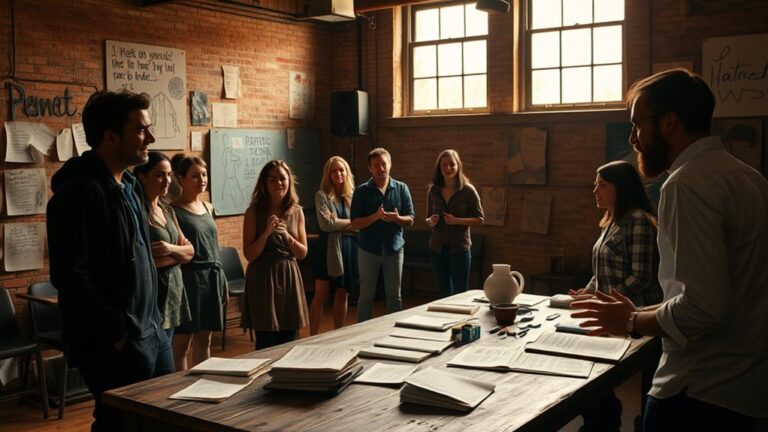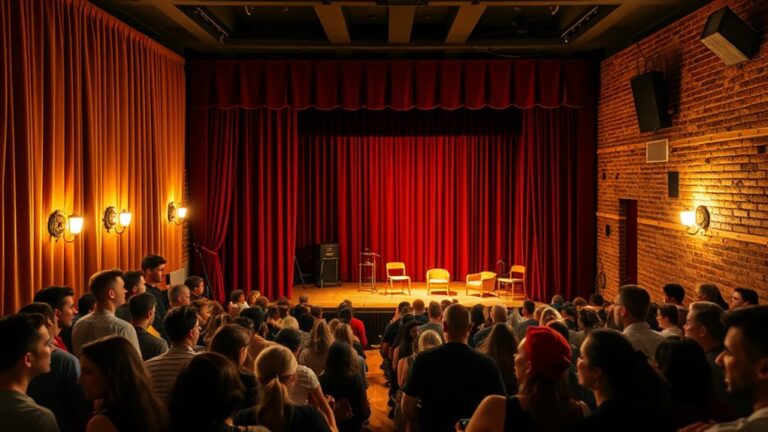

Off-Broadway is the ideal space for theater experiments because of its combination of artistic freedom and intimate settings. Emerging as an alternative to mainstream Broadway, it nurtures innovation and diverse narratives. The smaller venues cultivate emotional connections, transforming audiences into active participants. Furthermore, Off-Broadway's lower production costs allow for bold storytelling without the constraints of commercial pressures. This environment of support encourages interdisciplinary collaborations and the exploration of unconventional themes. As Off-Broadway continues to evolve, it remains an essential incubator for fresh artistic voices. Discover the evolving trends and opportunities that lie within this dynamic theatrical environment.
The History of Off-Broadway
Off-Broadway emerged in the 1950s as an crucial alternative to the commercial Broadway theater scene, characterized by its focus on innovative and experimental productions. The origins of Off-Broadway can be traced back to a desire for artistic freedom, as theater artists sought to escape the constraints of mainstream commercialism. Venues located outside the traditional Broadway district became incubators for groundbreaking work, allowing playwrights and directors to explore themes and styles that challenged societal norms.
Influential productions such as "The Threepenny Opera" and "Hair" marked significant milestones in Off-Broadway's evolution, showcasing works that resonated with contemporary audiences. These productions not just broke new ground in storytelling but also redefined theatrical performance, incorporating elements from various genres and cultural influences. The intimacy of Off-Broadway venues nurtured a unique environment where artists could experiment with form and content, leading to a rich mosaic of diverse narratives.
As Off-Broadway continued to flourish, it attracted a new generation of talent, including playwrights like Sam Shepard and Lanford Wilson, who pushed the boundaries of conventional theater. The movement also served as a launchpad for numerous artists, many of whom shifted to Broadway, bringing with them the avant-garde spirit that had characterized their Off-Broadway experiences.
In essence, Off-Broadway has been crucial in shaping the contemporary theater scenery, providing a platform for innovation and creativity. Its history reflects a commitment to artistic exploration, making it a key force in the ongoing evolution of theater.
Unique Audience Engagement
Engagement in theater transcends mere observation, inviting audiences into a participatory experience that is particularly pronounced in Off-Broadway productions. In these intimate settings, the barriers between performers and spectators dissolve, creating a unique dynamic that nurtures audience interaction. This direct engagement amplifies the emotional resonance of the narratives being presented, allowing participants to feel an integral part of the unfolding story.
Off-Broadway's smaller venues facilitate immersive experiences that challenge traditional theatrical conventions. Audiences are not just passive viewers; they become co-creators, influencing the atmosphere and energy of the performance. This participatory element encourages a deeper connection to the material, as audience members find themselves directly affected by the performers' energy and choices. Productions often incorporate innovative techniques, such as breaking the fourth wall, inviting audience members on stage, or utilizing interactive technology, all of which heighten the sense of involvement.
Moreover, the diversity of Off-Broadway productions allows for a wide range of themes and styles, appealing to varied audience demographics. This eclecticism often results in unexpected forms of engagement, as different groups respond uniquely to the material. As a result, Off-Broadway serves as a laboratory for theatrical experimentation, where audience interaction is not merely encouraged but fundamental to the experience. This transformative approach to storytelling eventually redefines the role of the audience, elevating their experience from passive observation to active participation, and enriching the overall theatrical environment.
Freedom From Commercial Pressures
Amid the lively scenery of theater, Off-Broadway productions thrive in an environment liberated from the stringent demands of commercial viability. This unique space allows artists to investigate innovative narratives and experimental forms without the relentless pressure to achieve commercial sustainability. Here, creators can afford to take risks that may seem untenable in more commercial venues, nurturing a culture of artistic freedom that is both invigorating and crucial for the evolution of the performing arts.
In Off-Broadway, the focus shifts from sheer profitability to the examination of bold concepts and avant-garde storytelling. Productions often emphasize originality and experimentation, giving rise to new voices and perspectives that might otherwise remain unheard. Without the constraints of commercial expectations, playwrights, directors, and actors can explore themes that challenge societal norms and provoke critical dialogue, thereby enriching the theatrical environment.
This lack of commercial pressure cultivates an atmosphere where innovation can flourish. Artists are encouraged to push boundaries, employing unconventional techniques and styles that invite audiences to engage with theater in transformative ways. The freedom to experiment not only benefits the artists but also improves the audience's experience, as they encounter works that ignite their imagination and provoke thought.
Ultimately, Off-Broadway serves as a crucial incubator for theatrical experimentation, where the fusion of artistic freedom and the absence of commercial pressures allows for the birth of groundbreaking works that can pave the way for the future of theater.
Diverse Storytelling Opportunities
Off-Broadway provides a platform for unique narratives that challenge conventional storytelling. It serves as an essential space for amplifying underrepresented voices, allowing diverse perspectives to shape the theatrical environment. Additionally, the experimentation with innovative formats encourages creative expression that transcends traditional boundaries.
Unique Narratives Explored
The scenery of theater has opened up, allowing for a rich fabric of unique narratives that challenge conventional storytelling. Off-Broadway serves as a lively incubator for intersectional narratives that explore the intricacies of human experience. Here, artists are encouraged to push boundaries, creating unconventional storytelling that reflects the multifaceted nature of contemporary society.
The intimate settings of Off-Broadway productions nurture a connection between the audience and the narrative, making it an ideal space for experimentation. Playwrights investigate themes often sidelined in mainstream theater, weaving together stories that resonate with diverse audiences. This investigation encourages a dialogue that transcends traditional narratives, inviting spectators to engage with perspectives that may be unfamiliar yet profoundly impactful.
Moreover, Off-Broadway's flexibility allows for innovative formats and structures, enabling creators to break free from the constraints of linear storytelling. This freedom cultivates an environment where intersectional narratives can flourish, combining elements of various genres and styles. As a result, audiences are treated to a theatrical experience that not just entertains but also provokes thought and nurtures empathy, eventually redefining the realm of modern theater.
Underrepresented Voices Amplified
A colorful fabric of diverse storytelling opportunities emerges within the Off-Broadway scene, where underrepresented voices find a platform to share their narratives. This lively theater environment is essential for amplifying underrepresented narratives that often go unheard in mainstream productions. By focusing on marginalized perspectives, Off-Broadway cultivates an atmosphere ripe for innovation and reflection, challenging conventional storytelling methods.
The intimacy of Off-Broadway venues allows for a closer connection between audiences and performers, nurturing an empathetic exchange that enhances the significance of each narrative. These productions often explore themes of identity, culture, and struggle, revealing the rich mosaic of human experience that lies beyond the mainstream lens. Consequently, Off-Broadway becomes a crucible for experimentation, where playwrights and directors can investigate bold ideas and unconventional formats that resonate with their communities.
This dedication to showcasing underrepresented voices enriches the theater environment but encourages audience engagement with diverse stories, prompting essential conversations around inclusion and representation. In the end, Off-Broadway serves as a fundamental incubator for these narratives, allowing marginalized perspectives to thrive and inspire change within the broader cultural discourse.
Innovative Formats Embraced
Experimental theater thrives on the exploration of innovative formats that challenge traditional storytelling methods and engage audiences in new ways. Off-Broadway has become a fertile ground for such experimentation, allowing artists to push boundaries in immersive experiences and interactive storytelling. These platforms enable creators to forge deeper connections with their audiences, inviting them to participate actively in the narrative rather than simply observe.
The use of non-linear narratives, site-specific performances, and multimedia elements not just captivates viewers but also encourages them to reflect on their own experiences and perspectives. By breaking down the fourth wall, productions invite audiences to step into the story, making them co-collaborators in the artistic process. This participatory approach can transform a passive viewing experience into a dynamic dialogue, nurturing a sense of community and shared comprehension.
Moreover, Off-Broadway's intimate settings allow for a diverse array of voices and stories to flourish. As artists experiment with format and form, they create space for unconventional narratives that resonate with contemporary social issues. In this domain, innovation is not merely encouraged; it is crucial for the evolution of theater as an important cultural medium.
Experimental Formats and Styles
Innovative approaches to theater have transformed Off-Broadway into a lively playground for artists willing to push boundaries. This creative space nurtures an environment where experimental formats and styles can flourish, allowing theater-makers to explore uncharted territories in storytelling and presentation. Off-Broadway's intimate venues encourage the use of experimental aesthetics, providing a canvas for innovative design, lighting, and sound that can elevate the emotional impact of each production.
Immersive storytelling has become a hallmark of many Off-Broadway performances, inviting audiences to engage with the narrative in unprecedented ways. By breaking the fourth wall and integrating spectators into the action, artists create an atmosphere that blurs the lines between performer and observer. This participatory model not merely deepens the audience's connection to the material but likewise challenges conventional notions of theater as a passive experience.
Furthermore, Off-Broadway is characterized by its embrace of hybrid genres and interdisciplinary collaborations. Productions often merge elements of dance, visual art, and technology, resulting in dynamic performances that defy categorization. This willingness to experiment cultivates a rich fabric of theatrical expression, where diverse voices and perspectives can be showcased.
As artists continue to reimagine the possibilities of theater, Off-Broadway remains at the forefront of innovation, offering a fertile ground for the exploration of experimental formats and styles. It is here that the future of theater is being forged, one bold experiment at a time.
Support for Emerging Artists
At the heart of Off-Broadway's dynamic ecosystem lies a robust support system for emerging artists, nurturing new talent amidst a competitive setting. This environment, characterized by its flexibility and willingness to embrace unconventional narratives, provides a fertile ground for innovation. Off-Broadway theaters often prioritize artist support, offering resources that are essential for the development of emerging talent, including mentorship opportunities, workshops, and access to experienced professionals who can guide fledgling creators.
The relatively lower production costs associated with Off-Broadway give emerging artists the chance to explore without the overwhelming financial pressures typical of larger venues. This accessibility allows for a diverse range of voices and perspectives to flourish, ensuring that the stage reflects a multitude of experiences. Programs designed particularly for new playwrights and performers not only uplift individual careers but likewise enrich the broader theatrical environment, encouraging an atmosphere where creativity can thrive.
Moreover, partnerships with educational institutions and community organizations further improve the support available to these artists. Such collaborations often result in a lively exchange of ideas and practices, which can lead to groundbreaking theatrical works. As Off-Broadway continues to champion emerging talent, it reaffirms its commitment to being at the forefront of artistic innovation. By providing a nurturing space for experimentation and growth, Off-Broadway remains an essential player in the evolution of contemporary theater, ensuring that the next generation of artists is empowered to push boundaries and redefine the art form.
Intimacy in Performance Space
The unique characteristics of Off-Broadway venues create an intimate atmosphere that markedly enhances the audience's experience. Unlike larger theater spaces, Off-Broadway's often smaller and more flexible environments facilitate a closer proximity between performers and spectators. This closeness cultivates an emotional connection that is crucial for innovative storytelling. In these intimate settings, the subtleties of a performer's expressions and the nuances of their delivery resonate more profoundly, allowing the audience to engage on a deeper level.
Moreover, the inherent vulnerability of an audience in such spaces enriches the theatrical experience. With fewer distractions and a more concentrated focus on the performance, spectators often find themselves more open to the themes and emotions being explored on stage. This vulnerability invites a reciprocal exchange between the audience and the actors, deepening the narrative as it unfolds.
The intimacy of Off-Broadway venues encourages experimental works that challenge conventional storytelling methods. When performers can see and sense the audience's reactions up close, they can adapt their delivery in real time, creating a dynamic atmosphere that feels both unique and ephemeral. This symbiotic relationship between performers and audience members not just amplifies the emotional stakes of the performance but also emboldens artists to push boundaries and explore new forms of expression. In this way, Off-Broadway offers an unparalleled environment for theatrical experimentation, where intimacy becomes a catalyst for innovation, propelling the art form into uncharted territories.
Collaboration and Innovation
Collaboration and innovation are crucial components of Off-Broadway theater, where diverse artistic partnerships often emerge from the need for fresh perspectives. This environment nurtures risk-taking opportunities, allowing creators to experiment with unconventional narratives and forms. In this way, Off-Broadway serves as a crucial incubator for new ideas that challenge traditional theatrical boundaries.
Diverse Artistic Partnerships
Diverse artistic partnerships play a significant role in the evolution of Off-Broadway theater, nurturing creativity through the blending of unique perspectives and backgrounds. These collaborations often manifest in innovative projects that break traditional molds and challenge the status quo. By bringing together artists from various disciplines—such as playwrights, directors, musicians, and visual artists—Off-Broadway becomes a crucible for artistic experimentation, encouraging a spirit of exploration that is crucial for the industry.
Such collaborative projects often lead to the creation of groundbreaking works that resonate deeply with audiences. The intersection of different artistic visions allows for the reimagining of narratives and forms, pushing the boundaries of what theater can accomplish. This environment encourages not just the sharing of ideas but also the co-creation of experiences that reflect the richness of contemporary society.
Moreover, the accessibility of Off-Broadway venues empowers emerging artists to take part in these partnerships, democratizing the creative process. By cultivating a culture of inclusivity and collaboration, Off-Broadway plays a key role in shaping the future of theater, making it a hotbed for innovation and a platform for voices that might otherwise go unheard.
Risk-Taking Opportunities
Within the dynamic scenery of Off-Broadway theater, risk-taking opportunities abound, nurturing an environment where artists can experiment without the constraints often found in mainstream productions. This unique platform facilitates bold creative choices, allowing playwrights and directors to push the boundaries of traditional storytelling.
Off-Broadway's intimate venues are particularly conducive to innovative works that prioritize audience engagement. The freedom to explore interactive performances cultivates an atmosphere where audiences are not merely spectators but active participants in the theatrical experience. This shift in direction toward audience involvement transforms the nature of the performance, inviting viewers to engage with the narrative in unprecedented ways, thereby enriching their emotional connection to the work.
Moreover, Off-Broadway productions often feature avant-garde techniques and unconventional narratives, allowing creators to take risks that larger theaters may shy away from. This spirit of experimentation draws innovative talent enthusiastic to collaborate, leading to thrilling outcomes that challenge societal norms and artistic conventions. In this nurturing space, the fusion of collaboration and innovation thrives, ensuring that Off-Broadway remains a crucial incubator for the future of theater, where the extraordinary becomes possible.
Accessibility and Affordability
Accessibility and affordability are critical factors in ensuring that Off-Broadway theater remains an inclusive space for all audiences. By keeping ticket prices reasonable, Off-Broadway productions can attract a diverse range of audience demographics, cultivating an environment where innovative storytelling can thrive. This inclusivity is vital, as it allows creative teams to experiment with narratives that resonate with various communities, eventually enriching the theatrical scenery.
To improve accessibility and affordability, Off-Broadway theaters can implement the following strategies:
- Tiered Pricing Models: Offering multiple price points for tickets can accommodate different income levels, allowing more people to experience the magic of live theater.
- Community Engagement Programs: Initiatives such as pay-what-you-can nights or discounted tickets for local residents can invite broader participation and build community relationships.
- Student and Senior Discounts: Providing reduced ticket prices for students and seniors can promote attendance from these groups, ensuring that the theater remains a cultural cornerstone for all age demographics.
- Flexible Seating Options: By allowing audiences to choose their seating within varying price ranges, theaters can maximize attendance while empowering patrons to select experiences that fit their budgets.
Emphasizing accessibility and affordability supports audience growth and encourages innovation in theatrical experimentation. When theater becomes a communal experience, it can spark conversations and inspire new artistic directions that might otherwise remain unexplored.
The Future of Off-Broadway
The future of Off-Broadway theater holds immense potential for innovation and transformation as it continues to adapt to the evolving backdrop of the performing arts. As we look ahead, future trends indicate a shift towards more interactive and immersive experiences that engage audiences in ways previously unexplored. This evolution is driven by a desire to create theater that resonates with contemporary societal issues while nurturing deeper connections between performers and spectators.
A focal point in this transformation will certainly be audience development. Off-Broadway's intimate settings provide an ideal platform for cultivating diverse audiences, integrating digital engagement strategies, and leveraging social media to expand reach. By embracing technology, productions can extend their narratives beyond the stage, allowing audiences to participate in storytelling through virtual and augmented realities, eventually enriching the theatrical experience.
Moreover, the rise of collaborative projects that involve creators from various disciplines—such as visual arts, music, and digital media—will further diversify the Off-Broadway environment. This cross-pollination not only invites innovation but additionally attracts a broader demographic, ensuring that the theater remains relevant and accessible.
As Off-Broadway continues to champion new voices and experimental formats, it will play a critical role in shaping the future of American theater. By prioritizing audience engagement and embracing future trends, Off-Broadway can redefine its identity, becoming a crucial incubator for the next generation of theatrical expression. The possibilities are boundless, and the stage is set for a thrilling future.
Frequently Asked Questions
How Does Off-Broadway Differ From Traditional Broadway Productions?
Off-Broadway productions markedly differ from traditional Broadway regarding audience engagement and production scale. Whereas Broadway showcases larger, commercial performances with extensive budgets, Off-Broadway nurtures intimate settings that encourage direct interaction between actors and audiences. This smaller scale allows for innovative storytelling techniques and experimental narratives, appealing to those seeking fresh theatrical experiences. Ultimately, Off-Broadway serves as an essential platform for artistic exploration and creative risk-taking in the performing arts.
What Types of Experimental Formats Are Commonly Seen in Off-Broadway?
Off-Broadway is a veritable playground for theatrical innovation, where imagination knows no limits. Common experimental formats include immersive theater, which fully engages audiences by blurring the lines between performers and spectators, alongside interactive performances that invite direct audience participation. These avant-garde approaches challenge conventional storytelling, nurturing a dynamic environment where creativity flourishes and new narratives emerge, enchanting those who seek fresh, transformative experiences in the realm of theater.
Are Off-Broadway Productions Less Expensive to Produce Than Broadway Shows?
Off-Broadway productions typically incur lower costs compared to their Broadway counterparts, making them more accessible for innovative theater endeavors. A thorough cost analysis reveals that reduced venue sizes and simpler production values align with budget constraints often faced by emerging artists. This financial flexibility encourages experimentation and the exploration of unconventional narratives, allowing creators to push artistic boundaries without the overwhelming financial risks commonly associated with large-scale Broadway shows.
How Can New Playwrights Get Their Work Produced Off-Broadway?
New playwrights can successfully get their work produced off-Broadway by adhering to submission guidelines established by various theaters. Researching these guidelines is essential for aligning with the venue's vision. Furthermore, engaging in networking opportunities, such as industry events and workshops, can facilitate valuable connections with producers and directors. By actively participating in the theater community, playwrights can improve visibility for their innovative works, increasing the likelihood of production in off-Broadway spaces.
What Role Do Audience Reactions Play in Off-Broadway Performances?
In the lively domain of Off-Broadway, audience reactions can feel like a thunderous applause echoing through the soul of a performance. Audience engagement serves as a pivotal catalyst for innovation, providing invaluable emotional feedback that shapes the trajectory of a production. This dynamic interplay not solely improves the experience for spectators but likewise empowers playwrights and actors to refine their craft, cultivating a collaborative atmosphere ripe for artistic experimentation and growth.
About the Author